Kids · लङ्काकाण्ड Laṅkā Kāṇḍa · Ages 8–12
The Arrow That Carried the Lord's Name
The war for Laṅkā has gone on for many days. Rāvaṇa has ridden out once and been sent home. His giant brother Kumbhakarṇa has been woken, and has fallen. Now the ten-headed king has one great champion left: his eldest son Meghanāda, 'Roar of the Clouds', whom everyone calls Indrajit — 'Conqueror of Indra' — because he once defeated the king of the gods himself.
Indrajit is the most dangerous warrior in Laṅkā, because he does not fight the way others do. He fights with māyā, the magic of illusion. He can vanish in the middle of a battle and send his arrows out of the empty air. It was he who once bound Lord Rāma and Lakṣmaṇa with serpent-arrows. And today he is planning something that would make him more dangerous than ever. This is the story of how he was stopped — by a guide who knew the way, and by a brother who knew whose strength he was fighting with.
A cruel trick, and a secret
In Sage Vālmīki's telling, Indrajit begins with the cruellest trick of the whole war. By his magic he sets a false image of Mother Sītā upon his chariot, and before the eyes of the vānaras he makes it seem that she is lost for ever. Hanumān Jī carries the news to Lord Rāma with a breaking heart, and the Lord sinks down in grief. Then Vibhīṣaṇa comes — Rāvaṇa's own brother, who knows the secrets of Laṅkā. 'It is not true,' he says. 'It was an illusion. He wants you grieving here, so that no one follows him to where he has really gone.' And where is that? To a hidden sanctuary called Nikumbhilā, where a great dark banyan stands, to feed a sacred fire. Long ago Brahmā, the Creator, gave him a boon: finish that rite, and a chariot will come to him from the fire, and not even the gods will be able to overcome him. But the boon carried a warning too. The enemy who strikes before the rite is finished will be his end.
Sage Vālmīki
A brother sets out
'Send Lakṣmaṇa,' says Vibhīṣaṇa. 'Now, while the rite is still unfinished.' In Gosvāmī Tulsīdās's telling the secret place is a mountain cave, and Lord Rāma gives the command himself: 'Go with Lakṣmaṇa, all of you, and break up the sacrifice. And you, Lakṣmaṇa — it is for you to face him.' Lakṣmaṇa ties on his quiver and strings his bow, and his voice is deep as thunder: 'If I come back today without defeating him, let me no longer be called Lord Rāma's servant.' In Sage Vālmīki's telling he touches the Lord's feet and walks around him once in reverence, and the Lord himself speaks blessings for his safety. Then he goes — Vibhīṣaṇa to guide him, Hanumān Jī and Prince Aṅgada beside him, and old Jāmbavān's bears and the vānara army all around.
In both Rāmāyaṇas
The fire left unfinished
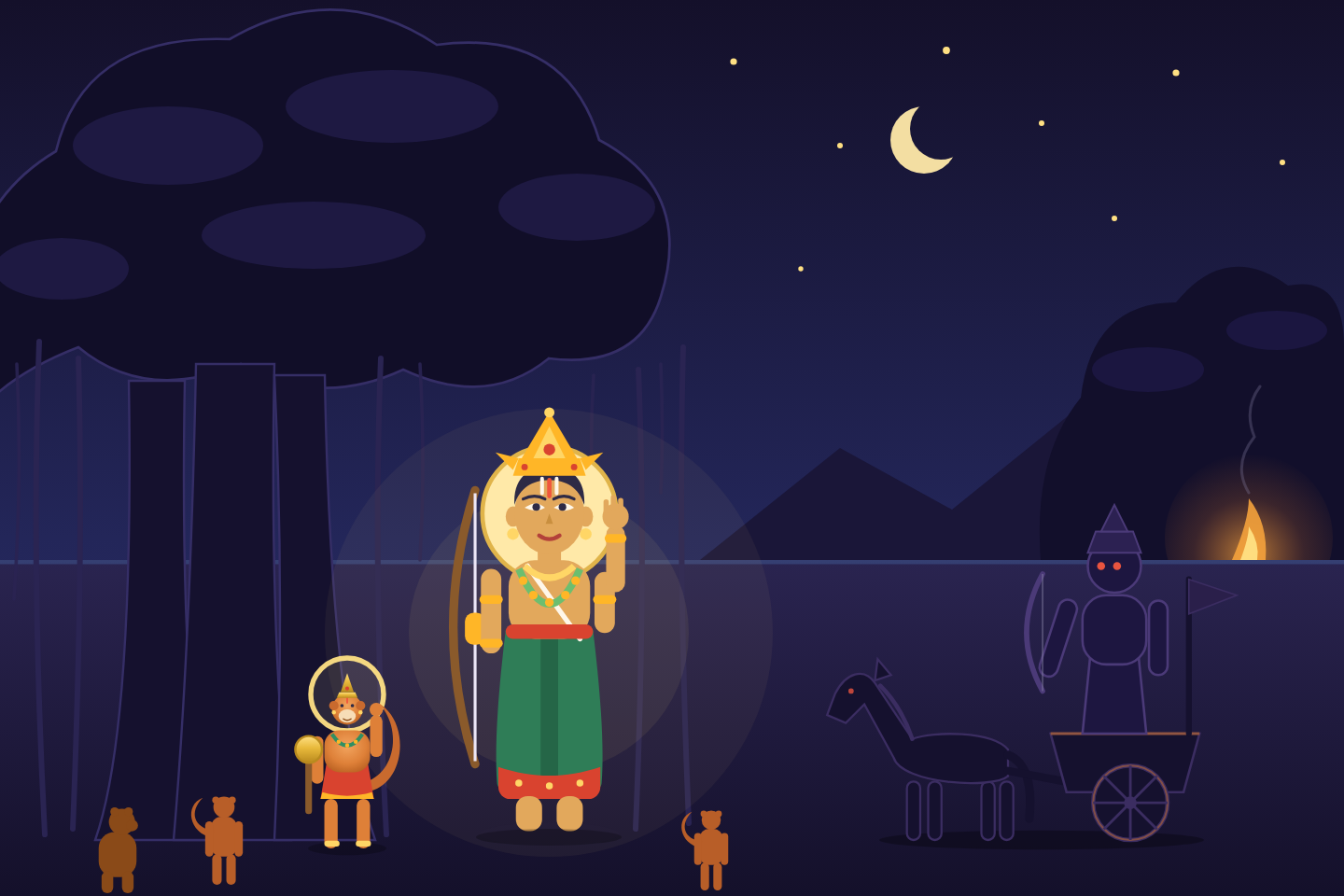
The vānaras and bears crash into the rākṣasa army that guards the grove, with rocks and whole trees for weapons, and the noise fills all of Laṅkā. Hanumān Jī is in the thick of it, tall as a mountain. And the plan works. Hearing that his army is breaking, Indrajit leaps up with the rite still unfinished and comes out of the darkness under the trees in a chariot that shines like fire. Vibhīṣaṇa leads Lakṣmaṇa deep into the thicket and shows him the banyan, dark as a rain-cloud. 'He must not reach that tree,' he says. Lakṣmaṇa takes his stand there, twangs his great bow, and calls out: 'I challenge you. Fight me in a straight and open fight.' In the Mānas, too, it is the vānaras who break up the sacrifice, and Meghanāda comes storming out with a trident in his hand.
In both Rāmāyaṇas
'Cruelty is not my nature'
Indrajit sees who has brought his enemy here, and he is furious. 'You are my father's own brother — my uncle!' he shouts at Vibhīṣaṇa. 'One's own family, even without a single virtue, is better than a stranger. A stranger is always a stranger.' Vibhīṣaṇa answers him steadily. 'I was born among the rākṣasas, but cruelty is not my nature, and I take no delight in wrong. I left my brother because of the wrongs he would not give up. Say what you like. You will not reach the banyan today.' Then the duel begins, and Sage Vālmīki fills chapter after chapter with it. Lakṣmaṇa fights from Hanumān Jī's shoulders, shining like the sun rising over the eastern hills. Bows are split and taken up again. Weapons of fire are turned aside by weapons of the sun. Two arrows meet in mid-air and burst into sparks. The gods and sages gather in the sky to watch.
Sage Vālmīki
The arrow that carried the Lord's name
At last Lakṣmaṇa sets one more arrow to his bow — the arrow of Indra, with which the king of the gods once won his own wars. But he does not put his trust in the arrow, or in his own arm. He draws the string back to his ear and speaks: 'If Lord Rāma, the son of Daśaratha, has set his heart on what is right, and is true to his word, and is unmatched in valour — then end this fight.' The arrow flies straight. And the warrior who conquered Indra, who had never once been beaten, falls. Gosvāmī Tulsīdās tells the same moment in a single line: remembering the glory of the Lord, Lakṣmaṇa fitted his arrow and let it go. And he adds something more. With his last breath Meghanāda put away every trick and disguise, and asked only where Lord Rāma was, and where his younger brother was. 'Blessed is your mother,' said Prince Aṅgada and Hanumān Jī. Then Hanumān Jī lifted him up and laid him at the great gate of Laṅkā.
In both Rāmāyaṇas
Home to the Lord
Flowers rain down from the sky, and the drums of the gods roll. Lakṣmaṇa, wounded and worn out, comes back leaning on Vibhīṣaṇa and Hanumān Jī. He walks around Lord Rāma in reverence and stands quietly at his side. It is Vibhīṣaṇa who tells the news. 'Well done, Lakṣmaṇa!' says the Lord. 'You have done what was hard for anyone to do.' And Lakṣmaṇa — who has just done what the gods themselves could not — looks down, shy at being praised. Lord Rāma draws him onto his lap, holds him close, and gazes at him again and again. Then he calls for Suṣeṇa the healer: 'Heal my brother. Heal Vibhīṣaṇa. Heal every bear and vānara who was hurt today.' One breath of the healing herb, and Lakṣmaṇa's wounds are closed and his pain is gone.
Sage Vālmīki
✦ Two tellings, one story
Sage Vālmīki’s Rāmāyaṇa (Sanskrit)
In Sage Vālmīki's Yuddha Kāṇḍa the episode runs across many chapters. Indrajit first deceives the vānaras with an illusory image of Mother Sītā, and Lord Rāma faints with grief until Vibhīṣaṇa explains the trick and its purpose: to keep everyone away while he completes a fire-rite at the sanctuary of Nikumbhilā. Brahmā's boon had promised Indrajit a chariot from the fire and safety in battle once the rite was complete — and had also named his end: the enemy who strikes before he reaches the banyan or finishes the fire. Lakṣmaṇa goes with Vibhīṣaṇa, Hanumān Jī, Aṅgada and Jāmbavān's army; the attack draws Indrajit out with the rite unfinished; Indrajit and Vibhīṣaṇa exchange hard words about family and right; and after a long duel of divine weapons Lakṣmaṇa looses Indra's arrow with a prayer that rests everything on Lord Rāma's righteousness and truth. Lord Rāma says the struggle took three days and nights, embraces his brother, and has Suṣeṇa heal all the wounded.
Gosvāmī Tulsīdās’s Rāmcaritmānas (Awadhi)
Gosvāmī Tulsīdās tells it in a few swift verses, and there is no illusory image of Mother Sītā. Meghanāda, ashamed after old Jāmbavān has flung him back into Laṅkā, goes to a mountain cave to perform a sacrifice that will make him unconquerable. Vibhīṣaṇa brings word; Lord Rāma sends Aṅgada and the vānaras to break up the rite and tells Lakṣmaṇa that it is for him to face Meghanāda, with Jāmbavān, Sugrīva and Vibhīṣaṇa close by with their troops. Lakṣmaṇa vows not to be called the Lord's servant if he fails. The vānaras wreck the sacrifice; Meghanāda comes out with his trident, strikes down even Hanumān Jī and Aṅgada for a moment, and vanishes and reappears in many shapes — until Lakṣmaṇa, remembering the glory of the Lord of Kosala, lets his arrow fly. Dying, Meghanāda drops all deceit and asks for Lord Rāma and his brother; Aṅgada and Hanumān Jī call his mother blessed; Hanumān Jī lays him at the gate of Laṅkā; and the gods rain flowers and praise Lakṣmaṇa as Ananta, the support of the universe. Another old telling, the Adhyātma Rāmāyaṇa, gives a reason why it had to be Lakṣmaṇa, and many families still tell it: the Creator had fixed that Meghanāda could fall only to one who had gone without sleep and food for twelve full years — and Lakṣmaṇa, serving the Lord day and night ever since they left Ayodhyā, was that one.
What this story teaches
Remember what you are standing for
Lakṣmaṇa was a great archer. But on the arrow that mattered most he put Lord Rāma's goodness and truth, not his own skill. When something hard is in front of you, being good at it helps. Knowing why you are doing it — and for whom — helps more.
Belonging is not the same as agreeing
Indrajit said that family comes first, right or wrong. Vibhīṣaṇa answered that he was born among the rākṣasas but cruelty was not his nature. You can love your team, your friends and your family — and still refuse to go along when they are doing wrong.
Great deeds do not need loud voices
Lakṣmaṇa had just done what even the gods could not. He did not announce it. He stood quietly beside his brother, let someone else tell the story, and looked down when he was praised. The people who do the biggest things often need the least applause.
Words to know
- Meghanāda (मेघनाद) · 'Roar of the Clouds' — Rāvaṇa's eldest son. He is also called Indrajit (इन्द्रजित्), 'Conqueror of Indra', because he once defeated the king of the gods.
- māyā (माया) · The magic of illusion — making things appear that are not really there. It was Indrajit's favourite weapon.
- Nikumbhilā (निकुम्भिला) · The hidden sanctuary near Laṅkā, with its great banyan tree, where Indrajit went to perform his secret fire-rite.
- yajña (यज्ञ) · A sacred rite in which offerings are poured into a fire. Meghanāda's was meant to make him unbeatable — and it was never finished.
- Vibhīṣaṇa (विभीषण) · Rāvaṇa's youngest brother, who left Laṅkā and took refuge with Lord Rāma because he would not side with wrong. He knew the way to the grove.
- Suṣeṇa (सुषेण) · A vānara chief and healer. In Sage Vālmīki's telling he cures Lakṣmaṇa's wounds with the scent of a healing herb.
Vālmīki Rāmāyaṇa — Yuddha Kāṇḍa (the illusory image, Vibhīṣaṇa's counsel, the sanctuary of Nikumbhilā, the duel of Lakṣmaṇa and Indrajit, and Lord Rāma's embrace); Rāmcaritmānas — Laṅkā-kāṇḍa (Meghanāda's sacrifice, Lakṣmaṇa's vow and the fall of Meghanāda). The tradition of the one who had not slept is from the Adhyātma Rāmāyaṇa — Yuddha Kāṇḍa. Retold for young readers; where the tellings differ, both are given.