Kids · उत्तरकाण्ड Uttara Kāṇḍa · Ages 8–12
The Baby Who Leapt for the Sun
Have you ever wondered why Hanumān Jī — who leapt across the whole ocean and carried a mountain through the sky — had to be reminded that he was strong? In 'The Hero Who Remembered', old Jāmbavān had to stand on the seashore and tell him what he could do. There is a reason for that, and it goes all the way back to when Hanumān Jī was a baby.
Sage Vālmīki tells the story in the last book of the Rāmāyaṇa. Lord Rāma is king in Ayodhyā now, and one day, with Hanumān Jī standing right there, he asks a great sage from the south a question. This is the Vālmīki telling. Gosvāmī Tulsīdās does not tell this story in the Rāmcaritmānas, and we will say more about that at the end.
The king's question
Lord Rāma joined his palms and spoke to the sage. 'Hanumān leapt across a sea a hundred yojanas wide,' he said. 'He found Mother Sītā, he burned Laṅkā, he struck down Rāvaṇa's greatest warriors by himself. Courage, strength, wisdom and power all live in him. So tell me — when Sugrīva and his brother Vālī quarrelled, why did Hanumān not simply end it? I think he did not know his own might.' The sage smiled. 'Everything you say is true, O Rāma. No one equals him in strength, in speed or in wisdom. But long ago, wise sages laid a word upon him: that although he was mighty, he would not know his full strength. And that story begins when he was very, very small.'
Sage Vālmīki
A fruit in the morning sky
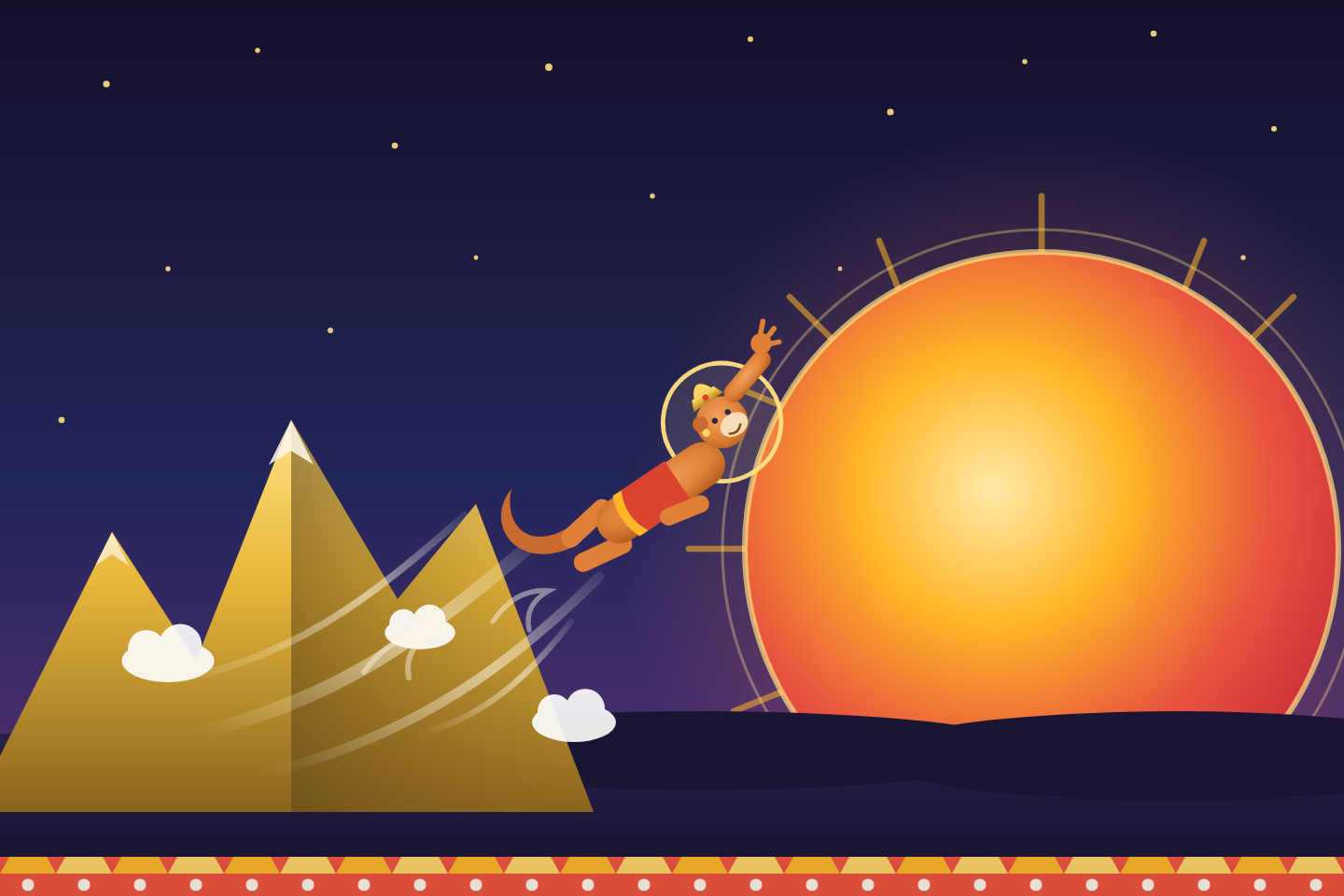
On the golden mountain Sumeru lived Kesarī, a chief of the vānaras, and his wife Añjanā. The Wind-god gave them a wonderful son — a baby, says Sage Vālmīki, the colour of ripe paddy, who did not yet have the name the whole world knows him by. One morning Añjanā went into the forest to look for sweet fruit, and the baby, hungry and missing his mother, began to cry. Then he looked up. The sun was rising, red as a heap of hibiscus flowers — and to a hungry baby it looked exactly like a fruit. He sprang into the sky to pluck it.
Sage Vālmīki
Higher than the wind
Up and up he went, thousands of yojanas, carried by his father's might and his own innocent heart. The gods looked on in astonishment. 'Not the wind, not Garuḍa, not even the mind moves as fast as this child,' they said. 'If this is his speed as a baby, what will it be when he is grown?' Close behind him flew his father, the Wind-god, keeping him cool as a heap of snow so that the sun's heat could not scorch him. And the sun-god, seeing that this was only an innocent little one — and that one day he would do great work for Lord Rāma — did not burn him at all.
Sage Vālmīki
The thunderbolt
That very morning Rāhu, the shadow who swallows the sun at an eclipse, had come to seize it. But when he saw a baby riding on the sun's own chariot, he fled to Indra, the king of the gods. 'Someone else has grabbed my sun!' he cried. So Indra came riding on Airāvata, his great white elephant. The baby, still hungry, took the elephant for an enormous fruit too, and rushed at it. Indra was startled more than angry, says Sage Vālmīki — but he struck the child with his thunderbolt. The little one fell onto a mountain, and as he fell his left jaw was broken.
Sage Vālmīki
The great hush
The Wind-god gathered up his son, went deep into a cave, and stopped moving. Now, the wind is the breath of every living thing. When he stopped, the whole world stopped with him — a great hush fell over the three worlds, and every creature stood as still as wood, as if the world were holding its breath. The gods, the people and all the creatures hurried to Brahmā, the creator. 'Air is life, air is happiness,' they said. Brahmā knew at once what had happened, and he led everyone to the cave, where the Wind-god sat with the still child in his lap. Brahmā reached out his long hand and gently stroked the baby — and he came back to life, says Sage Vālmīki, like a crop that has just been watered. The wind began to blow again, and every creature breathed and was glad, like lakes full of lotuses when the cold wind has gone.
Sage Vālmīki
The gifts, and the forgetting
'This child will do your work one day,' Brahmā told the gods. 'Each of you, give him a gift.' The sun-god gave him a hundredth part of his own brightness, and the knowledge of all the śāstras. Varuṇa, lord of the waters, promised that water would never harm him. Indra took the lotus garland from his own neck and put it round the baby's. 'Because my thunderbolt broke his jaw — his hanu,' he said, 'this little one shall be called Hanumān. And my thunderbolt will never hurt him again.' Yama, Kubera, Lord Śiva and Viśvakarmā each gave a boon, and Brahmā gave him long life and the power to take any shape he pleased. Now the little one feared nothing — and he played such tricks in the sages' hermitages, breaking their ladles and scattering their bark-cloths, that at last the sages, who were really not angry, said: 'You will forget this strength of yours for a long time. You will remember your might only when someone reminds you of your glory.' 'And that, O Rāma,' said the sage, 'is why Hanumān waited on the seashore until Jāmbavān spoke.'
Sage Vālmīki
✦ Two tellings, one story
Sage Vālmīki’s Rāmāyaṇa (Sanskrit)
In Sage Vālmīki's Uttara Kāṇḍa, Lord Rāma asks Sage Agastya why Hanumān Jī did not use his strength in the quarrel of Vālī and Sugrīva, and the sage tells his childhood: born to Añjanā and Kesarī on Mount Sumeru, the Wind-god's son; the hungry baby leaping at the rising sun, red as a heap of hibiscus flowers, thinking it a fruit; the Wind-god flying behind to keep him cool; the sun-god sparing him; Rāhu's complaint, Indra's thunderbolt and the broken left jaw; the Wind-god's withdrawal into a cave and the hush over the three worlds; Brahmā's touch bringing the child back to life; the boons of the gods, including Indra's naming of 'Hanumān'; and the sages' word that he would forget his strength until someone reminded him of it.
Gosvāmī Tulsīdās’s Rāmcaritmānas (Awadhi)
Gosvāmī Tulsīdās does not tell the story of Hanumān Jī's childhood in the Rāmcaritmānas. The Mānas has no leap at the sun, no thunderbolt and no sages' word; Hanumān Jī is simply Hanumān from the moment he appears. What the Mānas does give is the moment on the seashore in its Kiṣkindhā-kāṇḍa, when Jāmbavān reminds Hanumān Jī of his strength — told in 'The Hero Who Remembered'. Many children also know the leap from the Hanumān Chālīsā, the short hymn to Hanumān Jī that remembers in a single line how he took the sun for a sweet fruit; but that is a separate hymn, not the Mānas, and we have not invented a Mānas version of this story.
What this story teaches
You may be stronger than you know
Hanumān Jī carried all those gifts for years without remembering them. The strength you cannot feel today may still be there, waiting for the right moment — and the right friend.
The great are gentle with the small
The sun-god would not burn an innocent baby. Brahmā woke him with a stroke of the hand. Even Indra, who had struck him, gave him his own garland and his name. Real power looks after the little ones.
A reminder can be a gift
The sages said he would remember his strength only when someone reminded him. Years later, Jāmbavān did. When you tell a friend what they are capable of, you might be the one the story was waiting for.
Words to know
- Sumeru · the golden mountain at the centre of the world in old Indian stories, where Hanumān Jī was born
- hanu · the Sanskrit word for the jaw or chin; Indra gave the baby the name Hanumān after his broken jaw
- Airāvata · the great white elephant that Indra, the king of the gods, rides
- Rāhu · the shadow-demon who is said to swallow the sun at an eclipse — and who was too frightened of the baby to try that day
- boon · a special gift or promise granted by a god or a great person; the gods gave Hanumān Jī many
- vānaras · the brave forest people, Hanumān Jī's own people, who later helped Lord Rāma build the bridge and win the war
Vālmīki Rāmāyaṇa — Uttara Kāṇḍa (Sage Agastya's telling of Hanumān Jī's childhood, in answer to Lord Rāma's question). The Rāmcaritmānas does not tell this childhood; for the seashore reminder, see its Kiṣkindhā-kāṇḍa. Where the two Rāmāyaṇas differ, we tell both faithfully.