Kids · अरण्यकाण्ड Araṇya Kāṇḍa · Ages 8–12
The Bravest Bird in the World
Far across the forest, the golden deer has fallen — and with its last breath it has worked its cruellest magic: a cry of "O Sītā! O Lakṣmaṇa!" in a voice exactly like Lord Rāma's. The trick has done what no army of fourteen thousand could do. It is about to empty the little cottage at Pañcavaṭī.
But Rāvaṇa, waiting in the shadows, has forgotten something. The forest has friends. On a great tree nearby dozes an old, grey-feathered king of the birds who once told Lord Rāma, "Know me to be a friend of your father," and pledged to guard Mother Sītā whenever the brothers were away. His name is Jaṭāyu — and today is the day he keeps his word.
The cry in the borrowed voice
"O Sītā! O Lakṣmaṇa!" The false cry rang through the trees, in a voice so like Lord Rāma's that the birds went still. Mother Sītā turned pale. "Go to your brother!" she begged. Lakṣmaṇa knew that no danger in the three worlds could truly touch Lord Rāma — but her words pierced his heart until at last he bowed. Placing Mother Sītā in the care of the gods of the forest and the trees themselves, he went. And the clearing stood empty and quiet.
In both Rāmāyaṇas
The beggar who was not a beggar
Out of that quiet came a holy man in simple robes, softly asking for alms. But under the borrowed dress hid Rāvaṇa himself, the ten-headed king of Laṅkā, whose name frightened the gods so much they slept badly at night. Gosvāmī Tulsīdās says that the moment Rāvaṇa set his foot on that crooked path, all the shine of his strength and wisdom drained away, like light from a lamp that has run out of oil. When Mother Sītā honoured him as a guest, he showed his true shape — and carried her off to his flying chariot.
In both Rāmāyaṇas
Carried into the sky
The chariot rose above the treetops, and Mother Sītā's cry went out across the whole sky: "O hero of the Raghu house! O remover of sorrow — where are you?" Below, the deer wept and the trees bowed, and every living thing in the forest ached for her. Rāvaṇa held the reins of the swiftest chariot in the world — yet the poets say his heart was pounding with fear, for stolen things make heavy luggage. And far away, on a great tree, an old grey head lifted at the sound of a weeping voice it knew.
In both Rāmāyaṇas
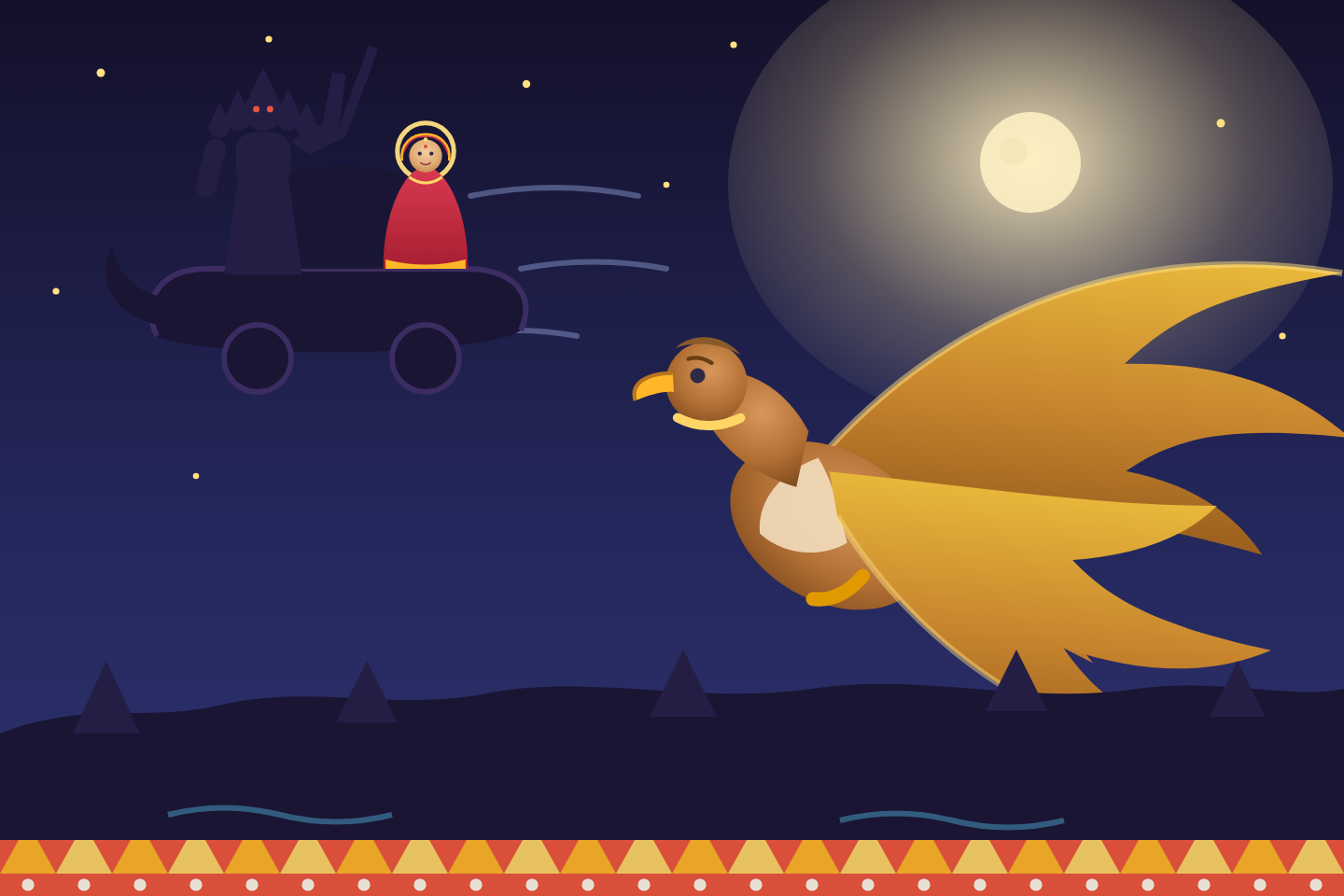
"Fear not, daughter!"
"Sīte, putrī — do not be afraid! I will finish this demon!" The voice was old, but it filled the sky like thunder. Jaṭāyu rose from his tree the way a thunderbolt leaps at a mountain. "Rāvaṇa! Hear my counsel: set Mother Jānakī free and go home in peace — or the fire of Lord Rāma's anger will burn your whole clan the way a flame burns a swarm of moths." Rāvaṇa, who had stared down gods, watched the great bird come on like Death itself — and for one moment wondered whether it was a mountain flying at him, or mighty Garuḍa himself.
In both Rāmāyaṇas
One last fight
Then the sky became a battlefield. Sage Vālmīki tells how the old eagle fought like a young one — he shattered Rāvaṇa's bow, brought the glittering chariot crashing down, and drove the demon king to the bare earth. Gosvāmī Tulsīdās tells how Jaṭāyu set Mother Sītā gently aside, out of harm's way, then returned and tore at Rāvaṇa with beak and talon until the conqueror of the three worlds swooned. But Rāvaṇa was cruel as well as strong. He drew his terrible sword and cut the brave old wings — and Jaṭāyu fell to the earth, remembering the wondrous deeds of Lord Rāma with all his heart.
In both Rāmāyaṇas
The promise kept
Rāvaṇa fled onward through the sky — but the sky itself had seen everything. Passing over a hilltop, Mother Sītā spied vānaras seated below and let her covering-cloth drift down to them as a sign for the one she knew would come; Sage Vālmīki says she knotted her bright ornaments inside it. And when Lord Rāma at last found Jaṭāyu — broken-winged, holding on to life just to deliver his message — he took the old eagle's head onto his lap and wept for him as a son weeps for a father. "He gave his life for my sake," said the Lord. What he gave Jaṭāyu in return is a story of its own — the one we have told before, of the eagle who gave everything.
In both Rāmāyaṇas
✦ Two tellings, one story
Sage Vālmīki’s Rāmāyaṇa (Sanskrit)
Sage Vālmīki gives Jaṭāyu a warrior's full honours. The old king of the vultures — sixty thousand years old — first reasons with Rāvaṇa like a statesman, naming the sacred law he is breaking, and only then fights like a storm: the bow shattered, the jewelled chariot smashed with its mules and charioteer, until Rāvaṇa stands weaponless on the ground. Only by drawing his sword against the old warrior's wings does the demon king finally pass, and unseen beings cry "Well done!" as the eagle falls.
Gosvāmī Tulsīdās’s Rāmcaritmānas (Awadhi)
Gosvāmī Tulsīdās tells it swift and shining: the ringing warning — leave Jānakī and go home safely, or the fire of Lord Rāma's wrath will burn your whole clan like moths — and Rāvaṇa's startled guess that the diving shape must be Maināka mountain or Garuḍa himself. His Jaṭāyu sets Mother Sītā safely aside before tearing at the demon king until he swoons; then comes the cruel kṛpāṇa, the cut wings, and the old bird falling with the wondrous deeds of Lord Rāma filling his heart.
What this story teaches
A promise is a living thing
Jaṭāyu's pledge to guard Mother Sītā was made in easy, happy days, and no one was there to make him honour it. Real promises do not expire when they become difficult — that is exactly when they begin.
Courage does not count the odds
An old bird against the conqueror of the three worlds is not a fair fight — and Jaṭāyu rose anyway. Whether you win is not always yours to choose; whether you rise is.
Even a fall can be a victory
Jaṭāyu could not stop the chariot. Yet everything that follows — the message, the search, the bridge, the victory — grows from his brave stand. When you do the right thing, no defeat is ever wasted.
Words to know
- Jaṭāyu (जटायु) · the noble old king of the vultures, a friend of King Daśaratha and guardian of Mother Sītā
- gṛdhra-rāja (गृध्रराज) · "king of the vultures" — Jaṭāyu's royal title
- yati (यति) · a wandering holy man — the disguise Rāvaṇa borrowed for his trick
- Jānakī (जानकी) · a loving name of Mother Sītā: daughter of King Janaka
- kṛpāṇa (कृपाण) · a curved sword
- vānaras (वानर) · the mighty forest-people who will soon join Lord Rāma's great search
Told from the Vālmīki Rāmāyaṇa — Araṇya Kāṇḍa (the abduction and Jaṭāyu cantos, told at section level) and the Rāmcaritmānas — Araṇya-kāṇḍa, dohās 27–29 with their caupāīs (corpus-verified). Where the tellings differ, both are honoured in the Two Tellings above. Jaṭāyu's farewell to Lord Rāma — the funeral honours and the gift he received — is told in our earlier story, "The Eagle Who Gave Everything."