Kids · लङ्काकाण्ड Laṅkā Kāṇḍa · Ages 8–12
The Chariot That Came from the Sky
The long war for Laṅkā is almost at its end. Rāvaṇa's champions have fallen one by one — his giant brother Kumbhakarṇa, his fearsome son Meghanāda. Now the ten-headed king comes out to fight for himself, standing tall in his great war-chariot, with his banners flying and his dark horses pulling hard.
And facing him stands Lord Rāma — on the ground. He came to this war as a forest-dweller, with no chariot and no horses: only his bow, his arrows, and the vānaras and bears who love him. This is the story of what happened next. The two great poets each tell a part of it that the other leaves out, so today we shall hear them both.
A king on wheels, a prince on foot
Rāvaṇa's chariot rolls forward, and from it he sends down arrows the way a storm-cloud sends rain down on a mountain. Lord Rāma stands firm and answers him, arrow for arrow. But anyone can see how this fight is set. One warrior rides high in a chariot. The other stands on the bare earth.
In both Rāmāyaṇas
The friend who was afraid
Gosvāmī Tulsīdās tells us who could not bear to watch. Vibhīṣaṇa — Rāvaṇa's own brother, who had left Laṅkā to stand with what is right — looked at the king in his chariot and the Lord without one, and his heart shook. He loved Lord Rāma so much that his love itself turned into worry. He bowed at the Lord's feet and said, 'My Lord, you have no chariot. You have no armour for your body and nothing to protect your feet. How will you conquer so mighty a warrior?'
Gosvāmī Tulsīdās
The chariot no one can see
'Listen, friend,' said Lord Rāma. 'The chariot that brings victory is a different one. Courage and patience are its wheels. Truth and good conduct are its banner and its flag. Its four horses are strength, good sense, self-control and care for others, and they are harnessed with the ropes of forgiveness, kindness and an even mind. The worship of God is its skilful driver. Contentment is its sword, a pure and steady mind its quiver, and respect for the wise and for one's teacher is armour that nothing can pierce. Friend, whoever has such a chariot of dharma has no enemy left to conquer anywhere.' Vibhīṣaṇa's fear melted away. He clasped the Lord's feet in joy and said, 'You have used this moment to teach me.'
Gosvāmī Tulsīdās
The gods look down
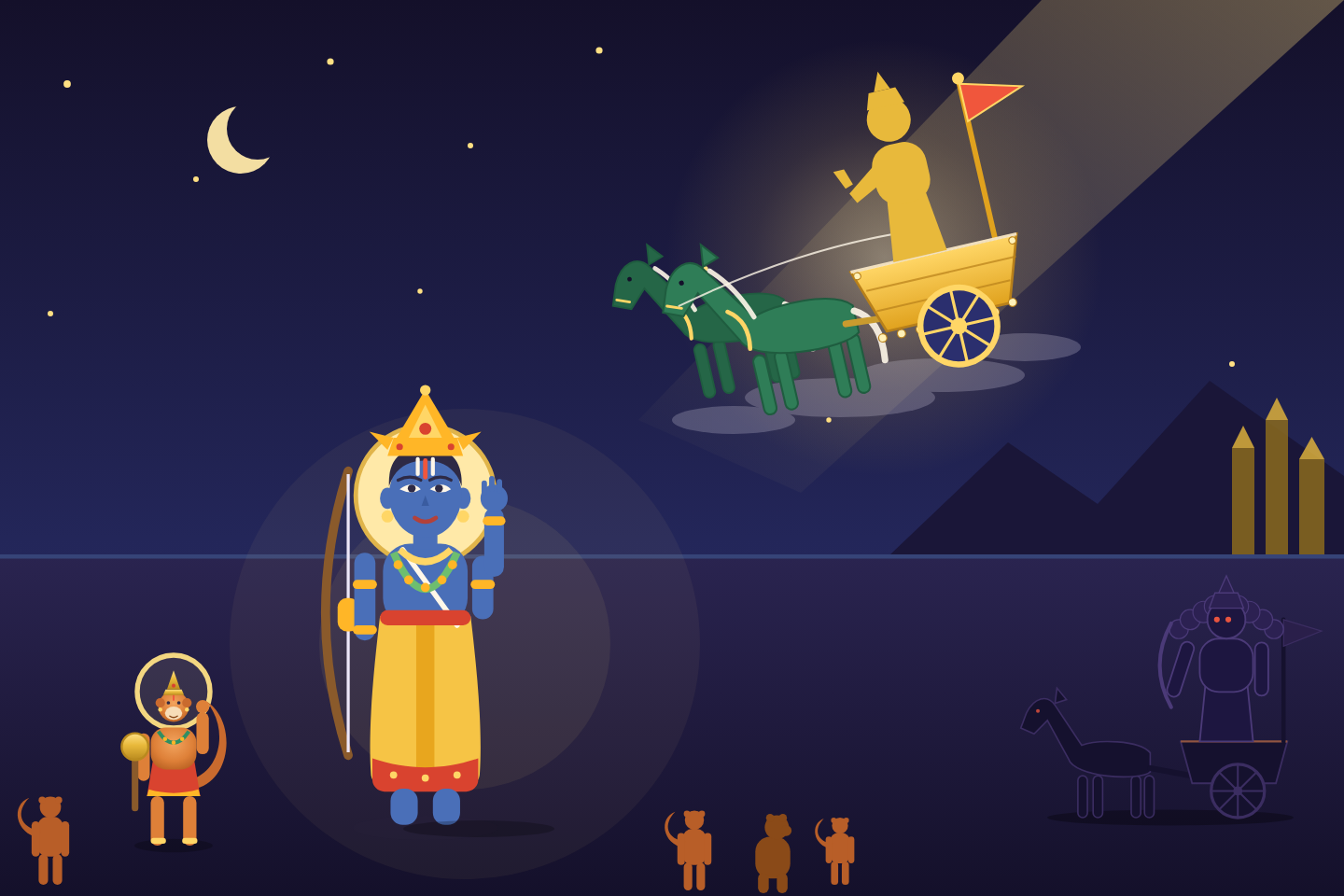
High above, the gods had gathered to watch, and they were troubled. In Sage Vālmīki's telling they said to one another, 'This fight is not a fair one — Lord Rāma on the ground, and the rākṣasa in a chariot!' Indra, the king of the gods, heard them and called for his own charioteer, Mātali. 'Take my chariot down to the earth at once,' he said, 'and ask Lord Rāma to mount it.' And down it came through the sky: a chariot of gold, hung with hundreds of tiny bells, shining like the morning sun, its banner on a golden staff, drawn by green horses decked with gold. Gosvāmī Tulsīdās says its four horses never grew old and ran as fast as thought.
In both Rāmāyaṇas
'With me as your charioteer'
Mātali brought the chariot before Lord Rāma. Still at his post, with the whip in his hand, he joined his palms and said, 'Indra has sent you this chariot for your victory. Here is his mighty bow. Here is his armour, bright as fire, his arrows, bright as the sun, and his shining spear. Mount, O hero, with me as your charioteer.' And what did Lord Rāma do? He did not simply jump in. He walked all the way around the chariot, keeping it on his right as one does with something sacred, and he bowed to it. Only then did he step up — and Sage Vālmīki says his radiance lit up all the three worlds.
Sage Vālmīki
'I am only reminding you'
When the vānaras saw their Lord riding in a chariot at last, says Gosvāmī Tulsīdās, they rushed forward with new strength. The duel that followed was fierce. In the Mānas, Rāvaṇa struck Mātali with a hundred arrows, and the charioteer fell crying, 'Victory to Lord Rāma!' — and the Lord, full of compassion, lifted him up. In Sage Vālmīki's telling, Lord Rāma tells Mātali how he would like the chariot driven: a steady heart, steady eyes, a firm hand on the reins. Then he adds, 'You drive the chariot of Indra himself. You need no teaching from me. I am only reminding you.' Mātali was delighted, and drove on. How that great duel ended is a story for another day. But when it was over, Lord Rāma saluted Mātali with respect, and the golden chariot rose back into the sky.
In both Rāmāyaṇas
✦ Two tellings, one story
Sage Vālmīki’s Rāmāyaṇa (Sanskrit)
In Sage Vālmīki's Yuddha Kāṇḍa there is no speech about a chariot of virtues. The gods, the heavenly musicians and the other beings of the sky declare that a combat between Lord Rāma on the ground and Rāvaṇa in a chariot is not well matched. Indra sends Mātali down with his own chariot — its body wrought with gold, fitted with hundreds of tiny bells, shining like the morning sun, with a standard on a golden staff and green horses decked with gold ornaments and white whisks — together with Indra's bow, his armour, his arrows and his spear. Mātali speaks with joined palms and offers himself as charioteer. Lord Rāma walks around the chariot in reverence, salutes it and mounts, lighting up the three worlds. In the duel Rāvaṇa strikes at Mātali, at the horses and at the chariot's banner. Later Lord Rāma gives Mātali his instructions and at once adds that he is only refreshing his memory, not teaching him. After the victory he respectfully salutes Mātali, who ascends to heaven in the chariot.
Gosvāmī Tulsīdās’s Rāmcaritmānas (Awadhi)
Gosvāmī Tulsīdās tells of two chariots. First, while the Lord is still on foot, Vibhīṣaṇa is shaken to see Rāvaṇa mounted and Lord Rāma without chariot, armour or anything for his feet, and asks how he can win. The Lord answers with the chariot of dharma: courage and patience for wheels; truth and good conduct for banner and flag; strength, good sense, self-control and care for others for horses, harnessed with forgiveness, compassion and evenness of mind; the worship of God for charioteer; and respect for the wise and for one's teacher for armour. Whoever has such a chariot has no enemy left to conquer. Then, later in the battle, the gods are troubled to see the Lord on foot, and Indra at once sends his own chariot, which Mātali gladly brings: a heavenly car full of splendour, with four lively horses, ageless and deathless, swift as thought. The Lord mounts it gladly and the vānaras take heart. He bows his head at the feet of the Brāhmaṇas as he drives out. When Rāvaṇa strikes Mātali down with a hundred arrows, the charioteer falls crying victory to Lord Rāma, and the Lord in compassion lifts him up. At the end Mātali bows his head at the Lord's feet and, with his leave, departs.
What this story teaches
The chariot inside you
Courage, patience, truth, kindness, self-control — Lord Rāma says these are the real wheels and horses. Nobody can take that chariot away from you, and you can begin building it today.
Be gentle with your helpers
Before he stepped into the chariot, Lord Rāma walked around it and bowed. He spoke politely to his charioteer and lifted him up when he fell. Truly great people are grateful for their help and kind to those who give it.
Worry that comes from love deserves a kind answer
Vibhīṣaṇa was afraid because he loved the Lord. Lord Rāma did not scold him. He called him 'friend' and explained. When someone is worried about you, answer them gently.
Words to know
- Mātali · the charioteer of Indra, who drove Lord Rāma into the last great duel
- Indra · the king of the gods, who sent his own chariot down from heaven
- ratha · a chariot
- dharma · what is right and good — doing your duty with truth and kindness
- Vibhīṣaṇa · Rāvaṇa's brother, who left Laṅkā to stand with Lord Rāma because it was right
- pradakṣiṇā · walking around something sacred, keeping it on your right, to show respect
A true episode from the last days of the war, told in both Vālmīki Rāmāyaṇa — Yuddha Kāṇḍa — and Rāmcaritmānas — Laṅkā Kāṇḍa. Vibhīṣaṇa's worry and Lord Rāma's teaching of the chariot of dharma are Gosvāmī Tulsīdās's; Sage Vālmīki does not tell them. The gods' words that the fight was unequal, the golden chariot with its bells and green horses, Mātali's speech and Indra's weapons, Lord Rāma walking around the chariot and saluting it, his courteous words to Mātali and his farewell salute are Sage Vālmīki's. Indra sending the chariot with Mātali is in both tellings; the four ageless horses swift as thought, the vānaras taking heart, Mātali falling with a cry of victory and being lifted up by the Lord, and Mātali bowing at the Lord's feet before he leaves are Gosvāmī Tulsīdās's.