Kids · बालकाण्ड Bāla Kāṇḍa · Ages 8–12
The Cow That Could Give Anything
In Mithilā, after Lord Rāma had set Ahalyā free, Sage Śatānanda — Ahalyā's own son — sat down with the two princes and said: 'Do you know who this is, who brought you here? Let me tell you how Sage Viśvāmitra became a sage.' Because Sage Viśvāmitra had not always been a sage. Long ago he had been a king — a mighty one, with a crown and a capital and an army so big it took days to march past.
This is the story Sage Śatānanda told: of a king who had everything, a hermit who had almost nothing, and a cow who could give anything at all.
A king at the hermitage gate
King Viśvāmitra, son of Gādhi, was touring his whole kingdom with his army when he came to a forest hermitage. Deer wandered about without fear, birds sang in every tree, and sages sat in meditation — it was so peaceful that it seemed like a little piece of heaven on earth. It was the hermitage of Sage Vasiṣṭha. The sage welcomed the king warmly, gave him a seat, and set wild fruits and roots before him. They asked after each other's welfare, and talked for a long time, and liked each other very much.
Sage Vālmīki
Śabalā
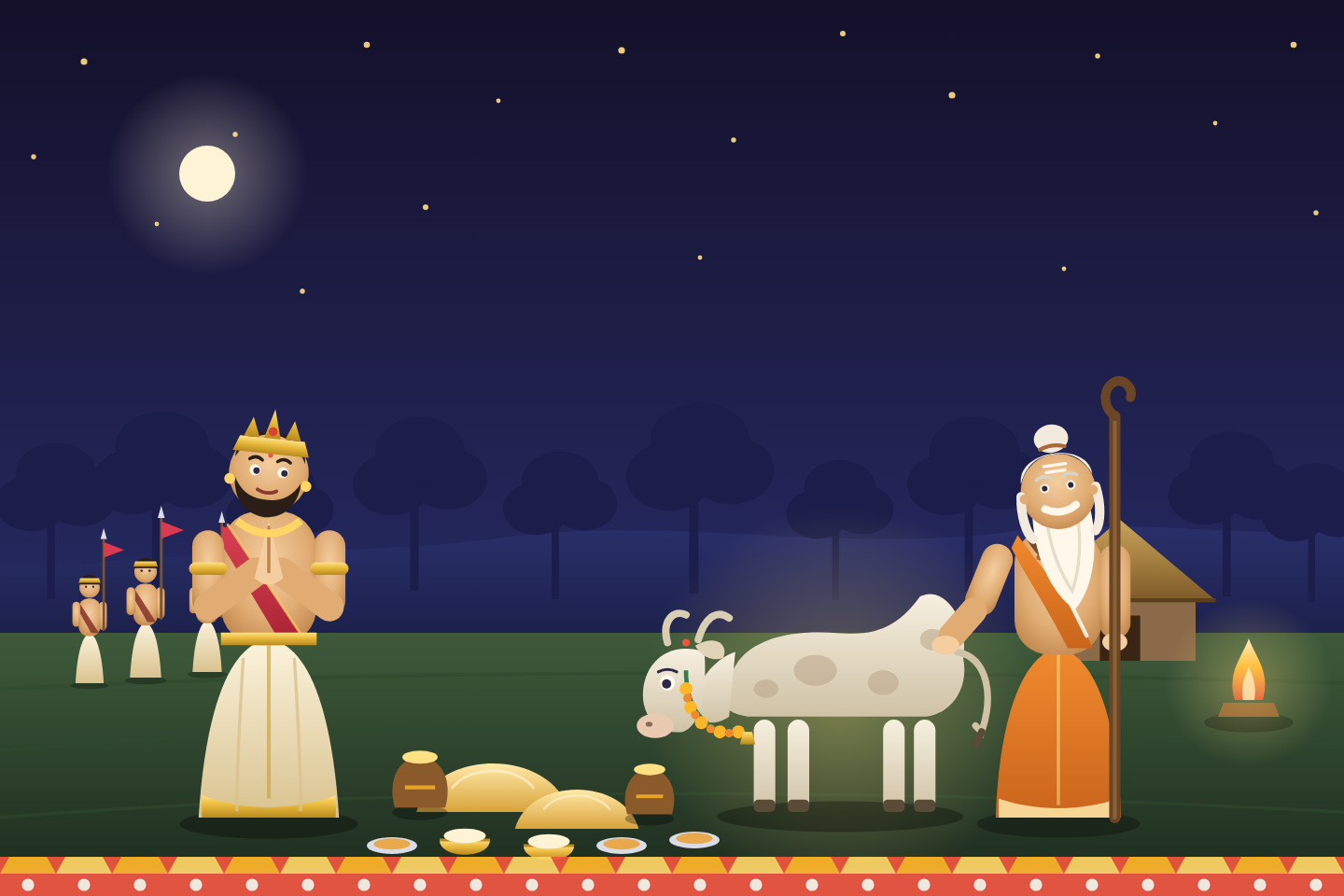
Then Sage Vasiṣṭha said, smiling: 'Let me give a feast to you and your whole army.' The king tried to say no — the fruits and the kind words were honour enough. But the sage asked again and again, and at last the king agreed. The sage called his cow: Śabalā, the spotted one, who could give whatever was asked of her. 'Come, Śabalā,' he said. 'I wish to feed this royal sage and all his army. Bring forth every kind of food.' And she did. Heaps of steaming rice rose up like hills. There were rivers of curd, sweet rice cooked in milk, honey and sugar-cane, and thousands of silver plates brimming with fruit juice. The whole army ate until they were happy and full — the queens, the ministers, the priests, the soldiers, everyone.
Sage Vālmīki
'Give her to me'
The king was amazed. He turned to the sage and said: 'You have honoured me wonderfully. Now I ask one thing. Give me Śabalā, and I will give you a hundred thousand cows for her. She is a jewel — and jewels belong with kings.' The sage shook his head. 'I would not part with Śabalā for a thousand million cows, nor for mountains of silver. My worship, my sacred fire, my offerings to the gods — all of it rests on her. She is my everything. She is my very life.' The king offered more: fourteen thousand elephants with golden chains, eight hundred golden chariots pulled by white horses, eleven thousand fine horses, ten million young cows, and all the gold and jewels the sage could want. 'Why go on talking?' said Sage Vasiṣṭha quietly. 'I will not give Śabalā away.'
Sage Vālmīki
The cow who ran back
So the king did a thing no guest should ever do. He ordered his men to take Śabalā by force. As they dragged her away, Śabalā wept. 'Has the sage abandoned me?' she wondered. 'What wrong have I done him?' Then she shook off the hundreds of soldiers holding her, and ran like the wind back to Sage Vasiṣṭha's feet. 'Have you forsaken me?' she asked him, with tears running down her face. 'I have not forsaken you,' said the sage gently, as if to a sister who was hurting. 'You have done nothing wrong. This king is drunk on his own power, and he is a king with a whole army behind him — what is my strength against that?' Śabalā lifted her head. 'The wise say a king's strength is nothing beside a sage's,' she said. 'Command me.' And the sage said: 'Then bring forth an army of your own.'
Sage Vālmīki
The warriors who came out of a cow
From Śabalā's bellow came warriors in their hundreds. The king fought them with every weapon he had, and she brought forth more — fierce fighters in yellow, with swords and spears, who scattered his army the way a fire runs through dry grass. The king's hundred sons rushed at the sage with their weapons raised, and with a single roar Sage Vasiṣṭha ended their attack. In a few moments the mighty king stood alone, his army gone, his pride broken, like a bird whose wings have been clipped. He handed his kingdom to his one remaining son and walked away into the Himālayas to do penance.
Sage Vālmīki
The staff that beat every weapon
Some time later the king came back. He had prayed to Lord Śiva and received every divine weapon there is, and he was sure that now he could crush the sage. He hurled them one after another — the fire-weapon, the wind-weapon, the weapons of sleep and of drying-up, the terrible noose of Death, and at last the Brahmāstra itself, which made all three worlds tremble. Sage Vasiṣṭha stood still, holding nothing but his wooden staff — and the staff swallowed every single one of them, the way water swallows fire. When it was over, King Viśvāmitra let out a long, slow sigh. 'The strength of a warrior is no strength at all,' he said. 'The strength of a sage is the only real strength. One wooden staff has beaten all my weapons.' And he went away to do penance so severe, and so long, that in the end he became what he had seen that day: a true sage. That is who came to Ayodhyā to ask for Lord Rāma.
Sage Vālmīki
✦ Two tellings, one story
Sage Vālmīki’s Rāmāyaṇa (Sanskrit)
This story is Sage Vālmīki's. In his Bāla Kāṇḍa, Sage Śatānanda tells it to Lord Rāma at Mithilā, over several cantos: the king's visit, the feast from Śabalā, the refused offers, the cow dragged away and running back, the warriors she brings forth, the king's defeat, his penance to Lord Śiva, the weapons against the staff, and his vow to become a sage. Sage Vālmīki gives the long list of weapons name by name — it is one of the grandest lists in the whole epic — and he lets the king say the lesson in his own words.
Gosvāmī Tulsīdās’s Rāmcaritmānas (Awadhi)
Gosvāmī Tulsīdās does not tell the story of Śabalā at all. In the Rāmcaritmānas, Sage Viśvāmitra simply appears as 'the great enlightened sage' living in a forest hermitage, troubled by the demons Mārīca and Subāhu, who decides that the Lord has already been born on earth and goes to Ayodhyā to ask for the two brothers. Tulsīdās is not interested in how the sage became a sage; he is interested in the sage's longing to see Lord Rāma. Both tellings agree on who he became: the wise and powerful sage who brought the princes to Mithilā.
What this story teaches
Some things are not for sale
The king offered elephants, chariots, gold and ten million cows. The sage said no every time, because Śabalā was not a thing he owned — she was his life and his work. When someone says 'not for sale', more money is not the answer.
Being a guest is a promise
Sage Vasiṣṭha fed the king and his whole army. The king thanked him by trying to take what he loved most. Everything that went wrong began the moment a guest forgot how to be one.
Losing can be the start of something better
The king lost his army, his pride and his weapons — and that loss was the beginning of Sage Viśvāmitra. Sometimes being beaten by something greater is how we find out what we really want to become.
Words to know
- Śabalā · 'the spotted one' — Sage Vasiṣṭha's wish-giving cow, who could bring forth anything that was asked of her
- Vasiṣṭha · the great sage and teacher of the kings of Ayodhyā; in this story, the hermit whose only treasure was his cow
- Śatānanda · the son of Ahalyā and Sage Gautama, and the priest of King Janaka, who tells this story to Lord Rāma
- akṣauhiṇī · a full division of an ancient army — tens of thousands of elephants, chariots and horses and over a hundred thousand foot-soldiers
- brahmadaṇḍa · a sage's wooden staff, carrying the power of his penance — in this story, stronger than every weapon
- tapas · penance: long, hard spiritual effort, like fasting and meditation, done to gain wisdom or power
Vālmīki Rāmāyaṇa — Bāla Kāṇḍa (Sage Śatānanda's account of King Viśvāmitra at Sage Vasiṣṭha's hermitage: the feast from Śabalā, the refused offers, the cow taken by force and her warriors, the king's defeat and penance, and the staff that neutralised every weapon — Cantos 51–56). Rāmcaritmānas — Bāl-kāṇḍa (Sage Viśvāmitra introduced only as the great sage troubled by the demons; the Śabalā story is not told). Told for ages 8–12; where the tellings differ, each is given as it stands.