Kids · उत्तरकाण्ड Uttara Kāṇḍa · Ages 8–12
The Crow Who Was Glad to Be a Crow
In 'The King of Birds Who Went to Listen to a Crow', Garuḍa flew to the blue mountain Nīlagiri and sat under the great banyan while the old crow Kākabhuśuṇḍi told him the whole story of Lord Rāma. When it was over, Garuḍa's doubt was gone. But a new question had been growing in him the whole time, and now, with his head bowed and his hands joined, he asked it.
This story, like yesterday's, comes only from Gosvāmī Tulsīdās. In his Rāmcaritmānas, Lord Śiva is telling it to Mother Pārvatī, and inside that telling the crow tells his own story to the king of birds. Sage Vālmīki does not tell it at all. So once again we are listening to one poet — and to a very old crow who remembers a very long way back.
A question asked with love
'My lord,' said Garuḍa, 'you know everything. You are wise, you are peaceful, and above all you are dear to Lord Rāma. Then how is it that you have the body of a crow? And where did you find this beautiful story? And Lord Śiva himself told me that time has no power over you — how can that be?' Kākabhuśuṇḍi was delighted. 'Blessed is your mind, Garuḍa!' he said. 'Your question pleases me very much. It brings back many of my old lives. Sit, and I will tell you my story from the very first birth I can remember.'
Gosvāmī Tulsīdās
The proud young man and the gentle teacher
'Long, long ago,' the crow began, 'in another age of the world, I was born in Ayodhyā — Lord Rāma's own city — though I did not know then how lucky that was. I was proud and loud and full of myself. I loved Lord Śiva, but I spoke rudely of every other god and looked down on everyone. When a famine came, I left for the city of Ujjain. There I met a teacher who worshipped Lord Śiva day and night — a kind man, wise and gentle, who never spoke ill of anyone. He saw me looking humble on the outside and taught me as if I were his own son. He gave me a holy mantra of Lord Śiva. But inside I was still swollen with pride. I would chant the mantra in Lord Śiva's temple with my nose in the air, and when my teacher gently tried to correct me, I burned with anger. One day he told me the deepest thing he knew: that the real fruit of worshipping Lord Śiva is love for Lord Rāma's feet, because Lord Śiva himself worships Lord Rāma. I could not bear to hear it. My teacher only grew kinder. I only grew prouder.'
Gosvāmī Tulsīdās
The day he would not stand up
'One day I was sitting in the temple repeating Lord Śiva's name when my teacher came in. I did not get up. I did not bow. I just sat there. He said nothing at all, and there was not a flicker of anger in him. But Lord Śiva could not let it pass. A voice came out of the temple itself: "Foolish, proud boy! Your teacher is gentle and forgives you — but I will not let anyone treat a teacher that way. You sat there as still as a snake; so for a while a snake you shall be, and live in the hollow of a tree." I began to tremble. And then the strangest thing happened. My teacher — the very man I had just insulted — cried out in grief for me. He fell to the ground before Lord Śiva, and with his voice shaking he sang a prayer. "Lord," he begged, "this poor boy is only confused. Do not be angry with him. Let Your curse turn into a blessing for him soon." And Lord Śiva answered: "So be it. For your sake, because you are so forgiving, I will be kind to him. He will pass through many births, but he will feel none of their pain, and he will never forget who he is. He was born in Ayodhyā, and love for Lord Rāma will grow in his heart. He may go anywhere he likes, and nothing will stop him. Only let him never again insult a holy man, and let him honour the saints." My teacher said, "Amen!", taught me one last time, and went home.'
Gosvāmī Tulsīdās
Many bodies, one longing
'So I became a snake in the Vindhya mountains. And when that life was over I slipped out of it as easily as a man takes off an old shirt and puts on a new one. Body after body I lived — as animals, as a god, as a man — and in every one of them I remembered, and in every one of them I loved Lord Rāma. One thing always pricked my heart: my teacher's kindness. I could never forget how gently he had treated me. At last I was born as a boy in a family of priests. When the other children played, I would only play Lord Rāma's games. My father tried to teach me his lessons; I listened, but nothing stayed, because my heart was somewhere else. When my parents had gone, I went into the forest and walked from one sage to the next, bowing at their feet and begging them to tell me of Lord Rāma. Every sage told me, "God is in everything; He has no form." But I longed to see Lord Rāma with my own eyes.'
Gosvāmī Tulsīdās
The sage who lost his patience
'On a peak of Mount Meru, in the shade of a banyan tree, sat the great sage Lomaśa. I bowed at his feet and asked him, as humbly as I could, to teach me how to worship the Lord who has a form — Lord Rāma. The sage kindly told me a few of Lord Rāma's virtues. Then he began to teach me what he loved best: that God is beyond all forms, and that you and God are one, as the water and its ripples are one. I could not love it. I bowed again and said, "My mind delights in Lord Rāma the way a fish delights in water. Please tell me how I may see him. Afterwards I will listen to all the rest." He taught me again. I argued back again. I argued more and more stubbornly, until at last even that wise and patient sage grew angry. "Fool!" he said. "You will not accept the highest teaching, and you argue and argue. You trust nothing, like a crow — so a crow you shall be!"'
Gosvāmī Tulsīdās
The curse that became a gift
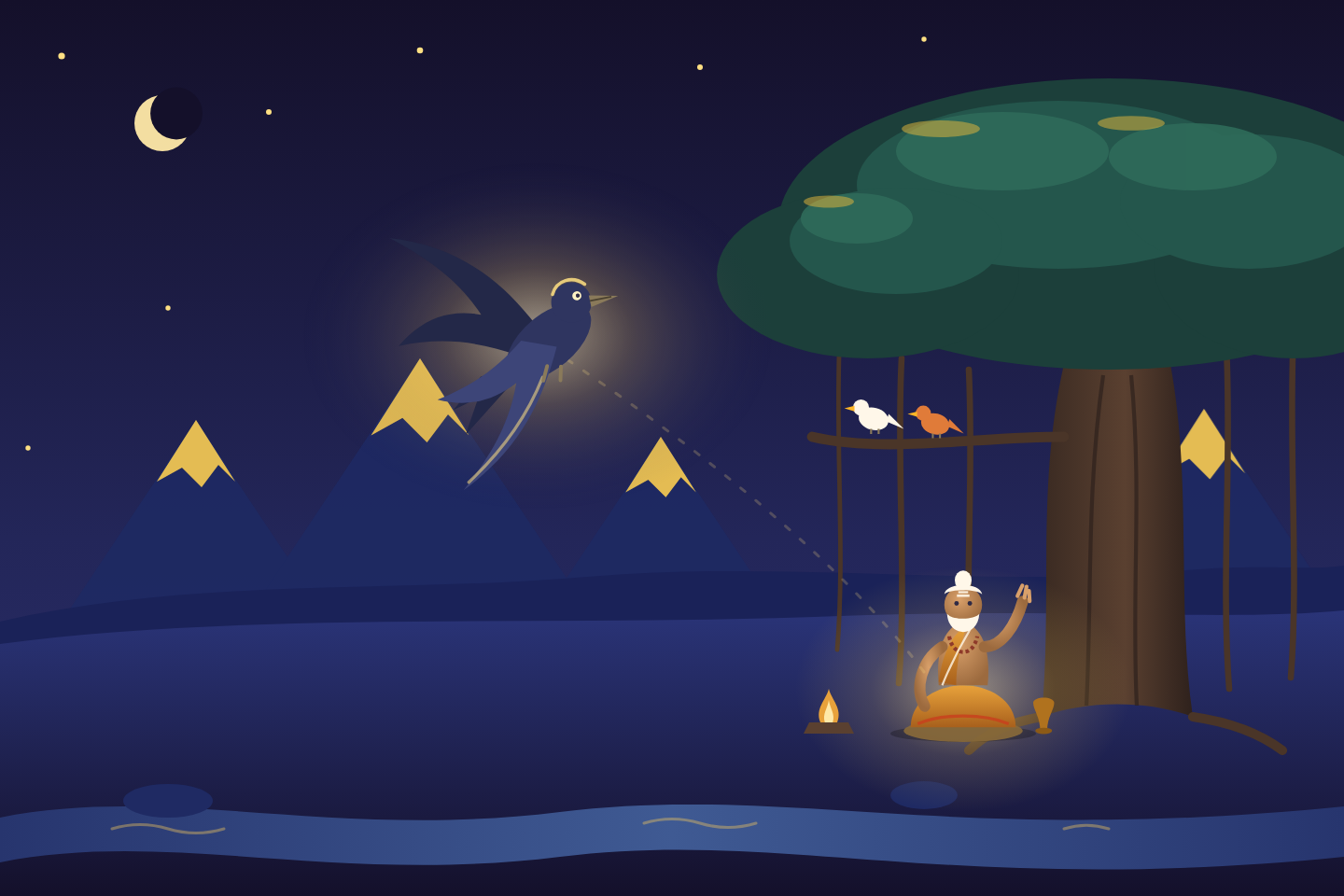
'At once I was a crow. And here is the thing, Garuḍa: I was not frightened, and I was not sad. I bowed my head at the sage's feet, fixed my thoughts on Lord Rāma, and flew off happily into the sky. The sage was not to blame — I believe the Lord clouded his mind for a moment, to see how much I truly loved him. Now the sage stared after me, amazed that I was not angry at all. He was sorry at once, and he called me back, gently, again and again. He comforted me, taught me the mantra of Lord Rāma's name, and showed me how to picture the Lord as a little child. He kept me with him for a while, and then he told me the whole Rāmcaritmānas — the lake of Lord Rāma's deeds — which he had received by Lord Śiva's grace. Then he laid his hand on my head and blessed me: "You will always be dear to Lord Rāma. You may take any form you wish, and leave this life only when you choose. Wherever you live, confusion will not come near, and no sorrow of time or fate will ever touch you." And a deep voice spoke from the sky: "Let it be so. He is My own, in thought, word and deed." I bowed and bowed, and flew here to Nīlagiri. I have lived here through twenty-seven ages of the world, singing Lord Rāma's story to the birds. And every time the Lord is born in Ayodhyā, I go there to watch him play as a child. So that is how I came to be a crow — and I love this body, because in it I found my love for Lord Rāma, and in it I saw my Lord.'
Gosvāmī Tulsīdās
✦ Two tellings, one story
Sage Vālmīki’s Rāmāyaṇa (Sanskrit)
Sage Vālmīki does not tell this story. In his Rāmāyaṇa there is no crow Kākabhuśuṇḍi, no blue mountain, no sage Lomaśa and no visit by Garuḍa after the war. The whole of today's story belongs to Gosvāmī Tulsīdās, and we have not invented a parallel for it.
Gosvāmī Tulsīdās’s Rāmcaritmānas (Awadhi)
Gosvāmī Tulsīdās tells it in his Uttar Kāṇḍa, inside Lord Śiva's telling to Mother Pārvatī. Garuḍa asks the crow three things: how one so wise and so dear to Lord Rāma came to have a crow's body, where he found the story, and why time has no power over him. The crow is delighted and tells of his first remembered birth: in a former age he was born in Ayodhyā, a proud and boastful worshipper of Lord Śiva who scorned other gods; a famine drove him to Ujjain, where a gentle teacher devoted to Lord Śiva taught him like a son and gave him a mantra. He chanted it with pride, burned with anger at every kind correction, and would not hear that Lord Śiva himself worships Lord Rāma. One day, when his teacher came into the temple, he did not rise. The teacher felt no anger, but a voice from the temple — Lord Śiva's — cursed him for disrespecting a teacher: to pass through many births and, having sat as still as a python, to become a snake in the hollow of a tree. The teacher wept, prayed to Lord Śiva with the hymn of eight verses, and begged that the curse become a blessing; Lord Śiva granted that the births would bring no pain, that his memory would never leave him, that love for Lord Rāma would grow in him because he was born in Ayodhyā, and that he could go anywhere unhindered. He became a serpent in the Vindhyas, then passed easily from body to body, loving Lord Rāma in each and never forgetting his teacher's kindness; born at last a brāhmaṇa boy, he played only Lord Rāma's games, lost interest in his lessons, and after his parents died wandered the forest asking sages for Lord Rāma. On Mount Meru he met the sage Lomaśa, who taught the formless Brahman; he stubbornly pressed again and again for the Lord with a form, until the sage angrily cursed him to become a crow. He bowed and flew off joyfully; the sage, amazed, repented, called him back, gave him the Rāma-mantra and the meditation on the child Rāma, recited the whole Rāmcaritmānas to him and blessed him with lasting devotion, a death at his own choosing, freedom from the sorrows of time and fate, and a home no ignorance could enter; a voice from heaven confirmed it. He has lived on Nīlagiri through twenty-seven rounds of creation, singing the story to the birds, and loves his crow's body because in it devotion to Lord Rāma was born and he beheld his Lord. The poem also gives the crow's long description of the Kali age, which this story leaves out.
What this story teaches
Pride closes the ears
The young man had a kind, wise teacher right in front of him, and he could not hear a word, because he was too busy being proud. The lesson you most need is often the one you are too proud to listen to.
A kind teacher forgives
The teacher he insulted did not get angry — he prayed for him. The sage who cursed him was sorry at once and called him back. Good teachers are not looking to punish you. When you have been rude, go back and bow; you may find a blessing waiting.
A humble shape can hold a great heart
A crow is not a grand bird. But Kākabhuśuṇḍi says he loves his crow's body more than any of the grand ones he had, because in it he found his love for Lord Rāma. What you look like matters far less than what your heart is full of.
Words to know
- Kākabhuśuṇḍi · the gentle, wise and very old crow of the blue mountain, who tells Lord Rāma's story to the birds; 'kāka' means crow
- Lomaśa · a great sage of very long life who sat under a banyan on Mount Meru and became the crow's teacher
- śāpa · a curse — strong words spoken by a holy person that come true; in this story two curses turn into blessings
- Ujjain · an ancient city sacred to Lord Śiva, where the proud young man met his gentle teacher
- Mount Meru · the golden mountain at the centre of the world in the old stories
- mantra · a holy name or short prayer that is repeated again and again with love
A true episode from Rāmcaritmānas — Uttar Kāṇḍa, where Lord Śiva tells it to Mother Pārvatī and the crow Kākabhuśuṇḍi tells it to Garuḍa. The question, the proud young man of Ayodhyā and his gentle teacher in Ujjain, the voice in Lord Śiva's temple, the teacher's prayer and Lord Śiva's softened word, the many births, the boy who played only Lord Rāma's games, the sage Lomaśa on Mount Meru, the curse, the crow's glad flight, the sage's repentance, the gift of the story and the blessings are all Gosvāmī Tulsīdās's. Sage Vālmīki does not tell this episode. Retold for young readers.