Kids · बालकाण्ड Bāla Kāṇḍa · Ages 8–12
The Daughter Found in the Furrow
We have heard how Lord Rāma was born in Ayodhyā, and how a sage's sorrow became the first verse of the Rāmāyaṇa. But what about Mother Sītā? Where did she come from? Sage Vālmīki lets King Janaka of Mithilā tell it himself, to a visiting sage, in a few plain words — and it is one of the quietest wonders in the whole epic.
Mithilā was a kingdom far to the east of Ayodhyā, and its king, Janaka, was known for two things: he was wise, and he was good. This is the story of how a wise, good king found a daughter in the earth — and, from the Rāmcaritmānas, of the morning that daughter and a dark-skinned prince first saw each other in a garden.
A king walks behind the plough
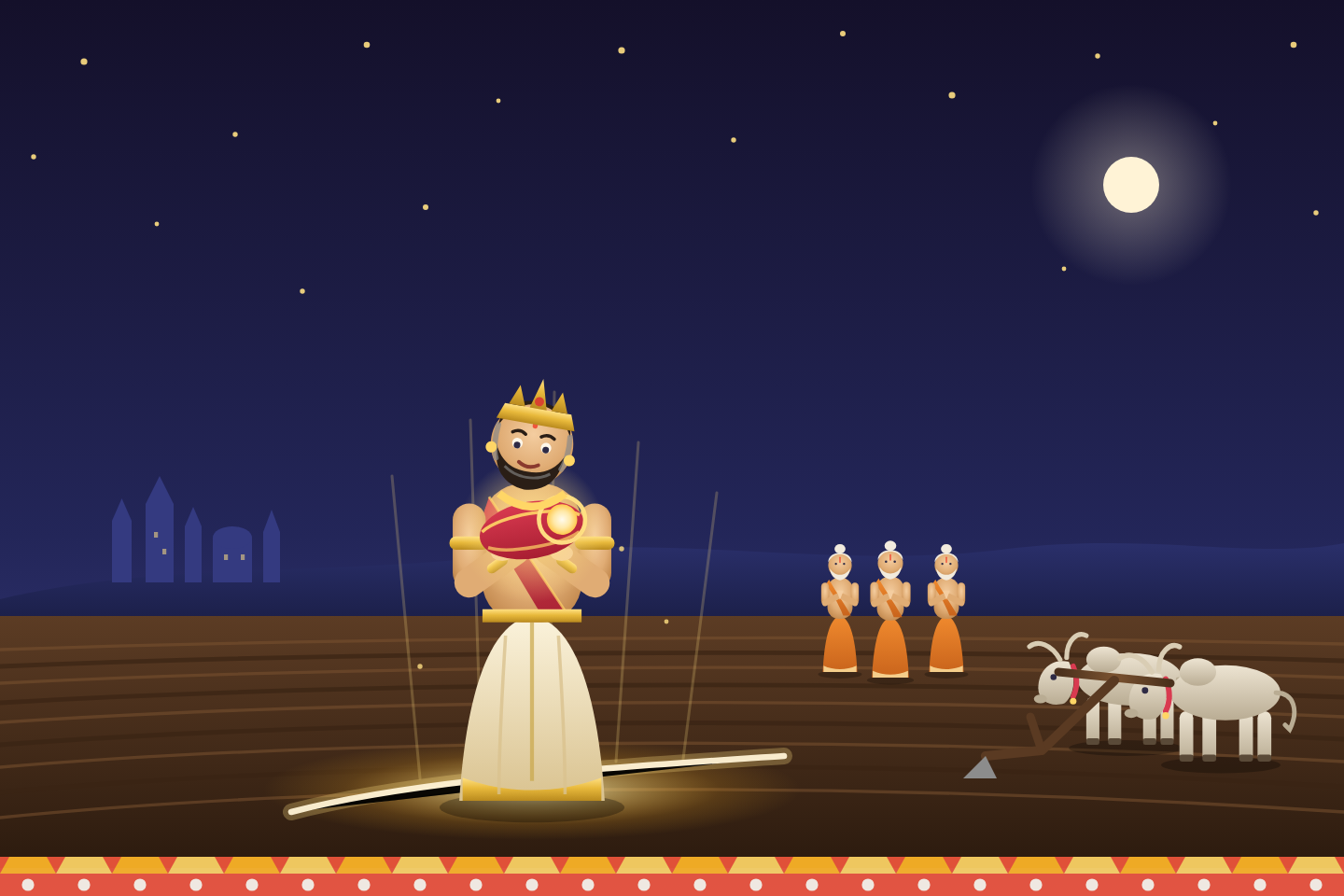
King Janaka was getting ready for a great yajña, a sacred fire-offering. He went out himself to the field set apart for the sacrifice and ploughed it, so that the ground would be clean and ready. So there he was, a king in the open air, following the oxen up and down, the ploughshare cutting long straight lines into the earth.
Sage Vālmīki
The furrow opens
And then, in the track the ploughshare had just made, something stirred. King Janaka stopped. Lying in the fresh-turned earth was a baby girl. She had not been born to any mother — she had simply risen from the soil, as if the earth herself had given her. The king lifted her up with joy and took her as his own daughter. And he named her for the place he found her. The word for the furrow a plough leaves is sītā — and so she was called Sītā, the daughter of the furrow. In his care she grew up fast, faster than any ordinary child, into a girl of extraordinary grace.
Sage Vālmīki
Only the brave may ask
When Mother Sītā grew up, kings from every land came to Mithilā asking for her hand. King Janaka gave them all the same answer: his daughter was not born of a womb, and she would only go to a man who won her by his own valour. 'How will you judge our valour?' the kings asked. So he had a great bow brought out — the bow of Lord Śiva himself, kept in his family for generations since the days of his ancestor Devarāta. Not one of the kings could even lift it, let alone bend it. Angry and ashamed, they joined together and surrounded Mithilā for a whole year, until the city's stores ran low. King Janaka prayed to the gods, and the gods sent him an army of horses, elephants, chariots and soldiers, and the proud kings fled.
Sage Vālmīki
A promise to a sage
Years later, Sage Viśvāmitra came to Mithilā with two young princes from Ayodhyā — Lord Rāma and his brother Lakṣmaṇa. The princes wanted to see the famous bow. King Janaka welcomed them, and before he showed it, he told the sage the whole story: the furrow, the baby, the kings who could not lift the bow. Then he made a promise. 'If Rāma can string this bow,' he said, 'I will give him my daughter Sītā, who was not born of a mother's womb.' And so the bow was waiting — and so was the morning that came next.
Sage Vālmīki
Flowers for the guru
Gosvāmī Tulsīdās tells us what happened the very next morning. Lord Rāma and Lakṣmaṇa went out early to gather flowers for their guru's worship, in the royal garden of Mithilā — a garden so lovely that spring had made its home there, with a lake of many-coloured lotuses in the middle. At that same moment Mother Sītā came to the garden too, sent by her mother to worship Goddess Gaurī at the little temple by the lake, with her friends singing around her. One of the friends wandered off, saw the two princes, and came running back with shining eyes: 'Two princes have come to see the garden — one dark, one fair — and I cannot describe them!' Lord Rāma heard the soft sound of bangles and anklets, looked up, and saw Mother Sītā. He said to his brother, 'That is King Janaka's daughter, for whom the bow-contest is being held. My right limbs are throbbing — a sign of something good to come.'
Gosvāmī Tulsīdās
The garland that fell
Mother Sītā saw the two brothers standing behind a screen of creepers, and her heart was full. Then her friends said, 'We are late — your mother will wonder where we are!' So she went back into Goddess Gaurī's temple and prayed with folded hands: 'You know what my heart wants, so I will not say it out loud.' And as she clasped the feet of the image, the flower garland slipped from the Goddess's neck and fell — and the image smiled. 'Hear my blessing, Sītā,' said the Goddess. 'The one your heart is set on shall be yours.' Mother Sītā placed the garland on her head and went home more glad than words can say. The daughter of the furrow had met the prince who would lift the bow.
Gosvāmī Tulsīdās
✦ Two tellings, one story
Sage Vālmīki’s Rāmāyaṇa (Sanskrit)
Sage Vālmīki gives us Mother Sītā's beginning in King Janaka's own words, in the Bāla Kāṇḍa, when the king welcomes Sage Viśvāmitra and the two princes and tells them the history of Lord Śiva's bow. The king says that while he was ploughing the plot set apart for a sacrifice, a female child rose from the track of the ploughshare; that she was called Sītā, 'the furrow'; that she grew at an extraordinary pace in his care; that she was not born of a mother's womb and would be given only to a suitor who won her by valour; that the kings who tried could not even lift the bow, besieged Mithilā for a year and were driven off by an army the gods gave him; and that if Lord Rāma strings the bow, Sītā will be his. It is all told in a few verses — a wonder spoken plainly, by the man it happened to.
Gosvāmī Tulsīdās’s Rāmcaritmānas (Awadhi)
Gosvāmī Tulsīdās does not tell how Mother Sītā came into the world. In the Rāmcaritmānas she is simply 'the daughter of King Janaka', and the poet saves all his attention for the morning in the garden: the two brothers gathering flowers for their guru, Mother Sītā arriving with her friends to worship Goddess Gaurī, the friend who sees the princes first, Lord Rāma hearing the sound of her anklets and telling Lakṣmaṇa who she is, and the garland that falls from the Goddess's image as a blessing. So the furrow belongs to Sage Vālmīki, and the garden belongs to Tulsīdās — and together they give us Mother Sītā's whole beginning.
What this story teaches
Great gifts come while you are doing your work
King Janaka was not looking for a daughter. He was doing a plain job with his own hands — ploughing a field for a sacrifice — when the greatest gift of his life rose out of the earth in front of him. Do your work well, and keep your eyes open.
Love what is given to you, wherever it comes from
The king did not ask where the baby came from or whose she was. He lifted her up with joy and called her his own. Mother Sītā had no mother in the ordinary way, but she had a father who chose her completely, from the very first moment.
Some things are worth saying no for
Dozens of kings asked for Mother Sītā, and King Janaka said no to every one who could not lift the bow — even when they surrounded his city for a whole year. He was waiting for the right one. Sometimes a good 'no' is how you keep room for the right 'yes'.
Words to know
- Mithilā · King Janaka's kingdom, far to the east of Ayodhyā; Mother Sītā is also called Maithilī, 'the princess of Mithilā'
- Janaka · the wise and good king of Mithilā, who found Mother Sītā in the furrow and raised her as his daughter
- sītā · the word for the furrow a plough leaves in the earth — the baby was named after the place she was found
- yajña · a sacred fire-offering; King Janaka was ploughing the ground to make it ready for one
- Devarāta · King Janaka's ancestor, to whom the gods gave Lord Śiva's great bow for safe keeping
- Gaurī · a name of the Goddess Pārvatī, Lord Śiva's consort; Mother Sītā worshipped her at the little temple in the garden
Vālmīki Rāmāyaṇa — Bāla Kāṇḍa (King Janaka's account to Sage Viśvāmitra of the bow and of how he found Sītā in the furrow). Rāmcaritmānas — Bāl-kāṇḍa (the flower-garden of Mithilā: the two brothers gathering flowers, Mother Sītā's worship of Goddess Gaurī, and the Goddess's blessing). Told for ages 8–12; where the tellings differ, each is given as it stands.