Kids · लङ्काकाण्ड Laṅkā Kāṇḍa · Ages 8–12
The Day the Lord Sent His Enemy Home
Garuḍa has come and gone, the serpent-arrows are broken, and the war has started again. But since that night things have gone badly for Laṅkā. One after another, Rāvaṇa's great generals have ridden out through the gates and not come back — Dhūmrākṣa, then Akampana, and last of all Prahasta, the commander-in-chief of all his armies, brought down by Nīla, the commander of the vānaras.
When the news of Prahasta reaches the palace, the ten-headed king is filled with anger and grief. 'An enemy who can do this is not to be taken lightly,' he tells his captains. 'I will go to the battlefield myself.' This is the story of the first time Rāvaṇa and Lord Rāma meet in battle — and of how it ended in a way that only Lord Rāma could have ended it.
The king rides out
Conches blow. Kettle-drums thunder. The gate opens, and out rolls a chariot that shines like fire, pulled by the finest horses in Laṅkā, with a white royal canopy above it as bright as the moon. From his side of the field Lord Rāma asks Vibhīṣaṇa to name the warriors he can see, and Vibhīṣaṇa names them one by one. Then he points to the chariot. Lord Rāma looks for a long moment — and what he says is not an insult. 'What splendour the king of the rākṣasas has! He is like the sun; I can hardly look at him for the light.' Then he takes up his bow.
Sage Vālmīki
Heroes fall like rain
Rāvaṇa cuts into the vānara army the way a great fish cuts through the sea. King Sugrīva tears off a mountain-top and hurls it; Rāvaṇa splits it in the air and strikes Sugrīva down senseless. Chief after chief rushes in and falls. The vānaras run to the one place that is always safe — to Lord Rāma — crying out for help. Lakṣmaṇa folds his hands: 'Let me go, brother.' In Sage Vālmīki's telling Lord Rāma gives him a fighter's advice: 'Go. But he is very strong. Look for his weak points — and guard your own.' Lakṣmaṇa bows at the Lord's feet and goes.
In both Rāmāyaṇas
A slap, and a vānara on the flagpole
Hanumān Jī gets there first. 'You were promised that gods and demons could not harm you,' he tells Rāvaṇa. 'Nobody promised you anything about vānaras.' Rāvaṇa strikes him so hard that he staggers. Hanumān Jī steadies himself and answers with one open palm — and the ten-headed king shakes like a mountain in an earthquake. When Rāvaṇa gets his breath back, he says, 'Well done, vānara! You are an enemy worth praising.' Hanumān Jī is not pleased at all: 'Shame on my strength, if you are still standing!' Then comes Nīla, who makes himself tiny and hops onto the tip of Rāvaṇa's flagpole, then the end of his bow, then the very top of his crown — and the king cannot work out where to aim. Even Lord Rāma watches in wonder.
Sage Vālmīki
The one he could not lift
Now Lakṣmaṇa and Rāvaṇa stand face to face, and arrows fly so fast that each one is cut in the air by another. Lakṣmaṇa breaks the king's bow in two. So Rāvaṇa reaches for something worse: a blazing spear that was a gift from Brahmā, the Creator. It strikes Lakṣmaṇa in the chest and he falls. Rāvaṇa rushes up and seizes him in his arms to carry him off — and cannot lift him. Arms strong enough to raise mountains cannot raise one fallen prince from the ground. Then Hanumān Jī arrives like a thunderbolt. One blow of his fist, and Rāvaṇa drops to his knees in his chariot and faints. Hanumān Jī gathers Lakṣmaṇa up in his arms and carries him to Lord Rāma. Sage Vālmīki explains it: for an enemy Lakṣmaṇa was too heavy to move, but for one who loved him he was light.
In both Rāmāyaṇas
On Hanumān Jī's shoulders
Lakṣmaṇa opens his eyes, whole again. And Lord Rāma picks up his bow. Rāvaṇa has a chariot; the Lord is on foot. So Hanumān Jī comes to him and says, 'Climb onto my shoulders, as Lord Viṣṇu rides upon Garuḍa.' From that high seat Lord Rāma twangs his bowstring like a clap of thunder. His arrows take Rāvaṇa's chariot apart piece by piece — the wheels, the banner, the white canopy. One arrow makes the king reel and let his great bow slip from his hand. And then a last arrow, shaped like a crescent moon, shatters the sun-bright crown upon his head.
Sage Vālmīki
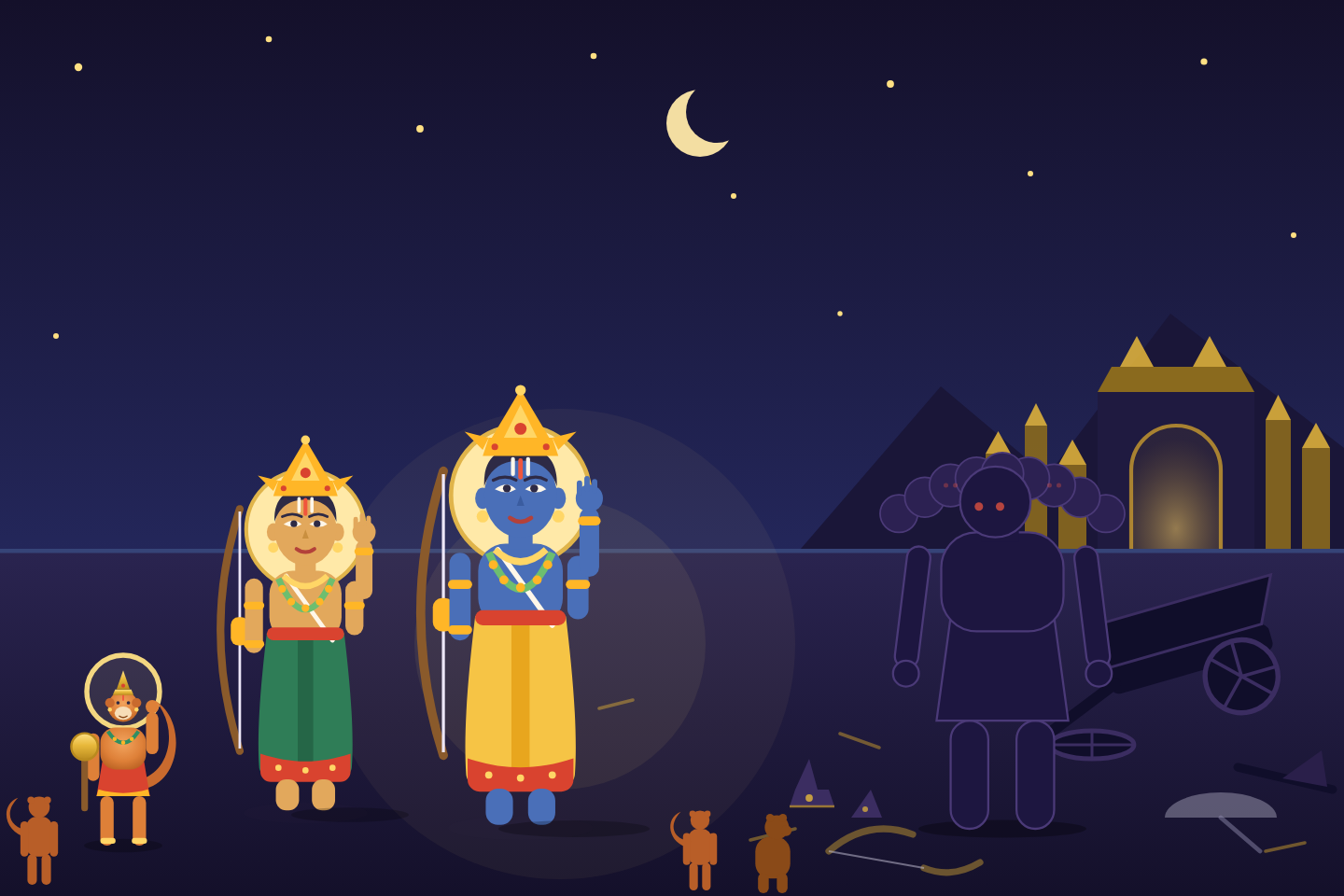
'Go home. Come back tomorrow.'
There stands Rāvaṇa, in front of his own city: no chariot, no bow, no crown. Sage Vālmīki says he looked like a snake with its venom gone, like a sun whose rays had been taken away. And Lord Rāma does not shoot. He speaks. 'You have fought a great and terrible fight today,' he says, 'and you have struck down my best warriors. I can see that you are worn out. I will not send you to Death like this. Go back into Laṅkā. Rest. Come out again with a new chariot and a new bow — and then you shall see my strength.' And the ten-headed king turns and goes back into Laṅkā, with his pride in pieces. Then Lord Rāma and Lakṣmaṇa go from vānara to vānara across the field, gently drawing out the arrows.
Sage Vālmīki
✦ Two tellings, one story
Sage Vālmīki’s Rāmāyaṇa (Sanskrit)
In Sage Vālmīki's Yuddha Kāṇḍa this is Rāvaṇa's first day on the battlefield, straight after his commander-in-chief Prahasta is felled by Nīla and before Kumbhakarṇa is woken. Lord Rāma admires the rākṣasa king's brilliance before fighting him. Rāvaṇa strikes down Sugrīva and many vānara chiefs, trades blows with Hanumān Jī (and praises him), fells Nīla with a fire-arrow that the son of the fire-god survives, and brings Lakṣmaṇa down with a spear given by Brahmā — but cannot lift him. Hanumān Jī's fist knocks Rāvaṇa senseless and he carries Lakṣmaṇa to safety. Lord Rāma then fights from Hanumān Jī's shoulders, shatters the chariot, makes Rāvaṇa drop his bow, breaks his crown — and, seeing him exhausted, sends him home to rest and return re-armed. Rāvaṇa goes back into Laṅkā with his pride crushed.
Gosvāmī Tulsīdās’s Rāmcaritmānas (Awadhi)
Gosvāmī Tulsīdās tells these events in other places, and there is no 'go home and come back tomorrow' in the Mānas. The falling crown comes before the war begins: from Subela hill the Lord looses a single arrow that brings down Rāvaṇa's royal umbrella, his crowns and Queen Mandodarī's earrings, and returns to the quiver; the court is alarmed, Rāvaṇa laughs it off, and Mandodarī does not. The spear comes much later, after Kumbhakarṇa and Meghanāda have both fallen: Rāvaṇa hurls Brahmā's spear at Lakṣmaṇa and cannot lift him, for — says the Mānas — this is the Endless One on whose head the whole universe rests like a grain of sand. Hanumān Jī is struck to his knees but does not fall, then fells Rāvaṇa with his fist so that the king drops like a mountain struck by lightning — and, waking, even Rāvaṇa admires his strength. Lord Rāma reminds Lakṣmaṇa who he is, the prince rises, the spear vanishes into the sky, and he fights on until a charioteer carries the senseless king back into Laṅkā.
What this story teaches
Real strength knows when to stop
Lord Rāma could have ended everything with one arrow. He would not strike someone who could no longer fight back. When you have won — the game, the argument, the race — and the other person has nothing left, that is the moment that shows who you are. Let them get up.
You can see what is great in someone you oppose
Before the fight, Lord Rāma said out loud how splendid Rāvaṇa looked. In the middle of it, Rāvaṇa praised Hanumān Jī's blow. Being against what someone is doing does not mean pretending they have no gifts. Tell the truth about people — even the ones on the other side.
Love can lift what force cannot
Rāvaṇa's arms had shaken mountains, and he could not move Lakṣmaṇa an inch. Hanumān Jī picked him up easily. Some things will never open to pushing and pulling. They open to the one who cares.
Words to know
- Prahasta (प्रहस्त) · The commander-in-chief of Rāvaṇa's armies. It was his fall that made Rāvaṇa decide to come out and fight himself.
- Nīla (नील) · The commander of the vānara army and a son of Agni, the fire-god — which is why Rāvaṇa's fire-arrow could knock him down but not destroy him.
- śakti (शक्ति) · A mighty spear or javelin. The one Rāvaṇa hurled at Lakṣmaṇa was a gift from Brahmā, the Creator.
- kirīṭa (किरीट) · A tall royal crown. Lord Rāma's crescent-headed arrow shattered Rāvaṇa's.
- Subela (सुबेल) · The hill beside Laṅkā where Lord Rāma camped with his army. In the Mānas it is from here that a single arrow brings down Rāvaṇa's umbrella and crowns.
- Ananta (अनन्त) · 'The Endless One' — the great serpent Śeṣa who holds up the worlds. The Mānas calls Lakṣmaṇa by this name, and that is why Rāvaṇa could not lift him.
Vālmīki Rāmāyaṇa — Yuddha Kāṇḍa (the fall of Prahasta, Rāvaṇa's first coming to the battlefield, his fights with Sugrīva, Hanumān Jī, Nīla and Lakṣmaṇa, and Lord Rāma sending him home); Rāmcaritmānas — Laṅkā-kāṇḍa (the arrow from Subela hill that brings down the umbrella and crowns; and, later in the war, Brahmā's spear, Hanumān Jī's fist and Rāvaṇa carried back into Laṅkā). Retold for young readers; where the two tellings differ, both are given.