Kids · लङ्काकाण्ड Laṅkā Kāṇḍa · Ages 8–12
The Day the Walls of Laṅkā Shook
Every message has been sent. Hanumān Jī burned the city. The spies went home with a warning. Prince Aṅgada stood in Rāvaṇa's court and no one could move his foot. And still the ten-headed king will not give Mother Sītā back. So now, on the shore of Laṅkā, Lord Rāma calls his counsellors together and asks the question everyone has been waiting for: Laṅkā has four great gates. How do we take them?
This is the story of the first day of the war — not one hero's duel, but a whole city shaking. It is told in both Rāmāyaṇas, and in both it is loud: drums, conches, roars, boulders on golden walls. Hold on tight.
Four gates, four armies
King Sugrīva, old Jāmbavān and Vibhīṣaṇa — who knows every stone of Laṅkā — think it through with Lord Rāma's name in their hearts. They split the great host into four divisions, one for each gate, and choose a captain for each. Hanumān Jī takes the western gate; Sage Vālmīki adds that Prince Aṅgada takes the southern one, and that Lord Rāma and Lakṣmaṇa themselves take the northern gate — because that is where Rāvaṇa stands, and no one but Lord Rāma could hold it. Then the captains gather every troop-leader, remind them whose army this is, and the vānaras answer with a roar like lions. They bow to Lord Rāma's feet, pick up whole mountain-tops in their arms, and run.
In both Rāmāyaṇas
The roar that shook the city
They surround Laṅkā the way storm clouds close in from every side, and they do not even need drums — they beat out the drumbeats with their mouths. 'Victory to Lord Rāma! Victory to Lakṣmaṇa! Victory to King Sugrīva!' The sound rolls over the walls and into every street. Sage Vālmīki says Rāvaṇa climbed to the top of his palace and saw the whole earth swallowed up by vānaras, and for one long moment he was afraid. Gosvāmī Tulsīdās says he laughed. 'Look at the cheek of these monkeys! My rākṣasas are hungry, and fate has delivered their dinner to the door.' Either way, he gives the order: every warrior out, to all four gates.
In both Rāmāyaṇas
Trees and boulders against golden walls
The rākṣasas climb onto the battlements with bows and maces and tridents until the walls look like Mount Meru with dark clouds sitting on its peaks. War-drums and trumpets blare. And the vānaras and bears come on — leaping ravines, cracking hills apart to make a path, hurling trees and mountain-peaks at the walls. They fill the moats with rocks and earth. They smash the golden archways over the gates. The rākṣasas roll boulders down; the vānaras catch them in mid-air and throw them straight back up. 'Rāvaṇa!' shout the walls. 'Rāma!' shouts the plain. Then the vānaras are over the top, racing through the palaces singing Lord Rāma's praises, each one grabbing a rākṣasa and jumping back down with him.
In both Rāmāyaṇas
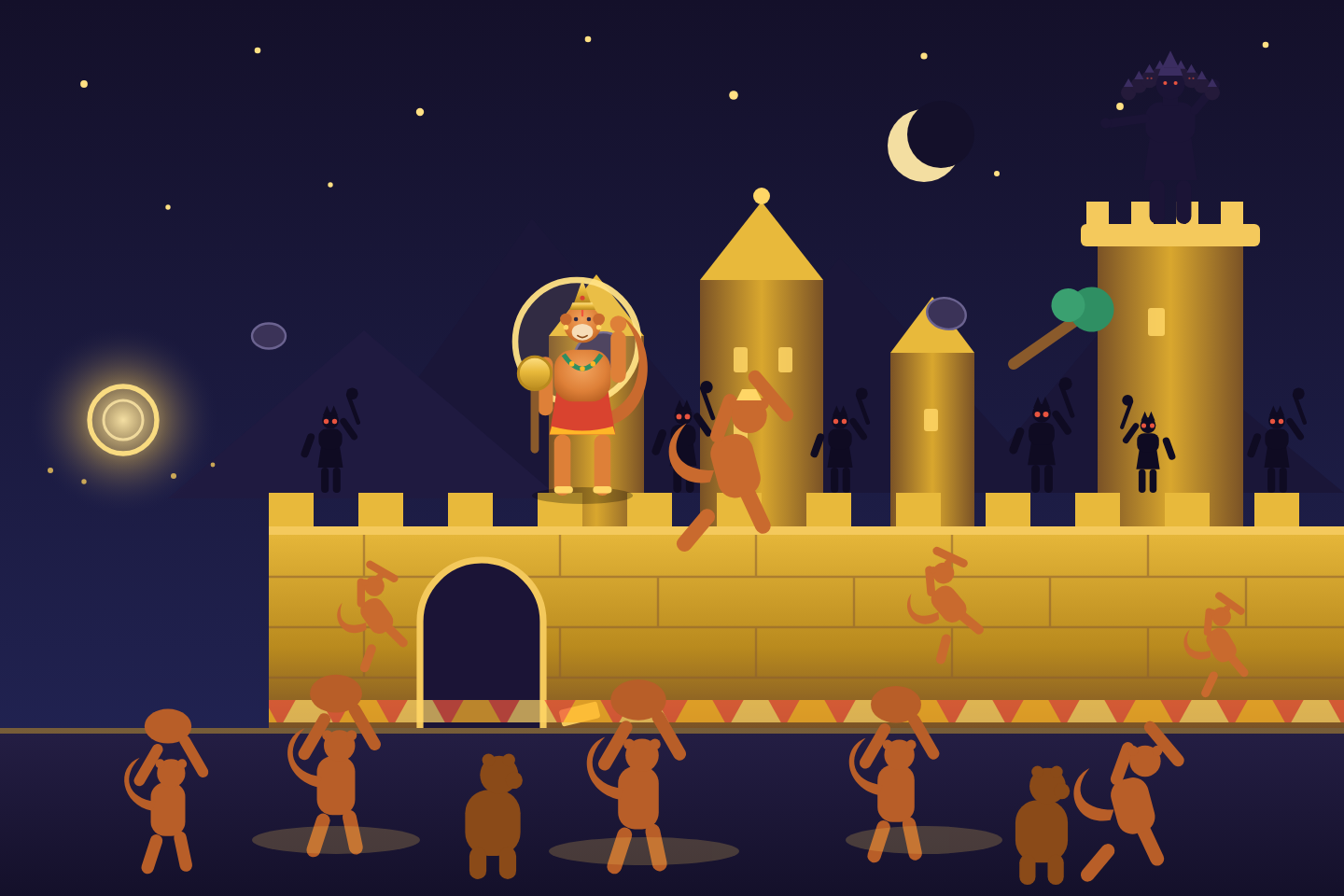
Two vānaras on the king's own roof
Rāvaṇa's warriors rally, and with their heavy weapons they push the vānaras back until some begin to run, calling out, 'Where is Aṅgada? Where is Hanumān Jī?' Hanumān Jī is at the western gate, which will not break, because Meghanāda himself is holding it. When he hears his friends are in trouble he roars like the end of the world, leaps clean onto the fortress with a hill in his hands, and smashes Meghanāda's chariot so badly that the prince has to be carried home. Aṅgada hears that Hanumān Jī is on the walls alone — and springs up after him as lightly as a game. The two of them run straight up onto Rāvaṇa's own palace, shout Lord Rāma's name from the roof, and bring the golden pinnacle crashing down. The women of the palace beat their breasts: 'This time two of them have come!' And far below, Lord Rāma smiles and says the two vānaras in Laṅkā look like two Mount Mandaras churning the sea.
Gosvāmī Tulsīdās
The duel with the prince who disappeared
Sage Vālmīki tells the battle differently. When the two armies crash together, the fighting breaks into duels: Prince Aṅgada against Indrajit, Rāvaṇa's terrible son; Hanumān Jī against Jambumālī; Vibhīṣaṇa against Mitraghna. The sun sets and nobody stops. In the dark, warriors grab each other shouting 'You're a rākṣasa!' — 'You're a vānara!' Golden arrows streak through the night like fireflies in autumn, and Mount Trikūṭa echoes with the noise. Then Aṅgada brings down Indrajit's horses and his charioteer. Indrajit leaps from his broken chariot — and vanishes into thin air. The gods and sages praise Vāli's son, and the vānaras shout 'Sādhu! Sādhu!' But an enemy who disappears is not an enemy who is beaten. Somewhere in the dark, Indrajit is very, very angry.
Sage Vālmīki
Night falls on the first day
In the Mānas, when the sun goes down, Hanumān Jī and Aṅgada leap back over the wall and bow at Lord Rāma's feet — and the moment he looks at them, their tiredness is gone. But the rākṣasas grow stronger after dark. Two of their generals, Akampana and Atikāya, work a spell: in the blink of an eye the whole battlefield goes pitch black, and blood and stones and ash rain from the sky. The vānaras cannot see their own hands. Lord Rāma knows exactly what is happening. He smiles, strings his bow and lets fly a single fire-arrow — and everywhere there is light, with not a shadow left, the way doubt disappears when understanding dawns. Hanumān Jī and Aṅgada roar; the rākṣasas run for the walls. And at last, in the quiet of the night, all four divisions come back to Lord Rāma. He looks at every one of them, and every one of them is rested. That was the first day.
Gosvāmī Tulsīdās
✦ Two tellings, one story
Sage Vālmīki’s Rāmāyaṇa (Sanskrit)
In Sage Vālmīki's Yuddha Kāṇḍa the vānaras, shouting 'Victory to Rāma, to Lakṣmaṇa and to King Sugrīva', storm Laṅkā's ramparts with trees and rocks, fill the moats, and crush the golden archways and gate-towers, while Rāvaṇa watches from his palace roof. He orders his whole army out; drums and hundreds of thousands of conches sound and the dark-bodied rākṣasas pour out like storm clouds. The battle becomes a chain of duels — Aṅgada with Indrajit, Hanumān with Jambumālī, Vibhīṣaṇa with Mitraghna — and carries on into the night, when Aṅgada destroys Indrajit's chariot and Indrajit vanishes by his magic, which sets up the next episode.
Gosvāmī Tulsīdās’s Rāmcaritmānas (Awadhi)
Gosvāmī Tulsīdās has Lord Rāma's counsellors form four divisions for Laṅkā's four gates; the host encircles the city roaring Lord Rāma's name and Rāvaṇa laughs the vānaras off as his rākṣasas' dinner. The walls are stormed, the city wails, and Rāvaṇa shames his fleeing warriors back into the fight. Hanumān Jī, at the western gate against Meghanāda, leaps onto the fort; Aṅgada follows; together they pull down the pinnacle of Rāvaṇa's palace and Lord Rāma compares them to two Mandara mountains churning the sea. At dusk the two return to him; the rākṣasas Akampana and Atikāya conjure darkness and a rain of blood and stones; Lord Rāma's fire-arrow turns night to day, and the four divisions come home to him at night.
What this story teaches
Courage shouts a name that is not its own
The vānaras did not roar 'Look at me!' They roared 'Victory to Lord Rāma!' When you are frightened, remembering who you are fighting for — your family, your friends, what is right — gives you a strength that showing off never can.
A wall is only as strong as the pride behind it
Rāvaṇa laughed at 'monkeys' in the morning. By evening two of them were standing on his roof. Laughing at people you have decided are small is the fastest way to be surprised by them.
When everything goes dark, look for the one who can see
The vānaras could not see their own hands, and they panicked. Lord Rāma could see perfectly, and one arrow was enough. Gosvāmī Tulsīdās says light returned the way doubt vanishes when understanding dawns. When you are confused, find the person who understands — a parent, a teacher — and ask.
Words to know
- Laṅkā-kāṇḍa / Yuddha Kāṇḍa (लङ्काकाण्ड / युद्धकाण्ड) · The 'Book of Laṅkā' in the Mānas and the 'Book of War' in Sage Vālmīki's poem — the same part of the story, with two names.
- kaṅgūrā (कँगूरा) · A battlement — the notched top of a fortress wall where defenders stand. Tulsīdās says the rākṣasas on Laṅkā's battlements looked like clouds on the peaks of Mount Meru.
- Meghanāda / Indrajit (मेघनाद / इन्द्रजित्) · Rāvaṇa's most dangerous son. 'Meghanāda' means 'thunder-voice'; 'Indrajit' means 'conqueror of Indra', the king of the gods. He can fight from the air and disappear.
- toraṇa (तोरण) · A great ornamental archway over a gate. Sage Vālmīki says the vānaras crushed Laṅkā's golden toraṇas with their bare hands.
- Trikūṭa (त्रिकूट) · The three-peaked mountain that Laṅkā is built on. On the first night of battle it echoed with the noise.
- agni-bāṇa (अग्निबाण) · A fire-arrow. Lord Rāma shot one to break the rākṣasas' spell of darkness and light up the whole battlefield.
Rāmcaritmānas — Laṅkā-kāṇḍa (the four divisions, the siege and the storming of the walls, Hanumān Jī and Aṅgada on Rāvaṇa's palace, the magical darkness and the fire-arrow); Vālmīki Rāmāyaṇa — Yuddha Kāṇḍa (the siege of Laṅkā, the assault on the ramparts and archways, the first duels, the night battle and Aṅgada's defeat of Indrajit's chariot). Retold for young readers; where the two tellings differ, both are given.