Kids · अरण्यकाण्ड Araṇya Kāṇḍa · Ages 8–12
The Deer of Gold
Some dangers roar when they come. They beat drums and darken the sky, the way Khara and Dūṣaṇa's army did. But the danger in tonight's story does not roar at all. It steps out of the trees on slender legs, catches the light like treasure, and dances.
For after the great battle at Janasthāna, Rāvaṇa, the ten-headed king of Laṅkā, chose not to march on Lord Rāma with armies. He chose a trick instead — and to work it, he needed the saddest, strangest helper in the whole epic: an old demon whose heart secretly belonged to the very Lord he was sent to deceive.
The king who chose a trick
When news of Janasthāna reached Laṅkā, Rāvaṇa did not call his armies. He thought of the two princes, and then he thought of a plan that no drum would announce. Alone, he mounted his chariot and crossed to a far seashore, where the old demon Mārīca lived quietly like a hermit. Long ago, Mārīca had felt the touch of Lord Rāma's arrow — one blow had flung him a hundred yojanas through the sky — and he had never forgotten it.
In both Rāmāyaṇas
Mārīca's warning
"Do not make an enemy of him," old Mārīca begged, when he heard the plan. "I have seen his arrows. Where you see two young princes, I see the Lord of all that moves and does not move." But Rāvaṇa only grew angry, and his words turned sharp as spears. Then Mārīca thought a brave, quiet thought: if I refuse, this wicked king will kill me — but if I go, I shall die by Lord Rāma's own arrow. Of the two deaths, he chose the better one, and his heart grew strangely light.
In both Rāmāyaṇas
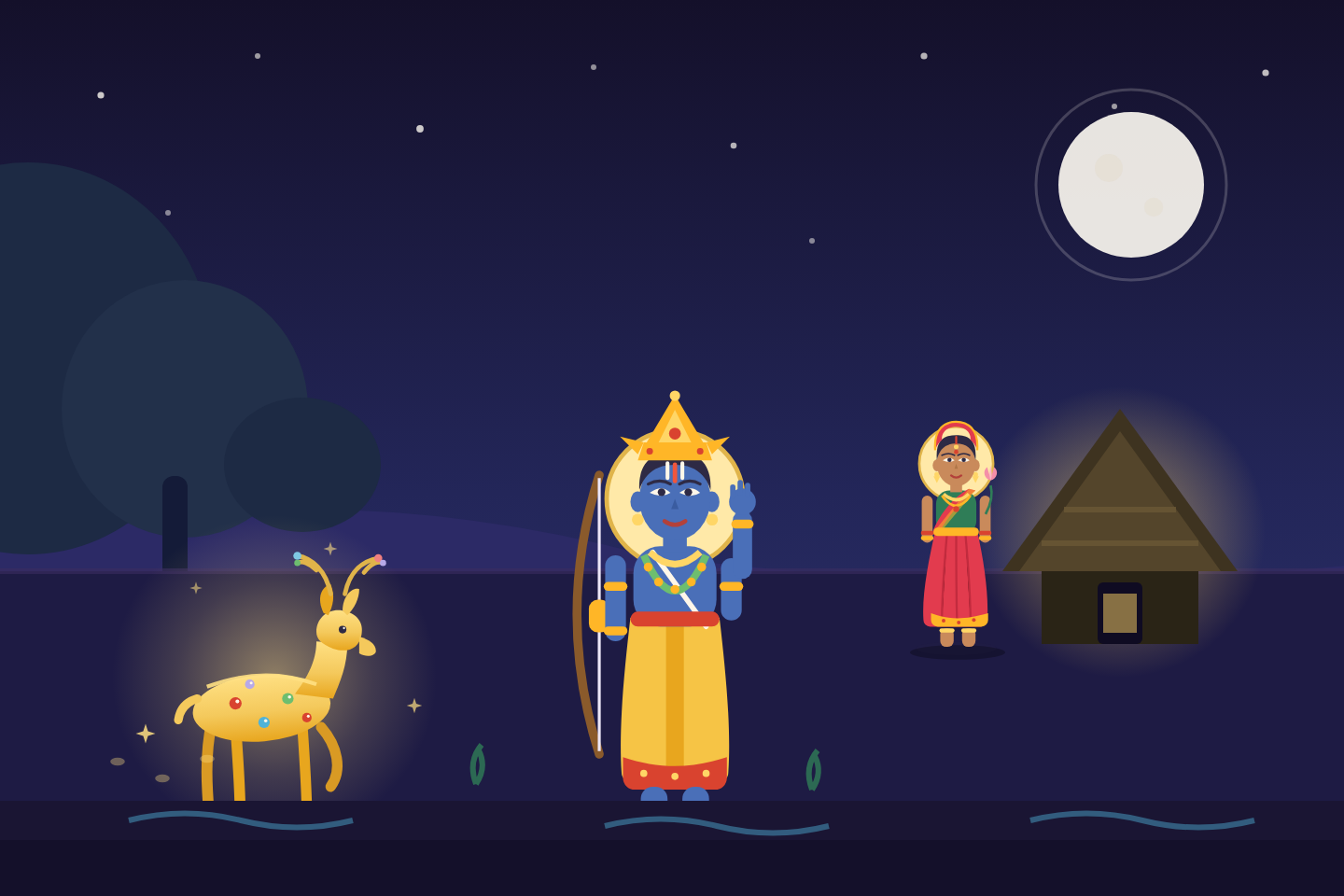
The deer no forest ever grew
At the edge of the Pañcavaṭī clearing, something impossible stepped out of the trees. A deer — but a deer of gold, its body set with gems, so strange and beautiful that no words could hold it. It glimmered near the cottage, nibbling grass it did not need, dancing closer and skipping away. Mother Sītā saw it and her eyes went wide with delight. "Look!" she said. "O kind Lord, have you ever seen such a deer?"
In both Rāmāyaṇas
The wish and the warning
In Sage Vālmīki's telling, Mother Sītā wished for the wonderful deer as a companion for the hermitage — and Lakṣmaṇa's eyes narrowed. "No deer like this walks the earth," he said quietly. "This is demon magic — this is Mārīca." But the wish had been spoken. Lord Rāma took up his bow and turned to his brother with a clear command: "Guard Mother Sītā with wisdom and watchfulness. I shall not be long."
Sage Vālmīki
The chase that bent like smoke
The deer led Lord Rāma deep, deep into the forest — near, then suddenly far; shining plainly, then gone like a lamp blown out. No honest animal runs like that. At last Lord Rāma set an arrow to his bow, and the golden shape crashed down — and out of it rose Mārīca's true form. With his last breath the demon worked the cruellest part of the trick: in a voice exactly like Lord Rāma's own, he cried out across the forest, "O Sītā! O Lakṣmaṇa!"
In both Rāmāyaṇas
The secret mercy
The false cry flew toward the cottage like a black arrow — what it set moving is tomorrow's story. But Gosvāmī Tulsīdās stays a moment with the fallen demon, and shares a secret: Mārīca died remembering the Lord with love, and the Lord, who knew his heart, granted him the shining state that even great sages rarely reach. The deer had been a lie. The mercy that answered it was true.
Gosvāmī Tulsīdās
✦ Two tellings, one story
Sage Vālmīki’s Rāmāyaṇa (Sanskrit)
Sage Vālmīki lingers on the deer itself — a marvel of gold and gems that makes even the forest seem plain — and on the argument at the cottage: Mother Sītā's wish to keep the gentle creature as a companion of the hermitage, and Lakṣmaṇa saying aloud exactly what he suspects, that no such deer exists in all the world and this must be Mārīca in a borrowed shape. The warning is spoken — and the wish wins.
Gosvāmī Tulsīdās’s Rāmcaritmānas (Awadhi)
Gosvāmī Tulsīdās guards a tender secret: before the deer ever appeared, Lord Rāma had told Mother Sītā of the play that was coming, and she dwelt safely in the fire, leaving her perfect likeness in the cottage — so in his telling the trick never truly touched her. His Lord rises to the chase already knowing every reason, smiling, finishing the work of the devas; and when the arrow finds Mārīca, the poet follows the demon's soul all the way to its reward.
What this story teaches
Beautiful is not the same as true
The deer glittered exactly the way a wish glitters. When something appears that is precisely what you wanted, that is the moment to look twice.
Listen to the careful voice
Lakṣmaṇa saw what delight could not see. The people who love us can sometimes spot the trick we are too dazzled to notice — it is wisdom, not weakness, to hear them out.
Mercy reaches further than tricks do
Even Mārīca, who wore the lie, was met with love at the very end. No one who turns their heart toward goodness — even at the last breath — is turned away.
Words to know
- kapaṭa-mṛga (कपटमृग) · a "trick deer" — a false form worn to deceive
- māyā (माया) · magic of illusion; making things seem what they are not
- kanaka (कनक) · gold — the corpus says the deer's body was gold, set with gems
- Pañcavaṭī (पञ्चवटी) · the forest clearing by the Godāvarī where the exiles built their cottage
- yojana (योजन) · an ancient measure of distance — many kilometres long
A real episode from both Rāmāyaṇas: Vālmīki Rāmāyaṇa — Araṇya Kāṇḍa (the Mārīca and golden-deer cantos), and Śrī Rāmcaritmānas — Araṇya-kāṇḍa (dohās 23–27 with their caupāīs). Where the two tellings differ, both are presented faithfully above.