Kids · उत्तरकाण्ड Uttara Kāṇḍa · Ages 8–12
The Demon King Under a Vānara's Arm
When Lord Rāma had been crowned king of Ayodhyā, great sages came to see him, and the greatest of them, Sage Agastya, told him the long story of who Rāvaṇa had really been. One day the Lord asked a sharp question: in all the years that cruel Rāvaṇa roamed the earth, was there truly no one who could stand up to him? Sage Agastya laughed — and told him today's story.
Sage Vālmīki tells it in the last book of his Rāmāyaṇa, and it has two parts. In the first, the demon king is carried off like a captured bird. In the second, he is tucked under somebody's arm like a parcel and flown around the world. This is the Vālmīki telling; we will say at the end what Gosvāmī Tulsīdās does with it.
The king who went looking for fights
In those days Rāvaṇa, ten-headed and twenty-armed, went about the world frightening kings and looking for anyone who might be a match for him. So he came to the city of Māhiṣmatī, where King Arjuna ruled — a king with a thousand arms, whose people kept a sacred fire burning day and night. 'Where is your king?' Rāvaṇa demanded of the ministers. 'I have come to test my strength against him!' But King Arjuna was away. So Rāvaṇa flew on in his sky-chariot Puṣpaka, over the great Vindhya mountains, to the holy river Narmadā. There he bathed, and on the sandy bank he set up the golden emblem of Lord Śiva that he carried everywhere, while his companions Prahasta, Śuka and Sāraṇa gathered a whole mountain of flowers for his worship.
Sage Vālmīki
The river that ran backwards
Not far upstream, King Arjuna himself was playing in the Narmadā with his queens. And just to see how strong his thousand arms really were, he stretched them out and held the whole river back, like a dam. The water had nowhere to go — so it turned round and rushed back upstream, carrying fish and flowers and bundles of grass, and swept away every one of Rāvaṇa's flowers in the middle of his worship. Rāvaṇa stopped his worship half-way and stared at the river. Without a word, he pointed one finger, and Śuka and Sāraṇa flew off to find the cause. Half a yojana away they saw a man like a giant sal tree standing in the water, holding back the river with a thousand arms. 'Arjuna!' said Rāvaṇa, and went to fight him.
Sage Vālmīki
Caught like a bird
The two armies clashed on the riverbank, and then the two kings faced each other with maces: the thousand-armed man and the twenty-armed demon, like two mountains, like two lions. King Arjuna's mace crashed against Rāvaṇa's chest and broke in two — a boon from Brahmā had made that chest unbreakable — but the blow still sent Rāvaṇa staggering back a bow's length and sinking down. Quick as Garuḍa catching a snake, Arjuna seized him and bound him in his thousand arms, the way the Lord in his Vāmana form once bound King Bali. The gods in the sky showered flowers and cried 'Well done!' Rāvaṇa's friends ran away. And King Arjuna carried the demon king home into Māhiṣmatī, as the people threw flowers and rice over him.
Sage Vālmīki
A grandfather comes to ask
Far away, Sage Pulastya — Rāvaṇa's own grandfather, and a son of Brahmā — heard the gods talking about it, and his heart went out to the boy. He came through the sky to Māhiṣmatī. King Arjuna hurried out to welcome him with honey and curds and water for his feet, and said, 'Today my whole life has borne fruit, because I have bowed at your feet. Tell me what I can do for you.' The sage praised the king's wonderful strength — and then asked him to set his grandson free. The king did not say one word. He simply set Rāvaṇa free, dressed him in fine garlands and clothes, and made a pact of peace with him in front of the sacred fire. Rāvaṇa, hugged by his grandfather, felt very shy about having been so completely beaten. 'So you see, O Rāma,' said Sage Agastya, 'there are always warriors mightier than the mighty.'
Sage Vālmīki
Under a vānara's arm
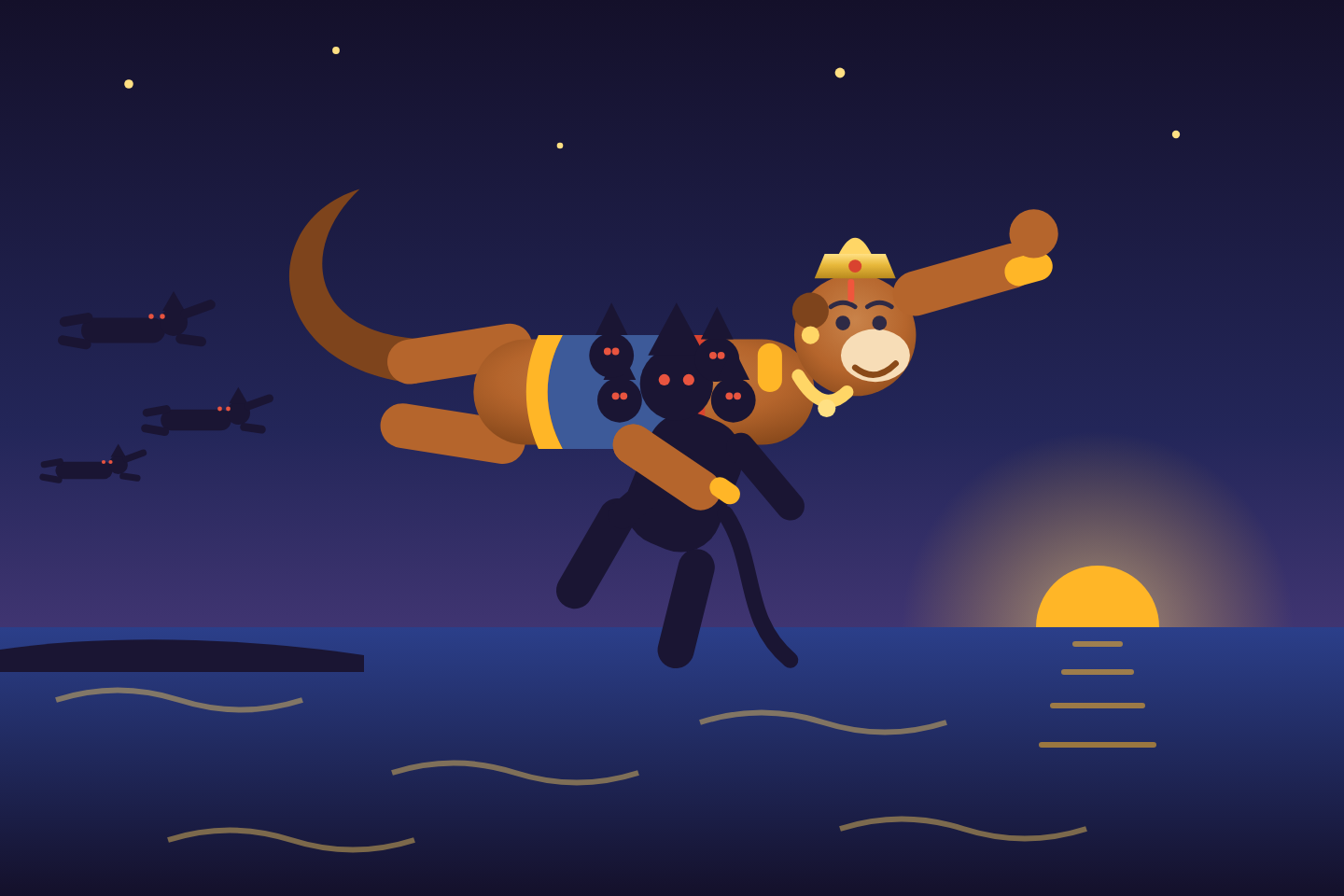
Did Rāvaṇa learn his lesson? He did not. Off he went again, challenging anyone said to be strong, and one day he arrived at Kiṣkindhā, the city of the vānaras, to fight their king, Vālī — the mighty Vālī who wore a gold necklace. Vālī's ministers — Tāra, Suṣeṇa, Aṅgada and Sugrīva — told him the king was away: every morning and evening Vālī said his sandhyā prayers on the shores of all four oceans. They pointed to heaps of bones, white as conch shells, of those who had come to fight him. 'If you are in such a hurry,' they said, 'go to the southern sea.' So Rāvaṇa flew there, and found Vālī standing on the shore like a mountain of gold, deep in his prayers. Rāvaṇa crept up behind him with silent steps to grab him. Vālī heard the footfalls. Without even turning round, he caught the demon king the way Garuḍa catches a snake, pressed him tight under his arm — and leapt into the sky!
Sage Vālmīki
'Where are you from?'
With Rāvaṇa pinned in his armpit, his legs and hands and clothes dangling like a snake in Garuḍa's claws, Vālī flew on to the western sea, dipped in, and calmly said his prayers. Then to the northern sea. Then to the eastern sea. Rāvaṇa pinched and scratched with his nails the whole way; Vālī took no more notice than the wind takes of a cloud. Rāvaṇa's ministers chased after them shouting, and could not keep up. At last Vālī came home to a park outside Kiṣkindhā, set the demon king down, and laughed and laughed. 'Where are you from?' he asked. Rāvaṇa, dizzy and worn out, told him his name. 'What strength, what speed!' he said. 'Only the mind, the wind and Garuḍa move like that. I came to fight you — let me be your friend instead.' So they lit a fire, embraced before it, and walked into Kiṣkindhā hand in hand like two lions. Rāvaṇa stayed a whole month as Vālī's guest. 'Matchless was the strength of Vālī,' Sage Agastya told the Lord at the end. 'And even he was consumed by You, as a moth is by a flame.'
Sage Vālmīki
✦ Two tellings, one story
Sage Vālmīki’s Rāmāyaṇa (Sanskrit)
Both episodes are told in full in the Uttara Kāṇḍa of Sage Vālmīki's Rāmāyaṇa, as part of Sage Agastya's long answer to Lord Rāma's question about Rāvaṇa's past. King Arjuna of the Haihayas, at Māhiṣmatī on the Narmadā, blocks the river with his thousand arms while sporting with his queens; the backwash sweeps away the flowers Rāvaṇa has laid out for his worship of Lord Śiva; Rāvaṇa fights him, is beaten, bound in his thousand arms and carried into the city; Sage Pulastya comes and asks for his release, and Arjuna frees him and makes an alliance before the fire. Then at Kiṣkindhā the ministers send Rāvaṇa to the southern sea, where Vālī, at his twilight prayers, catches him from behind, tucks him under his arm and carries him to the western, northern and eastern seas, praying at each, before landing in a park by Kiṣkindhā, laughing and asking 'Whence are you?'; Rāvaṇa asks for friendship, the two swear it before the fire, and he stays a month.
Gosvāmī Tulsīdās’s Rāmcaritmānas (Awadhi)
Gosvāmī Tulsīdās does not tell these two adventures as scenes in the Rāmcaritmānas — there is no river Narmadā, no sandy altar and no flight around the four seas. But he knows them, and he lets Aṅgada use them. In the Laṅkā-kāṇḍa, when Aṅgada goes as Lord Rāma's messenger to Rāvaṇa's court and Rāvaṇa boasts of his might, Aṅgada asks him which Rāvaṇa he is: the one King Sahasrabāhu ran and caught as a strange creature and carried home for fun, until Sage Pulastya came and set him free — or the one, Aṅgada says with a blush, who was held tight under Vālī's arm. Aṅgada even mentions a third humiliation, in the house of King Bali, which this part of Sage Vālmīki's telling does not include. So in the Mānas the stories live on as a sharp reminder in the middle of the war.
What this story teaches
There is always someone stronger
Rāvaṇa thought nobody could beat him, and the very next king he met tied him up in a thousand arms. 'There are always warriors mightier than the mighty,' Sage Agastya said. Being strong is fine; thinking you are the strongest is where the trouble starts.
The strongest did not need to hurt him
Vālī could have done anything he liked to the demon who crept up behind him. Instead he finished his prayers, set him down, laughed, and asked where he was from. Real strength does not need to be cruel to prove itself.
A grandfather's word is worth more than a sword
No weapon of Rāvaṇa's could get him out of King Arjuna's grip. One quiet request from his grandfather did. The people who love you can open doors that all your fighting cannot.
Words to know
- Māhiṣmatī · the city on the river Narmadā where King Arjuna of the Haihayas ruled
- Kārtavīrya Arjuna · the thousand-armed king of Māhiṣmatī (the Mānas calls him Sahasrabāhu, 'thousand-armed'); not the same Arjuna as in the Mahābhārata
- Narmadā · the great holy river of central India that flows west to the sea
- Sage Pulastya · a son of Brahmā and Rāvaṇa's grandfather, who came to ask for his release
- Vālī · the mighty king of the vānaras at Kiṣkindhā, Sugrīva's elder brother, famous for his gold necklace
- sandhyā · the prayers said at dawn and dusk; Vālī said his at the shores of all four oceans every day
- Puṣpaka · Rāvaṇa's flying chariot, which later carried Lord Rāma home to Ayodhyā
Vālmīki Rāmāyaṇa — Uttara Kāṇḍa (Sage Agastya's account of Rāvaṇa and King Arjuna of Māhiṣmatī, and of Rāvaṇa and Vālī). Rāmcaritmānas — Laṅkā-kāṇḍa (Aṅgada's reminder to Rāvaṇa in his court). Told for ages 8–12; where the tellings differ, each is given as it stands.