Kids · उत्तरकाण्ड Uttara Kāṇḍa · Ages 8–12
The Dog Who Came to Court
Who is allowed to complain to a king? The rich? The important? The ones with the loudest voices? In Lord Rāma's Ayodhyā the answer was: anyone at all. Even someone with four legs and a tail.
Sage Vālmīki tells this story in the Uttara Kāṇḍa, in the peaceful years after Lord Rāma came home and was crowned. It is a story only he tells — Gosvāmī Tulsīdās does not include it in the Rāmcaritmānas, and we will say so at the end. This is the Vālmīki telling.
'Go and see who is waiting'
In those days nobody in Ayodhyā was ill, the fields were heavy with grain, and no one died before their time. Lord Rāma sat in his council hall with the great sages Vasiṣṭha and Kaśyapa, his ministers and his wise men, to hear the business of the kingdom. 'Lakṣmaṇa,' he said, 'go out to the gate and call in anyone who has come with a complaint.' Lakṣmaṇa went — and came back. 'No one has come, my lord. Nobody in your kingdom stands at the gate with folded hands.' Lord Rāma was glad, but he sent his brother out once more. A king, he said, must keep looking.
Sage Vālmīki
The visitor who would not come in
This time there was someone at the gate: a dog, standing there looking at Lakṣmaṇa and barking. The prince did not laugh or shoo it away. 'Tell me your trouble,' he said to it, 'and do not be afraid.' And the dog answered. 'Agni, Indra, Sūrya and Vāyu live in temples and palaces and the houses of Brāhmaṇas,' it said. 'We who are born low are not fit to go in. King Rāma is dharma itself. Without his permission I will not enter.' Lakṣmaṇa went in and told the Lord, and Lord Rāma said: 'Let it come in at once.'
Sage Vālmīki
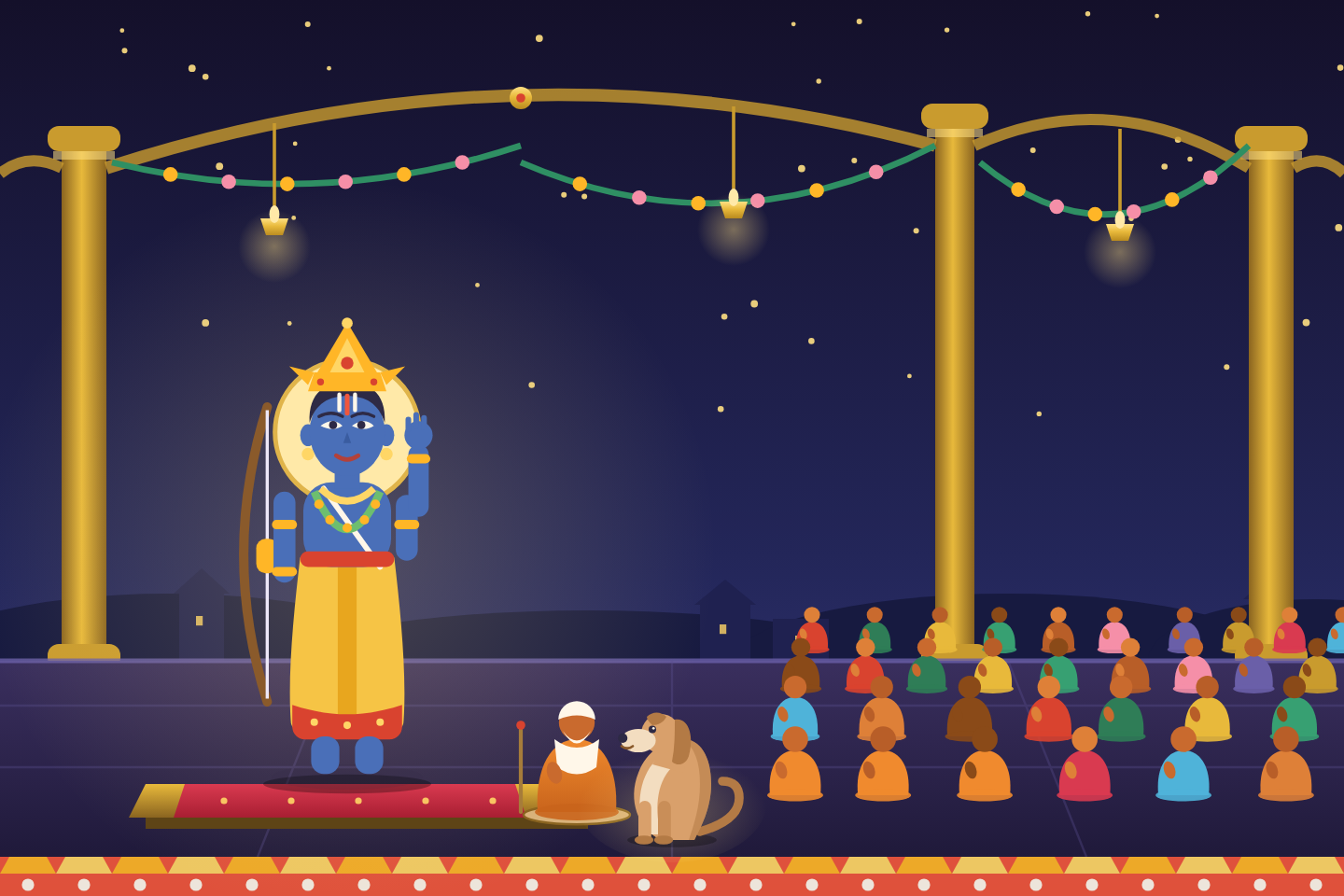
'Tell me, and do not fear'
So the dog came into the great hall, past the sages and the ministers, and stood before the king. It had been hurt on the head. Lord Rāma looked at it kindly. 'O dog,' he said, 'tell me what you have to say. You need not fear at all.' The dog began with the king's duty. 'The king stays awake when others sleep,' it said. 'The king protects his people; when the king does not protect them, they perish. The king is the father of the whole world.' Then it came to its own trouble. 'There is a mendicant named Sarvārthasiddha who lives in a Brāhmaṇa's house. For no fault of mine, he struck me.'
Sage Vālmīki
The man who told the truth
Lord Rāma sent for the man at once. And when Sarvārthasiddha stood before the king, he did not lie. 'The hour for begging my food had passed,' he said. 'I was hungry and angry. The dog was lying in the middle of the road and would not move, so I hit it. Punish me, O king — I would rather be punished by you than be afraid of what comes after.' The Lord spoke to him about anger. 'Anger is a deadly enemy,' he said. 'It is an enemy with a friend's face. It is a sharp sword. Whatever good a person has done, anger burns it away. A wise person reins in the senses the way a charioteer reins in wild horses.' Then he turned to the court. 'What should be done with him?'
Sage Vālmīki
The dog's surprising answer
The sages and ministers talked among themselves. A Brāhmaṇa, they said, must not be given the harshest punishment — the scriptures forbid it. So Lord Rāma asked the dog itself. 'If you are pleased with me, O Rāma,' the dog said, 'then grant me this: make him the Kulapati — the head — of the great monastery at Kālañjara.' The court was astonished, but the king had promised, and the king kept his word. The Brāhmaṇa rode away on an elephant, beaming. The ministers smiled. 'My lord, that was a reward, not a punishment!' Lord Rāma shook his head. 'You do not understand how actions work,' he said. 'The dog knows the reason. Ask the dog.'
Sage Vālmīki
Why the gift was a burden
'In my last life,' the dog said, 'I was the Kulapati of that very monastery at Kālañjara. I worshipped the gods. I gave the servants what was owed to them. I guarded everything that belonged to the temple, and I was humble, and I tried to do good to every living thing. And even so — I was born again as a dog. If that post was too heavy for me, who was careful, think what it will do to a man who is hot-tempered and strikes the helpless. It is not a prize. It is a weight.' Lord Rāma's eyes opened wide in wonder. And the dog, shining with a light of its own, turned and went back the way it had come.
Sage Vālmīki
✦ Two tellings, one story
Sage Vālmīki’s Rāmāyaṇa (Sanskrit)
In Sage Vālmīki's Uttara Kāṇḍa, this episode comes in the quiet years of Lord Rāma's reign, told in two short cantos that some editions print after the fifty-ninth canto and others leave out. Lord Rāma sends Lakṣmaṇa to the gate to call in anyone with a grievance; Lakṣmaṇa finds a dog with a wounded head, who will not enter without the king's permission. Before the court the dog names the mendicant Sarvārthasiddha, who admits he struck it in hunger and anger. Lord Rāma speaks against anger, the assembly says a Brāhmaṇa may not receive the harshest penalty, and the dog asks that the man be made Kulapati of Kālañjara. When the ministers call this a boon, the dog explains that it was once Kulapati there itself, lived carefully, and still fell to a dog's birth — so the post is a burden, not a reward. Then it leaves.
Gosvāmī Tulsīdās’s Rāmcaritmānas (Awadhi)
Gosvāmī Tulsīdās does not tell this story. The Rāmcaritmānas describes Lord Rāma's reign in Ayodhyā as a time of perfect peace and justice, but it has no dog at the gate, no mendicant brought to court, and no gift of a monastery. We have not invented a Mānas version of it. Where the two Rāmāyaṇas differ, we tell only what each one says.
What this story teaches
A great leader listens to the smallest voice
Lord Rāma was the greatest king in the world, and he stopped his whole court for a dog that would not even come in without asking. Nobody is too small to be heard. If you are ever in charge of anything — a team, a game, a classroom — remember who is waiting at the gate.
Anger wears a friend's face
The Brāhmaṇa was not a monster. He was hungry and late, and anger told him he had a good reason. Lord Rāma's words are for all of us: anger is an enemy that looks like a friend. Learn to spot it before it picks up the stick.
Being in charge is a weight, not a prize
Everyone in the court thought the dog had handed out a reward. Only the dog knew what it was like to carry that post. Positions of trust are heavy — which is exactly why they should go to people who are gentle, honest and slow to anger.
Words to know
- Uttara Kāṇḍa · the last book of the Rāmāyaṇa — 'uttara' means 'later' — which tells of Lord Rāma's years as king
- Kulapati · the head of a large monastery or hermitage, in charge of its people, its property and its gifts to the gods
- Kālañjara · an ancient holy place with a great monastery; the dog had once been its Kulapati
- mendicant · a holy man who owns nothing and lives on the food people give him; Sarvārthasiddha was one
- Brāhmaṇa · a member of the community of priests and scholars who kept and taught the scriptures
- dharma · doing what is right; the dog said Lord Rāma was 'dharma itself'
Vālmīki Rāmāyaṇa — Uttara Kāṇḍa (the dog at the palace gate and Lord Rāma's judgement, in the two cantos that some editions print after Canto 59). The Rāmcaritmānas does not tell this episode. Where the two Rāmāyaṇas differ, we tell both faithfully.