Kids · बालकाण्ड Bāla Kāṇḍa · Ages 8–12
The Four Brothers Who Went to School
In Ayodhyā the four little princes were growing up — Lord Rāma, Bharata, Lakṣmaṇa and Śatrughna. Gosvāmī Tulsīdās says that the Lord's childhood games were so sweet that Śāradā, the goddess of learning, Śeṣa, the thousand-headed serpent, Lord Śiva himself and the Vedas all sang about them. Anyone whose heart does not enjoy these stories, he says, has missed out on a great piece of good luck.
So here is one of them. It is not a story about a battle or a demon. It is a story about going to school.
Curds and rice
First, a picture of the little Lord before school days. Even when he sat down to dinner, says Gosvāmī Tulsīdās, his mind was restless. The moment he saw his chance he would run off this way and that with a squeal of delight — his mouth still smeared with curds and rice. His mother would have to chase him; when she caught him he was covered in dust, and King Daśaratha, smiling, would take him up in his arms. The One whom the Vedas cannot describe, and whose end even Lord Śiva could not find, had to be caught at dinner time like any other small boy.
Gosvāmī Tulsīdās
The sacred thread
Then the four brothers grew out of babyhood and into boyhood. When that time came, their guru and their parents gave them the janeū, the sacred thread, which a boy receives when he is old enough to begin his studies. From that day the princes were students.
In both Rāmāyaṇas
The Lord goes to school
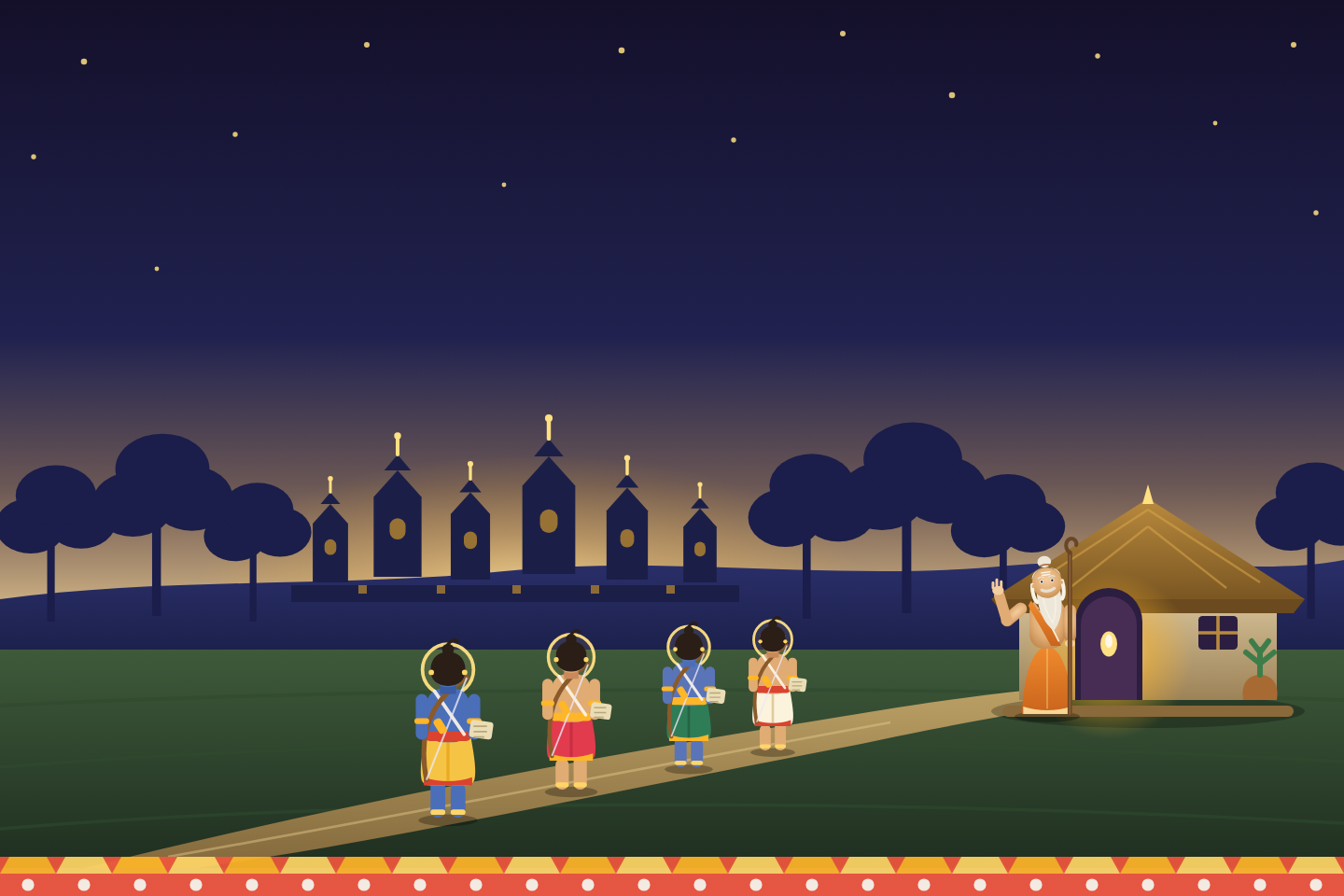
And so Lord Rāma went to his guru's house to learn. In a very short time, Gosvāmī Tulsīdās says, he had mastered every branch of knowledge. Then the poet stops and laughs at the wonder of it. The four Vedas — the oldest and holiest books in the world — are the Lord's own natural breath. And here was Śrī Hari, walking to lessons like a schoolboy. 'What a great fun,' says the poet, 'that he should go to school!'
Gosvāmī Tulsīdās
Four little kings
The brothers were quick learners — and just as good at good manners. Gosvāmī Tulsīdās says they were skilled in learning and perfect in politeness, virtue and gentle behaviour. When they played, they played at being kings, each with a bow and arrow in his hands, and they looked so lovely that the whole world, living and unliving, was charmed. Whenever the four of them went running down a street at their games, every man and woman there would stop quite still just to look at them. The people of Ayodhyā — men and women, old folk and children — all held the gracious Lord Rāma dearer than life itself.
Gosvāmī Tulsīdās
An ordinary day
Here is what an ordinary day looked like. Lord Rāma would call his brothers and his friends and go out with them to the forest, and show the king what they had brought home. He ate his meals with his younger brothers and his companions. He did whatever his mother and father asked of him, and he was always finding ways to make the people of the city happy. He listened to the Vedas and the Purāṇas with his whole attention — and then he would sit down and explain them to his younger brothers, so that they understood too.
Gosvāmī Tulsīdās
Before the sun was up
And every morning it began the same way. Rising at the break of day, the Lord of the Raghus would bow his head to his mother, his father and his guru. Only then, with their permission, would he set about the work of the city. King Daśaratha watched his son's noble ways and was glad in his heart. Gosvāmī Tulsīdās ends the picture with a reminder of who this schoolboy really was: the Lord who is everywhere, who cannot be divided, who wants for nothing, who was never born and has no name or form — doing all these wonderful things, the poet says, for the sake of the people who love him.
Gosvāmī Tulsīdās
✦ Two tellings, one story
Sage Vālmīki’s Rāmāyaṇa (Sanskrit)
Sage Vālmīki gives the boyhood of the princes in just a handful of verses at the end of the canto that tells of their birth. All four, he says, grew up to be masters of the Vedas, great heroes, wise, virtuous and devoted to the service of their parents, and all of them were well trained in archery. Lord Rāma shone brightest of them all. From his earliest days Lakṣmaṇa was devoted to his eldest brother: without him Lord Rāma would not sleep a wink, nor eat a fine dish brought to him, and when Lord Rāma rode out to the forest Lakṣmaṇa followed close behind with his bow, guarding him on every side. Śatrughna, in the same way, was dearer to Bharata than his own life. King Daśaratha was as happy with his four sons as Brahmā is with the four guardians of the quarters. There is no scene of a guru's house or a schoolroom in Sage Vālmīki's telling.
Gosvāmī Tulsīdās’s Rāmcaritmānas (Awadhi)
The lively, homely details all belong to Gosvāmī Tulsīdās: the toddler running from dinner with curds on his mouth, the sacred thread given by guru and parents, Lord Rāma going to his guru's house and the poet's delighted 'what a great fun that Śrī Hari should go to school', the games of kings with a bow in every hand, the townsfolk standing still to watch, the meals with brothers and friends, the explaining of the Vedas to the younger boys, and the daily bow to parents and guru before the day's work. Tulsīdās frames the whole passage with a reminder that the one doing all this is the Lord beyond name and form, who acts this way for love of his devotees.
What this story teaches
Even the greatest went to school
The Vedas are the Lord's own breath — and still he walked to his teacher's house and learned his lessons. Nobody is too great to be a student.
The day begins with a bow
Before the city's work, before anything else, Lord Rāma bowed to his mother, his father and his guru, and asked their leave. Respect first; everything else after.
What you learn, pass on
Lord Rāma did not keep the Vedas and Purāṇas to himself. He listened carefully, and then explained them to his younger brothers. Learning is finished when it is shared.
Words to know
- janeū (जनेऊ) · The sacred thread, worn over the shoulder, that a boy receives in a ceremony when he is ready to begin his studies.
- guru (गुरु) · A teacher; in the old days a student would go to live and learn at the guru's house.
- Vedas (वेद) · The four oldest sacred books of India, learned by heart and chanted; Tulsīdās calls them the Lord's own breath.
- Purāṇas (पुराण) · The great collections of ancient stories about the gods, kings and sages.
- Śāradā (शारदा) · Another name of Sarasvatī, the goddess of learning and music.
- Śeṣa (शेष) · The thousand-headed serpent on whom Lord Viṣṇu rests, famous for his endless telling of the Lord's glories.
Rāmcaritmānas — Bāl-kāṇḍa (the Lord's childhood games, the sacred thread, Lord Rāma's schooling at his guru's house, the brothers' games of kings, and the daily round from the morning bow to the city's work: the caupāīs after dohā 203 through dohā 205). Vālmīki Rāmāyaṇa — Bāla Kāṇḍa (the princes' upbringing, their mastery of the Vedas and archery, and Lakṣmaṇa's devotion to Lord Rāma, at the end of Canto 18).