Kids · उत्तरकाण्ड Uttar-kāṇḍa · Ages 8–12
The Four Sages Who Looked Like Children
Today's story steps back a few pages. In the Rāmcaritmānas it happens just before the day Bharata asked his great question under the trees — you may remember that story ended with four sages leaving for Brahmā's abode. This is who those four sages were, and what happened when they arrived.
Gosvāmī Tulsīdās tells it in the Uttar-kāṇḍa, in the happy years when Lord Rāma ruled Ayodhyā. It is a short story, and a quiet one. Nobody fights anyone. But in it a king bows to the ground before four children, and when you find out why, you may want to bow too.
A walk in the blossoming grove
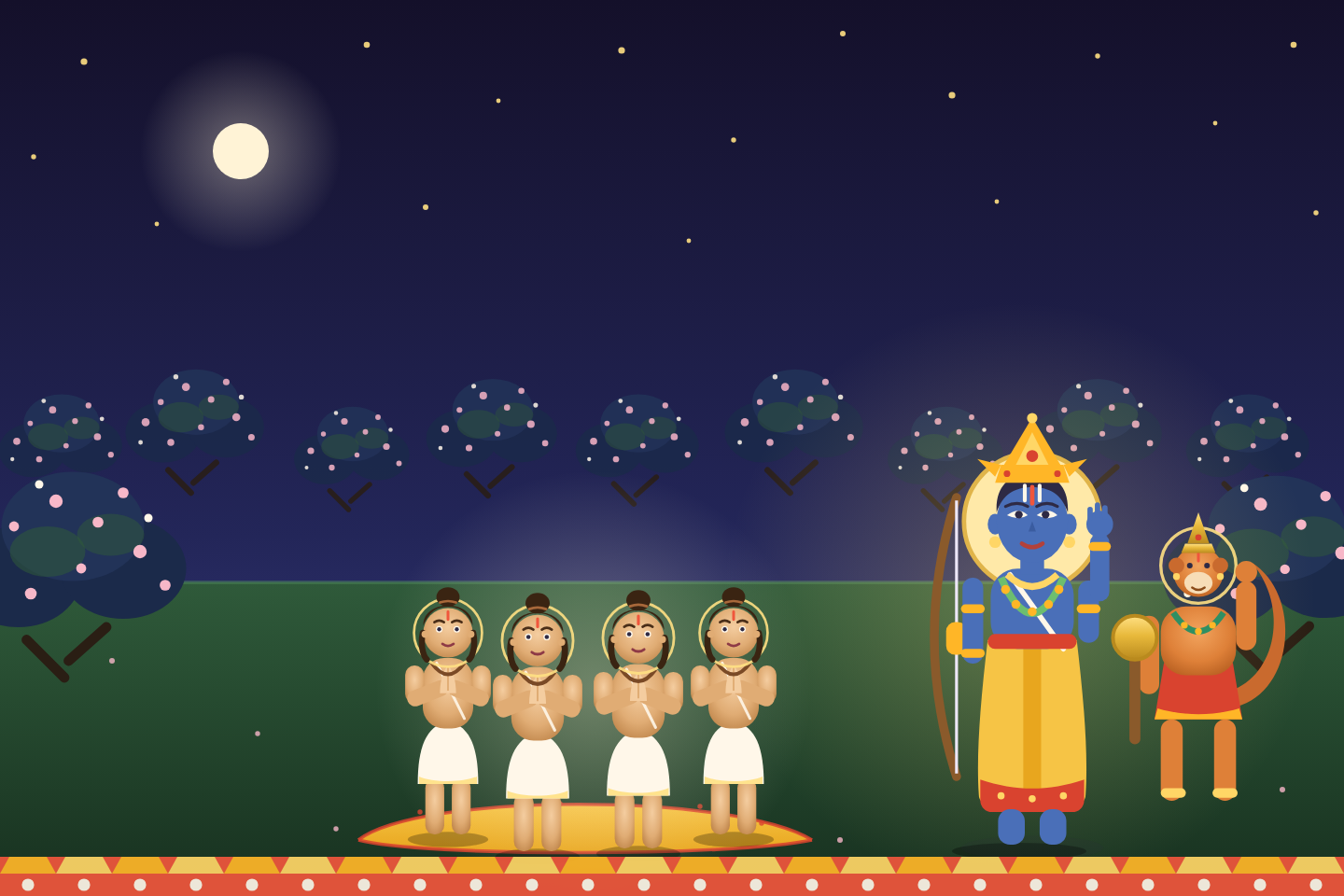
One day Lord Rāma went out with his brothers — Bharata, Lakṣmaṇa and Śatrughna — and with Hanumān Jī, whom he loved best of all, to see a beautiful grove. Every tree in it was in blossom and had put on new leaves. It was the kind of morning when nobody is in a hurry, and the Lord walked among the trees simply to enjoy them.
Gosvāmī Tulsīdās
Four visitors older than the world
Then four visitors came walking into the grove, and they looked like little boys. They were not little boys. They were Sanaka and his three brothers — Sanandana, Sanātana and Sanatkumāra — the very first children of Brahmā, the Creator, and so the eldest beings in all of creation. Though they looked like children, they were older than the mountains. They shone with a steady inner light. They looked on every creature with exactly the same eye, as if the four Vedas themselves had each taken a body and come for a walk. They owned nothing and wore nothing but the open sky — the four directions, the Mānas says, were their only clothing. And they had one single hobby in all the world: wherever the story of Lord Rāma was being told, they went there to listen. They had just come from the hermitage of Sage Agastya, who had been telling them story after story of the Lord, the way two sticks rubbed together make fire.
Gosvāmī Tulsīdās
The king who bowed first
Lord Rāma saw the four sages coming — and the king of Ayodhyā lay down flat on the ground before them, full of joy, the way you bow to someone far greater than yourself. He asked after their health. Then he took off his own yellow scarf and spread it on the grass for them to sit on. Bharata, Lakṣmaṇa and Śatrughna bowed down too, and so did Hanumān Jī, and everyone was glad. The sages, for their part, could not take their eyes off the Lord. They gazed and gazed at his dark, lotus-eyed form without blinking once, lost in happiness, while the Lord stood before them with his palms joined and his head bowed. When he saw the state they were in, tears ran from his eyes too. He took them by the hand and seated them, and spoke to them in the kindest words: 'Listen, great sages — today I am truly blessed. The mere sight of you wipes away all wrongs. Only by great good fortune does anyone come into the company of the holy — and in that company the long chain of births and deaths is broken without the least effort.'
Gosvāmī Tulsīdās
The hymn of the four
The four sages were so happy to hear the Lord's words that every hair on their bodies stood on end, and they began to sing his praises. 'Glory to the Lord who is endless, who is one and also many, who is full of mercy! Glory to the ocean of goodness, the home of joy! You dwell in every heart — so protect us every moment. Break the knots of joy-and-sorrow, hot-and-cold, that tie us up. Live in our hearts, O Rāma, and take away our wanting and our pride.' And then they asked for the one gift they had come for. Not riches, not power, not a kingdom. 'Give us unending love and devotion for you, O Lord of the Raghus — the kind that carries a person across the river of this world like a boat. You are the boatman,' they sang, 'and you are the boat.'
Gosvāmī Tulsīdās
Home to Brahmā's abode
Again and again the four sages praised the Lord, and then they bowed their heads with love. They had received the very boon their hearts most wished for, and they set off for Brahmā's abode, which is their home. Lord Rāma's brothers watched them go, and then all three of them turned and looked at Hanumān Jī — because Bharata had a question he was too shy to ask. But that, as you know, is a story we have already told.
Gosvāmī Tulsīdās
✦ Two tellings, one story
Sage Vālmīki’s Rāmāyaṇa (Sanskrit)
Sage Vālmīki does not tell this visit. In the Uttara Kāṇḍa of his Rāmāyaṇa, the years of Lord Rāma's reign are filled with other guests and other stories — the sages who come to Ayodhyā after the war, the long tales of Rāvaṇa's past, the dog who came to court, the great horse-sacrifice. Sanaka and his brothers do not walk into a grove in Sage Vālmīki's telling, and we have not invented a scene for them there.
Gosvāmī Tulsīdās’s Rāmcaritmānas (Awadhi)
In the Uttar-kāṇḍa of the Rāmcaritmānas, Lord Śiva tells Pārvatī how Lord Rāma went with his brothers and Hanumān Jī to see a blossoming grove, and how Sanaka, Sanandana, Sanātana and Sanatkumāra arrived — embodiments of spiritual glow, infants to look at but aeons old, seeing all with the same eye, like the four Vedas in bodily form, with the four directions as their only covering and the hearing of the Lord's story as their only pastime; they had been staying with Sage Agastya, who told them many tales of the Lord. Lord Rāma prostrated himself before them, asked after their welfare and spread his own yellow scarf for them to sit on; his brothers and Hanumān Jī bowed too. The sages gazed at him unblinking; the Lord bowed with joined palms and wept to see their love, seated them by the hand and said that he was blessed that day, that their very sight wipes out all sins, and that the company of saints breaks the chain of birth and death. The four sang a long hymn and asked for unceasing love and devotion; having received the boon they most wished for, they returned to Brahmā's abode — and the three brothers turned to Hanumān Jī, which is where the story of Bharata's question begins.
What this story teaches
The greatest bowed first
Lord Rāma was the king of the whole land, and he lay down on the ground before four visitors who looked like small boys. True greatness is never too proud to bow. The people who are really great are usually the first to honour someone else.
Do not judge by size
The four sages looked like children, and they were older than the world. Age, size and fine clothes tell you almost nothing about who someone really is. Lord Rāma looked past all of them in an instant — and so can you.
Ask for the thing that lasts
The eldest beings in creation could have asked the Lord for anything. They asked for love and devotion — the one gift that never runs out. When you get a wish, it is worth thinking about what will still matter in a year.
Words to know
- Sanaka and his brothers · Sanaka, Sanandana, Sanātana and Sanatkumāra — the four eldest sages, the first children of Brahmā, who always look like young boys
- Brahmā · the Creator of the world; the four sages are his first children and live in his abode
- the four Vedas · the most ancient holy books of India; the Mānas says the four sages looked as if the Vedas themselves had taken bodies
- Sage Agastya · the great sage of the south, in whose hermitage the four sages had been staying and listening to stories of Lord Rāma
- pīta paṭa · the yellow scarf Lord Rāma wore — he spread his own on the ground for the sages to sit on
- satsaṅga · the company of good and holy people; Lord Rāma told the sages that this company breaks the chain of births and deaths without any effort
Told from Gosvāmī Tulsīdās's Rāmcaritmānas — Uttar-kāṇḍa (the visit of Sanaka and his brothers to Lord Rāma in the blossoming grove, their hymn and their boon). Sage Vālmīki's Rāmāyaṇa — Uttara Kāṇḍa — does not tell this visit.