Kids · लङ्काकाण्ड Laṅkā Kāṇḍa · Ages 8–12
The Friend at the River Who Was Not Forgotten
Fourteen years is a long time. Fourteen years ago, when Lord Rāma, Mother Sītā and Lakṣmaṇa were setting out for the forest, they came to the bank of the river Gaṅgā. A forest chief named Guha, the leader of the Niṣāda people, came hurrying to welcome them with everything he had. That story is told in 'The Boatman's Dearest Fare'.
Now the war is won. The golden sky-chariot Puṣpaka has carried the Lord and all his friends almost the whole way home. A king coming home in triumph has a thousand things to think about — and this is the story of one thing Lord Rāma thought about. Sage Vālmīki and Gosvāmī Tulsīdās both tell it, but not in the same way. In one telling a message is carried to the friend. In the other, the Lord comes himself. Listen for whose telling is whose.
A kind thought, high in the air
Sage Vālmīki tells it like this. The sky-chariot was still in the air, and the Lord could see Ayodhyā, just before coming down at the hermitage of Sage Bharadvāja. And what was on his mind? He was wondering how to do something kind for his friends and for the people of Ayodhyā. He thought for a while. Then he turned to Hanumān Jī. 'Go quickly to Ayodhyā,' he said. 'But go first to Śṛṅgaverapura, and give my news to Guha, the chief of the Niṣādas, who lives in the woods. Guha will be so glad to hear that I am safe and well and free from worry. He is my friend — as dear to me as my own self. He will be pleased, and he will show you the road to Ayodhyā and tell you how Bharata is.'
Sage Vālmīki
Hanumān Jī carries the news
Hanumān Jī took the form of a man and sprang into the sky, as swift as Garuḍa, the king of birds. He crossed the place where the Gaṅgā and the Yamunā meet, came to Śṛṅgaverapura, and found Guha. Hanumān Jī was full of joy, and he spoke in a sweet voice. 'Your friend Lord Rāma, with Mother Sītā and Lakṣmaṇa, asks whether all is well with you. He is spending the night with Sage Bharadvāja, as the sage wished. When the sage gives him leave, you will see him — here, at this very place.' Imagine hearing that, after fourteen years! Sage Vālmīki does not tell us what Guha said. What do you think you would have said? And Hanumān Jī did not stop to rest. Tired or not, he leapt up and sped on towards Bharata, the hairs on his body standing on end for joy — glad, Sage Vālmīki says, to be of some little service to the Lord.
Sage Vālmīki
'The boat! Where is the boat?'
Gosvāmī Tulsīdās tells it differently. In the Mānas no message goes to Guha. The Lord visits Sage Bharadvāja, bows at the sage's feet with joined palms, and boards the sky-chariot once more. Meanwhile, at the river, Guha hears that the Lord has come. 'The boat!' he cries. 'Where is the boat?' — and he calls his people together. Fourteen years ago the Lord had crossed this river in a boat. But this time no boat was needed. The golden sky-chariot flew across the Gaṅgā and, at the Lord's word, came down on the bank.
Gosvāmī Tulsīdās
A prayer answered at the water's edge
Then Mother Sītā went to the river. Long ago, on the way to the forest, she had joined her palms beside this same river and prayed: 'Mother, grant my wish — let me come back with my husband and his younger brother, and worship you.' And the river had answered that she would come safely home. Now here she was. So Mother Sītā worshipped Mother Gaṅgā in many ways, and bowed at her feet. And Mother Gaṅgā, glad at heart, gave her a blessing.
Gosvāmī Tulsīdās
Held as close as a brother
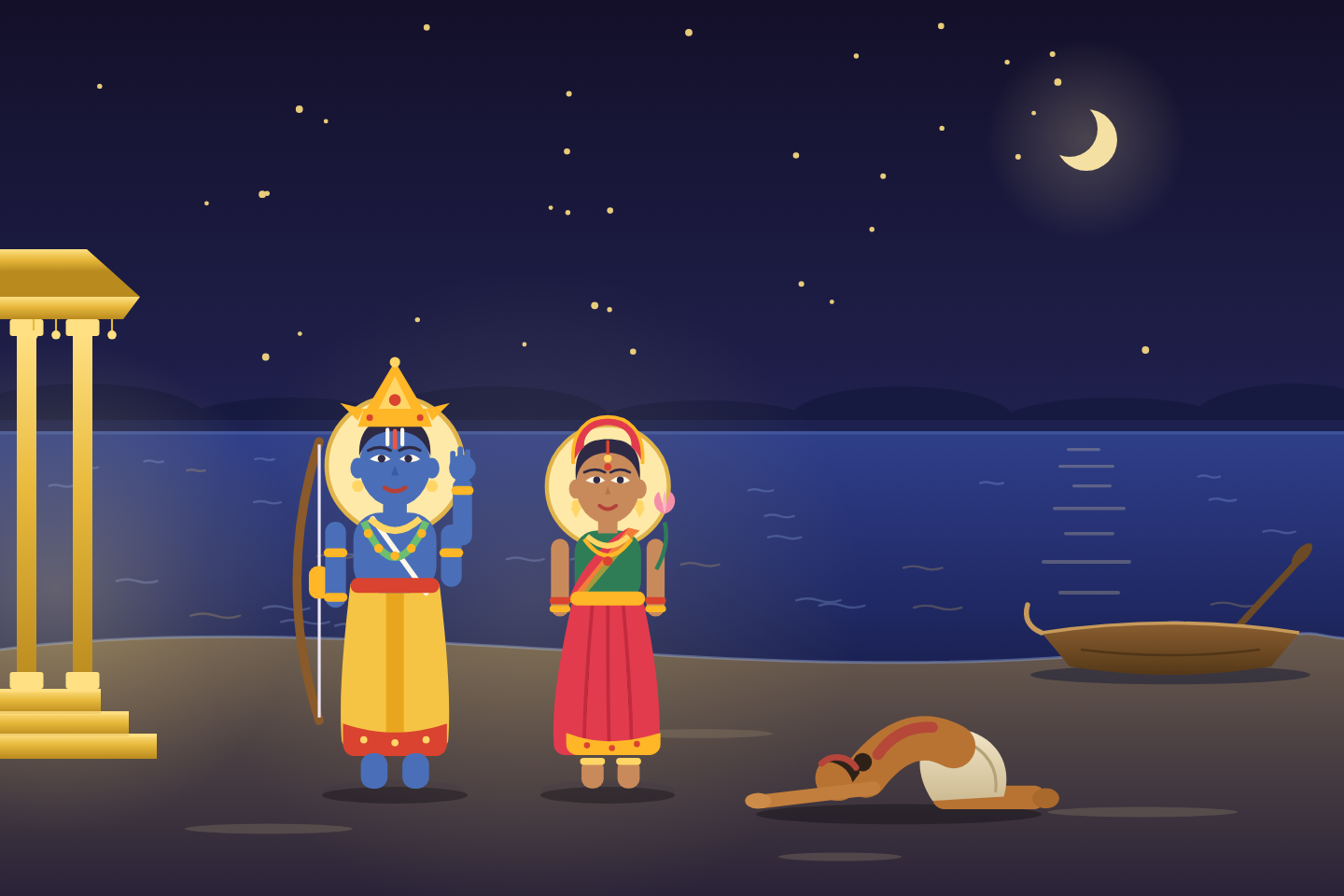
And then Guha came running, so full of love that he could hardly bear it. He saw the Lord, with Mother Sītā beside him — and he fell flat on the ground, forgetting himself completely. Lord Rāma saw how much his friend loved him, and he was overjoyed. He lifted Guha up and held him to his heart. He sat him down very close beside him and asked if all was well with him. 'Now all is well with me,' said Guha, 'for I have seen your lotus feet.' Here Gosvāmī Tulsīdās stops to wonder at it. Guha was a simple chief of the forest people, a man the world of that time did not count as great. And the Lord held him to his heart as if he were Bharata himself — his own brother.
Gosvāmī Tulsīdās
One friend, remembered twice
So which was it — a message, or a meeting? Sage Vālmīki tells of the message, and Gosvāmī Tulsīdās tells of the meeting. But look at what is the same. The Lord was coming home in triumph, with kings for companions and a golden sky-chariot to ride in — and he did not forget the friend who had welcomed him when he was setting out with nothing. In one telling he calls Guha 'as dear to me as my own self'. In the other he holds him like a brother. From here the road runs on to Ayodhyā, where Bharata is waiting — and that is told in 'The Lamps of Ayodhyā'.
In both Rāmāyaṇas
✦ Two tellings, one story
Sage Vālmīki’s Rāmāyaṇa (Sanskrit)
Sage Vālmīki tells this in his Yuddha Kāṇḍa. While the Puṣpaka is still in the air and Ayodhyā is in sight, before the landing at Sage Bharadvāja's hermitage, the Lord considers how to do a kindness to his friends and to the people of Ayodhyā. After reflecting for a while he tells Hanumān Jī to hurry to Ayodhyā, but to go first to Śṛṅgaverapura and give his news to Guha, the lord of the Niṣādas, who lives in the woods. Guha, he says, will be delighted to hear that he is safe and well and free from anxiety, for Guha is his friend, as dear as his own self; and Guha, pleased, will show the way to Ayodhyā and give news of Bharata. Hanumān Jī takes a human form and flies swiftly — Sage Vālmīki compares him to Garuḍa — crosses the confluence of the Gaṅgā and the Yamunā at Prayāga, reaches Śṛṅgaverapura, and joyfully, in a sweet voice, tells Guha that his friend Lord Rāma, with Mother Sītā and Lakṣmaṇa, asks after his welfare, and that Guha will see the Lord at that very place when Sage Bharadvāja, with whom the Lord is spending the night at the sage's wish, gives him leave to go. Then, not minding his tiredness, the hairs of his body standing on end with joy at being of some little service to the Lord, Hanumān Jī speeds on to Bharata. In this telling the story follows Hanumān Jī: Sage Vālmīki does not give Guha's reply here.
Gosvāmī Tulsīdās’s Rāmcaritmānas (Awadhi)
Gosvāmī Tulsīdās tells it at the very end of his Laṅkā Kāṇḍa. Here no message is sent to Guha: Hanumān Jī is sent ahead, in the form of a young student, to Bharata. The Lord visits Sage Bharadvāja, who worships, praises and blesses him; he bows at the sage's feet with joined palms and boards the sky-chariot again. Meanwhile Guha hears that the Lord has come and, crying 'The boat! Where is the boat?', calls his people. The sky-chariot crosses the Gaṅgā and comes down on the bank at the Lord's command. Mother Sītā worships the Gaṅgā in many ways and bows at her feet, and the Gaṅgā, glad at heart, blesses her. (In the Ayodhyā Kāṇḍa of the Mānas, on the way to the forest, she had prayed to the Gaṅgā with joined palms that she might return with her husband and his younger brother and worship her, and the river had answered that she would return safely.) Guha, overwhelmed with love, runs to the Lord; seeing him with Mother Sītā, he falls to the ground, unaware of his own body. The Lord, overjoyed at such love, lifts him and holds him to his heart, seats him very close and asks after his welfare. Guha answers that all is well now that he has seen the Lord's lotus feet. Gosvāmī Tulsīdās adds, in his own voice, that the Lord held this Niṣāda to his heart as he would Bharata. This meeting is the last scene of his Laṅkā Kāṇḍa.
What this story teaches
Remember who was kind when you had nothing
Guha welcomed the Lord at the start of the exile, when there was nothing to gain by it. Fourteen years later, coming home a victor, the Lord thought of him before he reached his own door. When good things come to you, think back: who was kind to you when things were hard?
Carry good news to those who worried
In Sage Vālmīki's telling, the news that the Lord is safe and well is carried to a forest chief by a river even before it reaches the prince waiting near Ayodhyā. Good news is a gift — take it early to the people who cared.
Go back and say thank you
Mother Sītā had prayed at this river that she might come home safely and worship her. When the prayer came true, she did not hurry past. She stopped, worshipped and bowed. When something you hoped for comes true, go back and give thanks.
Words to know
- Guha · the chief of the Niṣādas, who lived beside the Gaṅgā — Lord Rāma's dear friend
- Niṣāda · the people of the forest and the river whom Guha led
- Śṛṅgaverapura · Guha's town on the bank of the Gaṅgā
- Puṣpaka · the great golden sky-chariot (vimāna) that carried everyone home
- Prayāga · the holy place where the rivers Gaṅgā and Yamunā meet
- lotus feet · a loving, respectful way of speaking of the Lord's feet
A true episode from the journey home, told in both Vālmīki Rāmāyaṇa — Yuddha Kāṇḍa — and Rāmcaritmānas — Laṅkā Kāṇḍa. The Lord's kind thought while still in the air, the message sent with Hanumān Jī first to Guha at Śṛṅgaverapura, 'my friend, as dear as my own self', Hanumān Jī's human form and Garuḍa-like speed, the crossing at Prayāga, his glad words to Guha, and his joy at being of some little service are Sage Vālmīki's. Guha's cry for the boat, the sky-chariot coming down on the bank of the Gaṅgā, Mother Sītā's worship of the Gaṅgā and the river's blessing, Guha running to the Lord and falling to the ground, the Lord lifting him and holding him to his heart, Guha's answer about the Lord's lotus feet, and the comparison with Bharata are Gosvāmī Tulsīdās's; Mother Sītā's earlier prayer to the Gaṅgā is from Rāmcaritmānas — Ayodhyā Kāṇḍa. The Lord's remembering Guha on the way home, and his visit to Sage Bharadvāja, are in both tellings.