Kids · किष्किन्धाकाण्ड Kiṣkindhā Kāṇḍa · Ages 8–12
The Garland and the Arrow
By the campfire on Ṛṣyamūka mountain, Sugrīva has told his sad story, and Lord Rāma has made his promise: one arrow will end Vāli's tyranny. Sugrīva has seen that arrow pass through seven mighty trees. Now the promise must be kept.
But keeping it will not be simple. For Vāli and Sugrīva are brothers — and brothers, as you will see, can look very much alike.
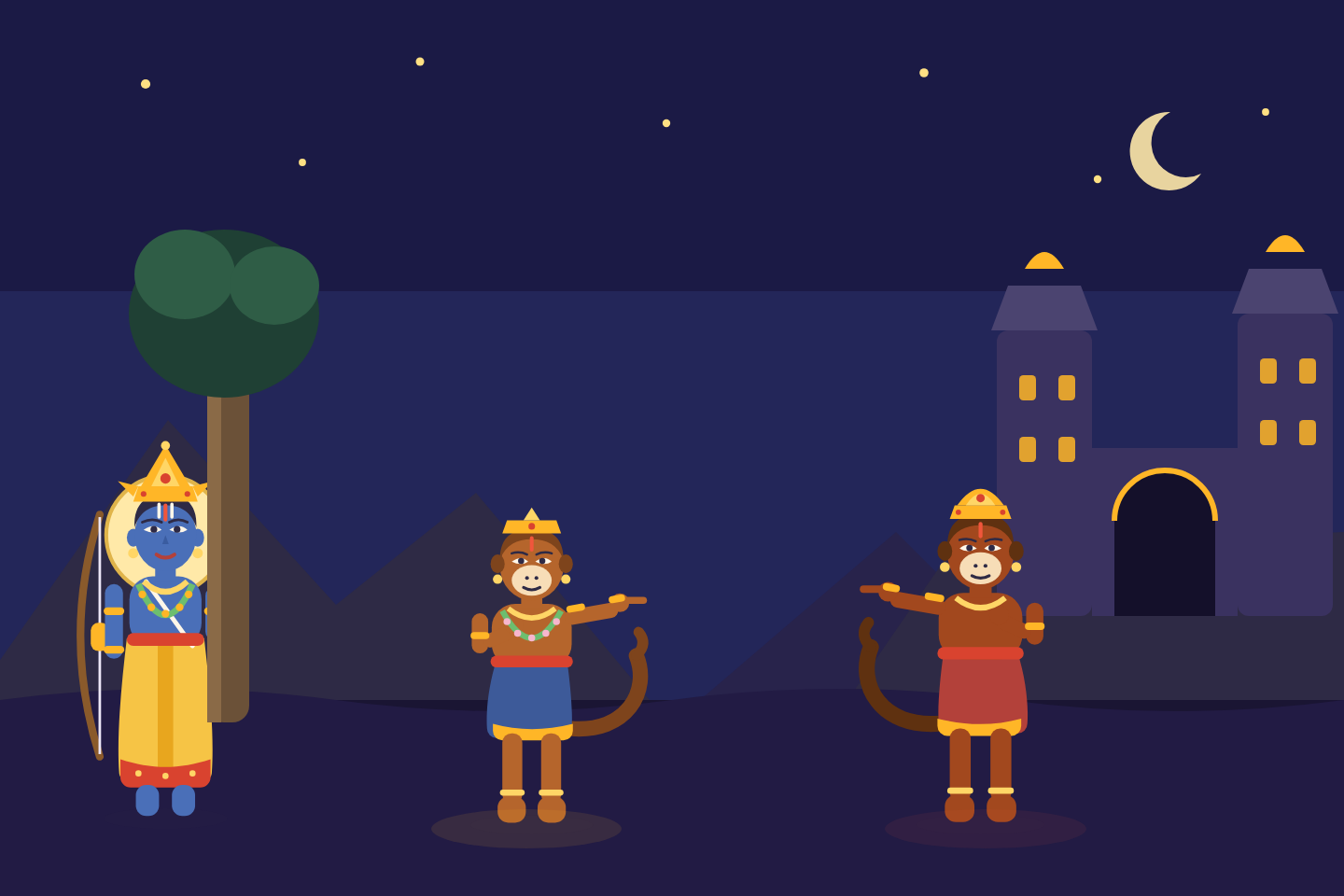
Two brothers, one face
Sugrīva marched to the gates of Kiṣkindhā and roared out his challenge. Out stormed mighty Vāli, and the two brothers grappled and struck like two storms colliding. But no arrow came from the trees — and battered Sugrīva barely escaped back to Ṛṣyamūka. "My friend, why did you not shoot?" he cried. Lord Rāma answered gently: "You two are so alike, I could not tell brother from brother. I dared not loose my arrow at the wrong heart."
In both Rāmāyaṇas
A garland of forest flowers
So a garland of fresh forest flowers was hung around Sugrīva's neck — a simple, bright mark, so that this time there could be no mistake. His courage came flooding back, and his aching body felt strong as thunder. Wearing his garland like a second sunrise, Sugrīva walked back to the gates of Kiṣkindhā and called his brother out once more.
In both Rāmāyaṇas
The queen's warning
Inside the palace, Vāli's wise queen Tārā caught his feet. "My lord, do not go," she begged. "The princes who stand with Sugrīva are Lord Rāma and Lakṣmaṇa — they can conquer Death himself in battle." Vāli's answer was the strangest, bravest thing. "Listen, my timid darling," he said. "The Lord of the Raghus looks upon all with the same eye. And if he should slay me — why then, I shall go to him, and be blessed." And out he went.
In both Rāmāyaṇas
The arrow and the question
The brothers fought again, fierce and thunderous. But this time Lord Rāma could tell them apart — and when Sugrīva began to lose heart, one arrow flew from the trees and found Vāli's proud chest. The great king fell — then sat up, and saw before him the dark-bodied Lord with his bow. Vāli's heart filled with love, but his words came out proud: "You took birth to protect dharma, Gosāīṁ — and you struck me from hiding, like a hunter! What was my fault?" And the Lord did not grow angry at the question. He answered it, gently and honestly: Vāli had taken what was never his to take, crushed the brother who had come under Lord Rāma's protection, and closed his ears to every loving warning.
In both Rāmāyaṇas
A father's last gift
Hearing Vāli's softening words, Lord Rāma touched the dying king's head with his own hand. "Let me make your body whole," he said. "Live." But Vāli, his eyes full, would not trade what he could now see. "Sages strive lifetime after lifetime," he whispered, "and here you stand before my own eyes." With his last strength he placed the hand of his young son Aṅgada into Lord Rāma's hand. Then he let his body go — as easily as an elephant lets a flower garland slip from its neck. Gentle wisdom dried Queen Tārā's tears; Sugrīva was crowned king of Kiṣkindhā; and brave Aṅgada was made yuvarāja, the prince beside him.
In both Rāmāyaṇas
✦ Two tellings, one story
Sage Vālmīki’s Rāmāyaṇa (Sanskrit)
Sage Vālmīki tells the duel in rich detail. In the first fight the brothers look so alike that Lord Rāma dares not shoot, and Sugrīva is badly beaten; it is Lakṣmaṇa who then ties the flowering gajapuṣpī creeper around Sugrīva's neck as his mark. The fallen Vāli questions Lord Rāma long and sharply, like a lawyer in court, and the Lord answers him point by point until the great king accepts the answer, asks forgiveness, and commends Aṅgada to his care. Tārā's lament and Sugrīva's grand coronation close the episode.
Gosvāmī Tulsīdās’s Rāmcaritmānas (Awadhi)
Gosvāmī Tulsīdās tells it swiftly and tenderly. The flower garland is placed around Sugrīva's neck and he is sent back with great strength given to him. Tārā's warning draws from Vāli that astonishing answer — the Lord looks on all with an equal eye; even if he slays me, I am blessed. Struck by the arrow, Vāli knows the Lord at once: his heart is full of love though his words stay proud. And when Lord Rāma offers to make his body whole again, Vāli refuses with a smile in his tears — who would cut down a wish-fulfilling tree to plant a fence of thorns? — and passes with his eyes on the Lord's face, as gently as a garland slipping from an elephant's neck.
What this story teaches
Ask your hardest question
Vāli asked the Lord himself, "Why?" — and was answered with patience, not anger. When something feels unfair, it is never wrong to ask honestly and listen to the whole answer.
Love takes care to tell things apart
One small garland of flowers prevented a terrible mistake. When feelings run high and two things look alike — two sides, two stories — pause and be very sure before you act.
How you end things matters
Vāli spent his last strength not on anger but on trust: he placed his son's hand in Lord Rāma's. Even a quarrel that went too far can still end in peace.
Words to know
- vānara · the noble forest people of Kiṣkindhā, mighty and brave
- sumana-mālā · a garland of fresh flowers
- samadarśī · one who looks upon all with an equal eye
- yuvarāja · the crown prince, next in line to the king
- Aṅgada · Vāli's brave young son, made prince of Kiṣkindhā
This story is told in the Vālmīki Rāmāyaṇa — Kiṣkindhā Kāṇḍa (the duel and farewell cantos) and in the Rāmcaritmānas — Kiṣkindhā-kāṇḍa (the passage around dohās 7–11).