Kids · अरण्यकाण्ड Araṇya Kāṇḍa · Ages 8–12
The Giant Who Pointed the Way
Brave Jaṭāyu has flown on to the heavens, and the little clearing where Lord Rāma performed his funeral rites with his own hands lies far behind. Now the two brothers walk south and west through forest darker than any they have known — trees packed so close the sun forgets the ground, thorns that catch at their bows, and no path, no friend, and no news of Mother Sītā anywhere.
The forest they are entering holds one more terrible surprise. But the Rāmāyaṇa loves to hide its kindest turns inside its most frightening shapes — and the worst thing in these woods is about to become the person who shows them the way to everything.
The forest with no answers
After Jaṭāyu's farewell, Lord Rāma and Lakṣmaṇa searched on through the great wilderness. Sage Vālmīki tells how they left the fearsome Krauñca forest behind and pressed into woods deep as a cave, dark even at midday. Every shadow was questioned, every glade searched. But the forest kept its silence, and nowhere was there a trace of Mother Sītā.
In both Rāmāyaṇas
Caught!
Then the trees ahead simply ended — and two arms longer than rivers swept out of the gloom and closed around the brothers like great gates. They belonged to Kabandha: a giant with no head at all, one huge blazing eye set in his chest, and a mouth in his belly. Even Lakṣmaṇa's heart sank. But Lord Rāma stayed calm, and the brothers acted as one: with their swords they cut the mighty arms, Lord Rāma the right and Lakṣmaṇa the left — and the giant came down like a falling hill.
Sage Vālmīki
The story under the monster
And then the strangest thing: the fallen giant sounded glad. "Who are you, heroes?" he asked — and when he heard the name Rāma, his gladness overflowed. He told them his story: long ago he had been a splendid heavenly being, until his pride earned him an old sage's curse and this dreadful shape. The curse came with one promise — it would end only on the day Lord Rāma himself cut off those arms. "I have waited so long," he said. "Give my body to the fire, and I will help you as no one else in this forest can."
In both Rāmāyaṇas
The fire that set him free
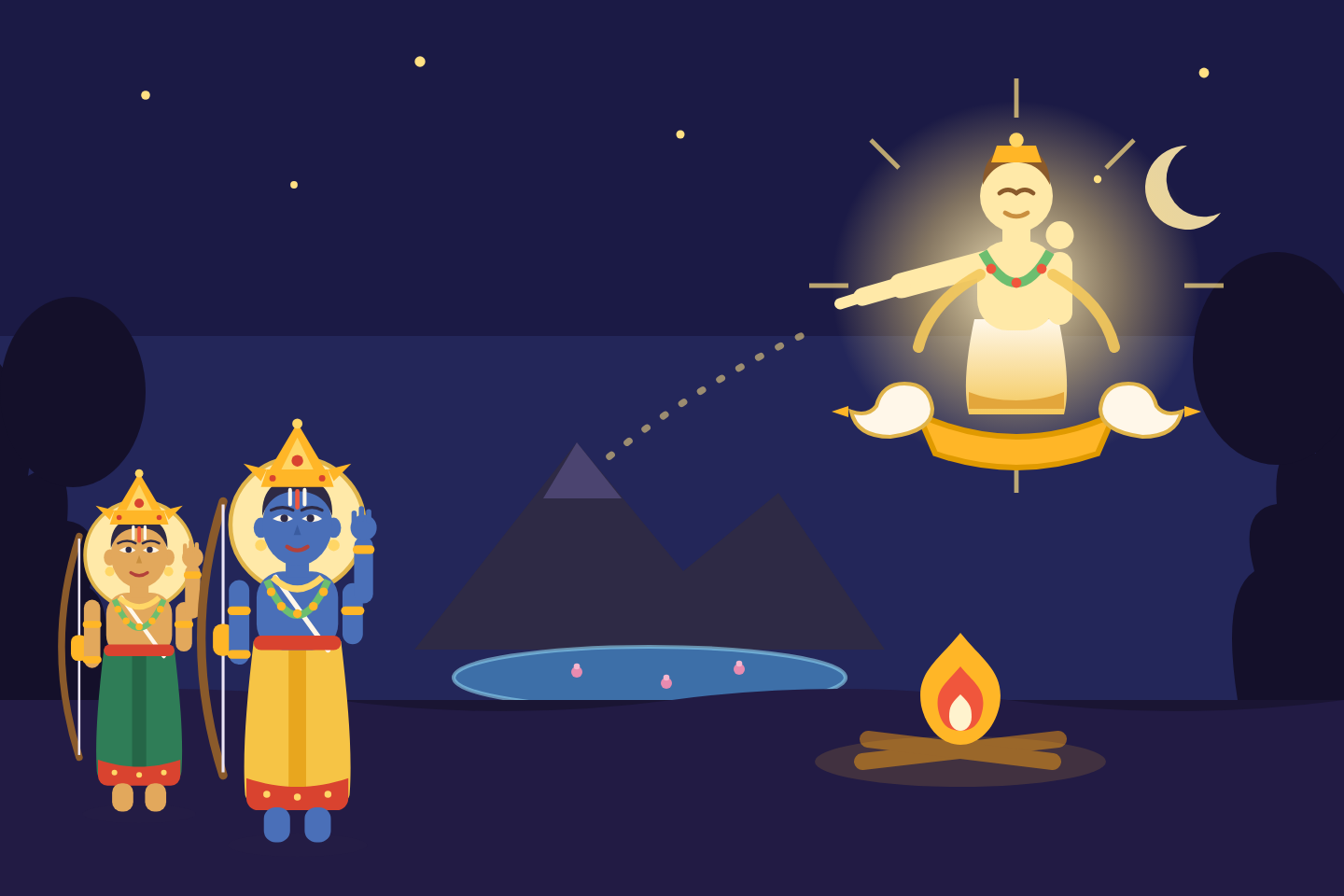
The brothers built the pyre and lit it, and the flames wrapped the giant like a blanket over a long bad dream. Then out of the fire rose someone new — a shining being in spotless garments and a garland of light, riding a bright chariot drawn by swans. The monster was gone. The gandharva, free at last, looked down at the two princes with a heart full of thanks.
Sage Vālmīki
The friend he pointed to
"Listen, Lord Rāma," said the shining one, "for those in deep trouble, the best helper is a friend who knows trouble too." And he stretched out his hand toward the far hills. "There lives a vānara king named Sugrīva, driven out by his own brother, hiding on Mount Ṛṣyamūka by the lotus lake Pampā. Make him your friend — he will search the whole world for Mother Sītā. And on your way, visit the hermitage of Śabarī, who has waited her whole life to meet you." Then he bowed and rose into the sky — the giant who could not find his own way for a thousand years, now pointing the way for the Lord of the worlds.
Sage Vālmīki
✦ Two tellings, one story
Sage Vālmīki’s Rāmāyaṇa (Sanskrit)
Sage Vālmīki tells the episode in full, over several cantos: Kabandha's huge arms seizing both brothers, the counsel between them and the severing of the arms — Lord Rāma the right, Lakṣmaṇa the left; the giant's account of the sage Sthūlaśirā's curse and of Indra's thunderbolt, which drove his head and legs into his trunk and left him his monstrous shape; the cremation the giant himself asks for; his rising in shining form on a swan-drawn chariot; and his counsel — seek Sugrīva at Ṛṣyamūka by Lake Pampā, and visit Śabarī's hermitage on the way.
Gosvāmī Tulsīdās’s Rāmcaritmānas (Awadhi)
Gosvāmī Tulsīdās tells the meeting in a few luminous lines: Lord Rāma slays Kabandha on the path, and the freed gandharva tells how Sage Durvāsā's curse had bound him — a curse erased the moment he beheld the Lord. Lord Rāma teaches him reverence for the wise, and the gandharva bows at his feet and rises to heaven in his own true form. In the Mānas it is Śabarī, a little further down the road, who points the brothers on toward Sugrīva.
What this story teaches
No shape is forever
Kabandha wore his worst day for a thousand years — and it still was not the end of his story. However stuck things look, the curse is not the last chapter.
Even the lost can point the way
Kabandha could not save himself, yet the moment he was free, the first thing he did was help someone else find their road. You don't have to be finished with your own troubles to be a light in someone else's.
Seek friends who know the road
His advice to Lord Rāma is advice for everyone: when you are in deep trouble, the best friend is one who has known trouble too. Kindness that has suffered understands.
Words to know
- Kabandha · the headless giant of the forest; his name means "trunk" or "barrel"
- gandharva · a radiant heavenly being, famed for music and beauty
- śāpa · a curse spoken by a sage — powerful, but never without an ending
- Ṛṣyamūka · the mountain where Sugrīva hid from his brother
- Pampā · the beautiful lotus lake at the foot of Ṛṣyamūka
- vānara · the noble forest people who became Lord Rāma's great allies
This story is told in full in Sage Vālmīki's Rāmāyaṇa — Araṇya Kāṇḍa (the Kabandha cantos), and remembered briefly in Gosvāmī Tulsīdās's Rāmcaritmānas — Araṇya-kāṇḍa, each in its own way.