Kids · बालकाण्ड Bāl-kāṇḍa · Ages 8–12
The King and Queen Who Asked for the Lord as Their Son
Today's story goes back to the very beginning — before Ayodhyā had a king called Daśaratha, before anyone had heard the name Rāma. In the Rāmcaritmānas, Lord Śiva is telling Mother Pārvatī why the Lord of all the worlds chose to be born as a human prince. 'Listen,' he says, 'to another reason' — and he tells her about a king and a queen who wanted him so much that they gave away everything else.
Gosvāmī Tulsīdās tells it in his Bāl-kāṇḍa. There is no battle in it and no demon. There is a forest, a river, two people growing thinner and thinner, and a voice from the sky. And at the end there is a promise — the promise that made the whole Rāmāyaṇa possible.
The first king feels his life slipping away
The very first of all kings was Svāyambhuva Manu, and his queen was Śatarūpā. The human race itself began from these two, and the way they lived was so good that the Vedas still sing of it. Manu ruled for a very long time and did everything the Lord's commandments asked of a king. But one day, when he was old, a sad thought came to him. 'I have reached the last part of my life,' he said to himself, 'and I am still sitting in my palace, still fond of all its comforts — and I have not yet given my heart to Śrī Hari. My whole life has gone by without him.' That thought hurt him more than anything a king could lose.
Gosvāmī Tulsīdās
The forest by the river
So Manu did something no one expected. He placed the crown on his son's head — he would hear no argument about it — and he and Queen Śatarūpā walked out of the palace and away to the forest. They went to Naimiṣa, the holiest of holy places, where sages and perfected ones lived under the trees. As the king and queen walked along the road, firm and calm, they looked like Wisdom and Devotion themselves come down to walk the earth. They reached the river Gomatī and bathed in its clear water. The sages came out to meet them, and took them to every holy spot, and every day the two of them sat among the saints and listened to the ancient stories.
Gosvāmī Tulsīdās
Water, then air, then nothing at all
They wore hermits' robes now, and their bodies grew thin. Over and over they repeated the twelve-lettered prayer to Lord Vāsudeva, and their minds were fixed on his lotus feet. At first they ate only leaves and fruits and roots. Then, to win the Lord's sight, they gave up even those, and lived on water alone — for six thousand years. Then for seven thousand years they lived on air alone. Then for ten thousand years they did not even breathe, but stood on one leg. Brahmā, Viṣṇu and Śiva themselves came to them again and again, saying 'Ask for a boon!' — but the king and queen would not be moved. Their bodies were nothing but bones; yet there was no pain in their hearts, because their hearts wanted only one thing: to see, with their own eyes, the Lord the Vedas can only describe by saying 'not this, not this'.
Gosvāmī Tulsīdās
The voice from the sky
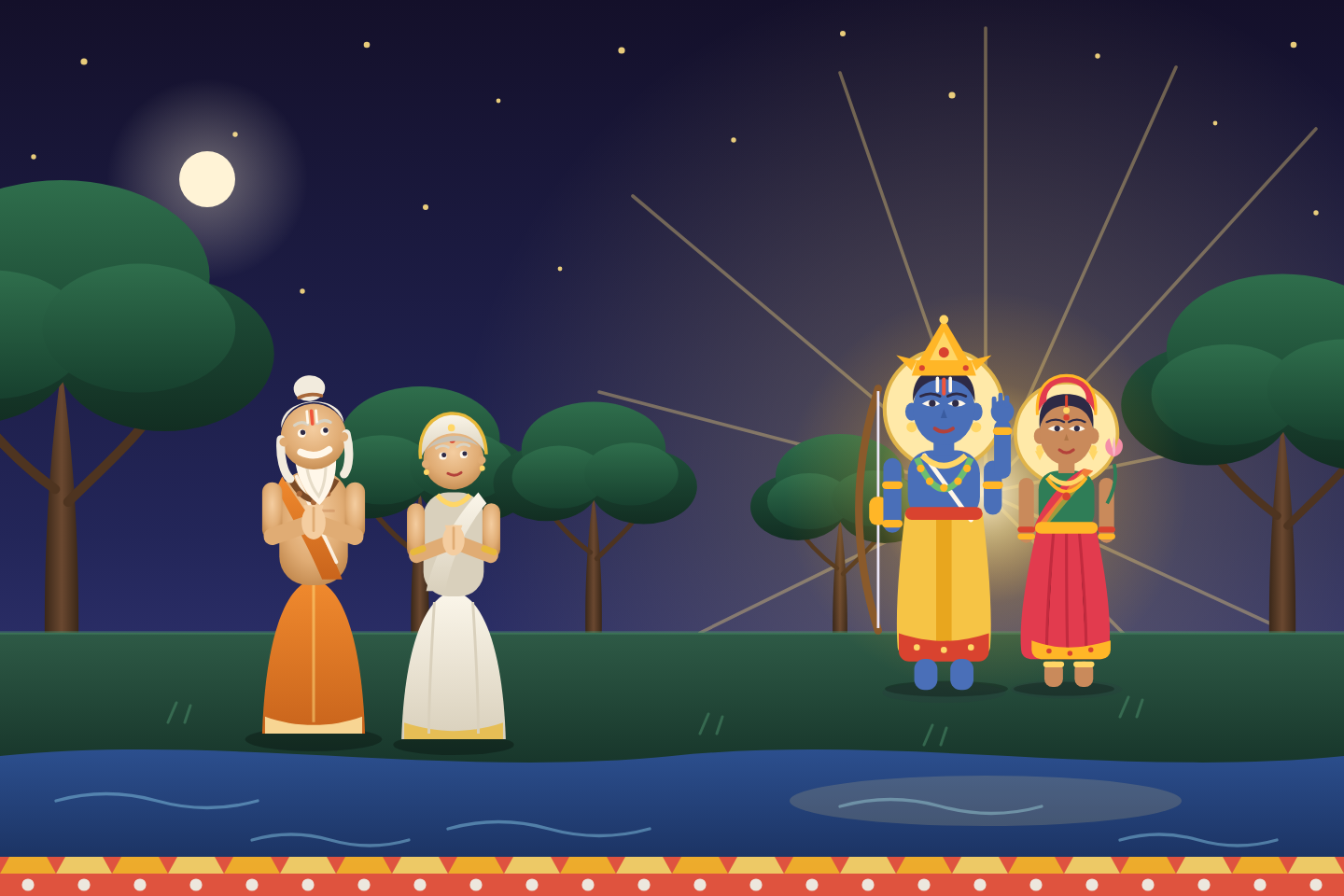
Then a deep voice rolled across the heavens: 'Ask! Ask for a boon!' It was so full of compassion that it could have brought the dead to life. As it entered their ears and reached their hearts, their worn-out bodies became strong and beautiful again, as if they had just stepped out of their own front door. Manu fell to the ground in prostration and spoke, his heart overflowing: 'Lord, you are a wish-giving tree to your servants. If you have any love for us, grant us this: let us see, with our eyes, the form that lives in Lord Śiva's heart, the form the sages search for.' And the Lord, who loves his devotees, appeared before them — dark as a blue lotus, as a sapphire, as a rain-cloud, with a crown on his head and a bow and arrow in his hands, and on his left side Mother Sītā, the mother of the universe. Manu and Śatarūpā gazed and gazed, and could not get enough of looking. Then they fell at his feet, and the Lord lifted them up with his own lotus hands.
Gosvāmī Tulsīdās
The one thing left to ask
'I am very pleased with you,' said the Lord. 'Ask for whatever boon you like.' Manu folded his hands. 'Now that we have seen your feet, all our wishes are already fulfilled,' he said. 'But one longing is still in my heart. It is so easy for you to give — and so hard for me to ask. I feel like a poor man who has found a wish-giving tree and is too shy to ask it for riches.' 'Ask without fear,' said the Lord. 'There is nothing I would not give you.' And Manu said it: 'I want a son just like you.' The Lord smiled. 'So be it,' he said. 'But where shall I go to find my equal? I myself will be your son.' Then he turned to the queen. Śatarūpā asked only for what the Lord's own devotees have — the same joy, the same love for his feet. 'Granted,' said the Lord. 'Mother, your wisdom will never fail.' And Manu asked one thing more: 'Let me love your feet the way a father loves his son — even if people call me a fool for it. As a snake cannot live without its jewel, and a fish cannot live without water, let my life depend on you.' Holding the Lord's feet, he would not let go until the Lord said, 'So be it.'
Gosvāmī Tulsīdās
The promise that never, never fails
'Now go and live for a while in the city of Indra, king of the gods,' the Lord told them. 'After some time you will be born as the king of Ayodhyā — and then, dear father, I will be your son. I will take a human form and be born in your house, and Mother Sītā will come too, and I will do deeds that bring joy to my devotees. This promise of mine shall never, never, never fail.' He said it three times — and then he vanished. The king and queen stayed on in the hermitage a little longer, with the Lord's picture in their hearts. And when the time came they left their bodies without the smallest pain and went to Amarāvatī, the city of the immortals, to wait for their promise to come true. 'That is the sacred story Śiva told Umā,' says Gosvāmī Tulsīdās — and then, 'now hear yet another reason why Śrī Rāma was born.'
Gosvāmī Tulsīdās
✦ Two tellings, one story
Sage Vālmīki’s Rāmāyaṇa (Sanskrit)
Sage Vālmīki does not tell the story of King Manu and Queen Śatarūpā at all. In his Bāla Kāṇḍa, Lord Rāma's birth comes about in a different way: King Daśaratha of Ayodhyā, longing for sons, has the sage Ṛṣyaśṛṅga perform a great sacrifice; in the middle of that sacrifice the gods come to Brahmā and beg for an end to Rāvaṇa, and Lord Viṣṇu agrees to be born as Daśaratha's son; then a shining being rises from the sacrificial fire carrying a golden vessel of divine pāyasa, which the king gives to his queens. Sage Vālmīki also knows Manu as the first of the line of kings from which Daśaratha and Lord Rāma descend — but the forest, the long penance and the boon are not in his telling.
Gosvāmī Tulsīdās’s Rāmcaritmānas (Awadhi)
This is Gosvāmī Tulsīdās's story, and his alone. In the Rāmcaritmānas Lord Śiva gives Mother Pārvatī several reasons, one after another, why the Lord took birth as a man, and this is one of them: Manu and Śatarūpā hand their kingdom to their son, go to Naimiṣa, bathe in the Gomatī, live on fruits, then water, then air, then nothing at all, refuse every boon the gods offer, and are rewarded with the sight of the Lord himself — crowned, with bow and arrow, Mother Sītā at his left. Manu asks for a son like him; the Lord answers that there is none like him, so he will be the son himself; Śatarūpā asks for his devotees' love; and the Lord promises, three times over, that they will be born as the king and queen of Ayodhyā and that he will be their child. Tulsīdās then goes straight on to the next reason.
What this story teaches
Give away what you have, and ask for what matters
Manu had a whole kingdom, and he felt his life had been wasted because he had not given his heart to the Lord. When he finally asked for a boon, he did not ask for his kingdom back. He asked for the one thing a kingdom could not give him.
The best things are worth the long wait
Water for six thousand years, air for seven thousand, nothing at all for ten thousand — and still the king and queen did not stop. The gods themselves tried to hurry them with easier gifts, and they said no. Sometimes the only way to get what you really want is to keep going long after everyone expects you to give up.
A promise kept is the beginning of a story
'Never, never, never shall this fail,' the Lord said — and the whole Rāmāyaṇa is him keeping his word. When you promise something to someone who loves you, you are starting a story too. Keep it the way he did.
Words to know
- Svāyambhuva Manu · the first of all kings, from whom the human race began; his queen was Śatarūpā
- Naimiṣa · a famous holy forest where sages lived; the king and queen did their penance there
- Gomatī · the river that flows past Naimiṣa, where Manu and Śatarūpā bathed
- tapa · penance — giving up comforts and even food to win something far greater
- boon · a gift or wish granted by a god; the king and queen refused every one except the Lord himself
- Amarāvatī · the city of Indra, king of the gods, where the couple waited to be born again
- Vāsudeva · a name of the Lord, Śrī Viṣṇu, whose twelve-lettered prayer the king and queen repeated
Rāmcaritmānas — Bāl-kāṇḍa (Lord Śiva's account to Mother Pārvatī of King Manu and Queen Śatarūpā, dohās 141–152). Vālmīki Rāmāyaṇa — Bāla Kāṇḍa (Ṛṣyaśṛṅga's sacrifice for King Daśaratha and the gods' prayer to Lord Viṣṇu, for the 'Two tellings' comparison). Told for ages 8–12; where the tellings differ, each is given as it stands.