Kids · उत्तरकाण्ड Uttara Kāṇḍa · Ages 8–12
The King of Birds Who Went to Listen to a Crow
Do you remember Garuḍa? He is the king of all the birds, the one who carries Lord Viṣṇu on his back. In 'The Serpent-Arrows and the Coming of Garuḍa' he flew to the battlefield before Laṅkā and freed Lord Rāma and Lakṣmaṇa from the snake-arrows. Every serpent in the world is afraid of him. You might think that someone so strong and so wise would never be puzzled by anything.
But he was. This story comes from Gosvāmī Tulsīdās, who tells it near the end of his Rāmcaritmānas. In his poem Lord Śiva is telling it to Mother Pārvatī, who has asked a very good question: why would the great king of birds leave all the wise sages and go to hear Lord Rāma's story from a crow? Sage Vālmīki does not tell this story at all — so today we are listening to one poet only.
The question that would not go away
When Garuḍa had freed the Lord and flown away, he should have been happy. Instead a heavy sadness came over him, and one thought went round and round in his head. 'They say he is the Lord of everything, come down into the world. People are set free just by saying his name. Then how could a small rākṣasa tie him up with snakes? I saw none of his glory.' He tried every way he knew to settle his own mind. It did not work. The more he thought, the more muddled he became.
Gosvāmī Tulsīdās
Three doors
So he did a brave thing: he went and asked. First he flew to the sage Nārada and told him his doubt. Nārada felt very sorry for him. 'The Lord's māyā is powerful,' he said. 'It has fooled even me, many times. My words will not clear this quickly. Go to Brahmā, and do what he tells you.' Brahmā, the Creator, bowed his head to Lord Rāma and thought to himself, 'That same power has often made a puppet of me. No wonder it has puzzled the king of birds.' Then he said kindly, 'Dear child, Lord Śiva knows Lord Rāma's glory. Go to him. That is where your doubts will be cleared.'
Gosvāmī Tulsīdās
'You have met me on the road'
Garuḍa found Lord Śiva on the road, on his way to visit Kubera. He bowed at his feet and told him everything. Lord Śiva answered lovingly. 'Garuḍa, you have met me on the way — how can I teach you here? Doubts like this go only when you stay a long time in the company of good people and listen to the Lord's story. I will send you where it is told every day. In the north there is a beautiful blue mountain called Nīlagiri. A gentle, wise old crow named Kākabhuśuṇḍi lives there. He never stops telling Lord Rāma's story, and noble birds of every kind come to listen. Go and listen too.' Garuḍa bowed and flew off with joy. Afterwards Lord Śiva told Mother Pārvatī why he had not taught Garuḍa himself. Perhaps, he said, Garuḍa had once felt proud, and the kind Lord wished to cure him of it. And besides — a bird understands best the language of a bird.
Gosvāmī Tulsīdās
The blue mountain
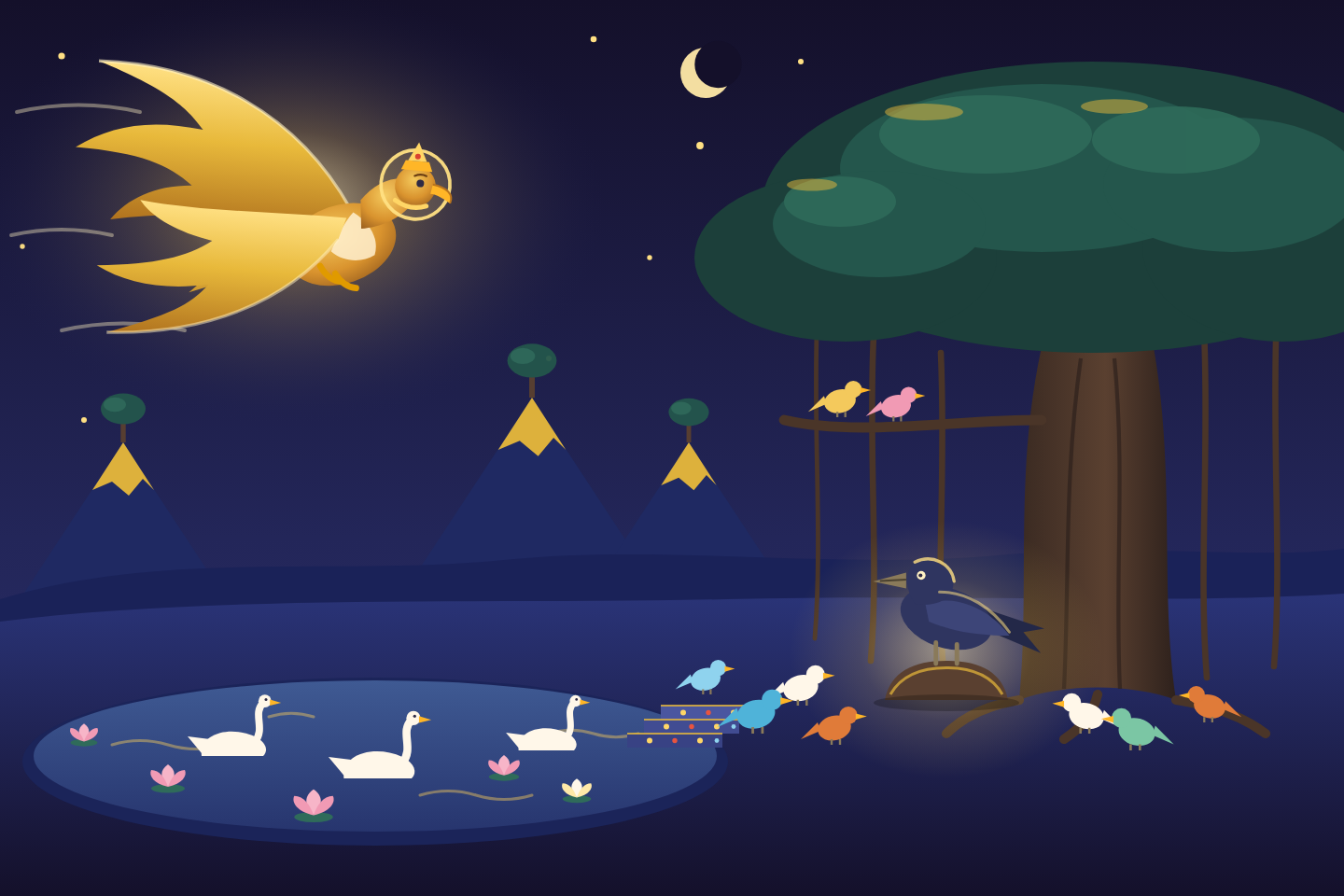
The mountain stands far away in the north. It has four golden peaks, and on each peak grows one great tree: a banyan, a peepul, a plakṣa fig and a mango. At the top is a lake with jewelled steps, cool sweet water, lotuses of many colours, and swans. The old crow has a place for everything. Under the peepul he meditates. Under the plakṣa he repeats the Lord's name. In the shade of the mango he worships the Lord in his heart. And under the banyan he tells the story, while the birds flock round. Lord Śiva knew the place well: he had once taken the form of a swan and stayed there a while, just to listen. The moment Garuḍa saw that mountain, his heart grew glad, and his worry and confusion left him. He bathed in the lake, drank its water, and went to the banyan tree.
Gosvāmī Tulsīdās
The best seat for the guest
Old birds of every kind had gathered, and Kākabhuśuṇḍi was just about to begin when the king of birds arrived. Everyone was delighted. The crow welcomed him with the greatest respect, asked if he was well, and led him to a high seat. 'My lord, I am blessed to see you,' he said sweetly. 'Tell me what you would like me to do. Why have you come?' And Garuḍa answered gently, 'What I came for is already done. The moment I saw your holy home, my doubt and confusion left me. Now, dear one, please tell me the story of Lord Rāma. I ask you again and again.'
Gosvāmī Tulsīdās
'I am glad I was puzzled'
So the crow told it — all of it, from the Lord's birth and his childhood games to the forest, the bridge across the sea, the war and the crown. Garuḍa listened to every word. When it was finished he said, 'My doubt is gone, and by your kindness my heart is full of love for the Lord's feet. I am even glad that I was puzzled. Only someone who has been scorched by the sun knows how good the shade of a tree is. If I had never been confused, how would I ever have met you?' The old crow's eyes filled with tears of joy. 'My lord,' he said, 'I do not think you were truly confused at all. The Lord sent you here as a kindness to me.'
Gosvāmī Tulsīdās
✦ Two tellings, one story
Sage Vālmīki’s Rāmāyaṇa (Sanskrit)
Sage Vālmīki does not tell this story. In his Yuddha Kāṇḍa, Garuḍa comes to the battlefield before Laṅkā, the serpent-arrows flee at the sight of him, he heals Lord Rāma and Lakṣmaṇa with his touch, calls himself the Lord's dear friend, and flies away — that is told in 'The Serpent-Arrows and the Coming of Garuḍa'. Sage Vālmīki says nothing of a doubt afterwards, of the blue mountain, or of the crow Kākabhuśuṇḍi. So there are not two tellings to set side by side today, and we have not made one up.
Gosvāmī Tulsīdās’s Rāmcaritmānas (Awadhi)
Gosvāmī Tulsīdās tells it in his Uttar Kāṇḍa, as part of what Lord Śiva tells Mother Pārvatī. After cutting the Lord's bonds, Garuḍa is seized by a great sadness: how could the all-pervading Lord, whose name frees people from the bonds of the world, be tied by a rākṣasa with coils of snakes? He cannot settle his own mind. He goes to the sage Nārada, who pities him, says the Lord's māyā has fooled him too many a time, and sends him to Brahmā. Brahmā bows to Lord Rāma, reflects that the same power has often made a puppet of him, and sends Garuḍa to Lord Śiva. Lord Śiva, met on the road to Kubera's home, says that doubts are fully cleared only by long company with the good and by listening to the Lord's story, and sends him north to Nīlagiri, where the gentle and wise Kākabhuśuṇḍi tells that story without ceasing to birds of every kind. Lord Śiva explains to Mother Pārvatī that Garuḍa must once have felt proud and the merciful Lord wished to cure him, and that a bird follows best the language of a bird. The mountain has four golden peaks with a banyan, a peepul, a plakṣa and a mango, and a lake with jewelled steps; Lord Śiva himself once listened there in the form of a swan. At the sight of the mountain Garuḍa's delusion and anxiety leave him. He bathes, drinks, and goes to the banyan. The crow receives him with the utmost reverence, seats him on a high seat and tells the whole of Lord Rāma's story. Garuḍa says his doubts are gone, that he now counts his confusion a blessing — only one scorched by the sun knows the worth of a shady tree — and the crow, with tears of joy, replies that the Lord sent him only to do the crow a kindness.
What this story teaches
Asking is a brave thing to do
Garuḍa was the king of birds, and he still went and said, 'I do not understand.' He asked at three doors. Being strong or clever does not mean you never have questions. It means you are brave enough to ask them.
A teacher can come in a humble shape
The king of birds sat down to learn from a crow, and the crow gave the king the best seat. Each honoured the other. You can learn from someone smaller, plainer or younger than you — if you are willing to sit and listen.
A puzzle can turn into a present
Garuḍa said he was glad he had been confused, because his question led him to the blue mountain and to a new friend. When you are stuck on something hard, it may be taking you somewhere good.
Words to know
- Garuḍa · the king of birds, who carries Lord Viṣṇu; every serpent in the world is afraid of him
- Kākabhuśuṇḍi · a gentle, wise and very old crow who lives on the blue mountain and never tires of telling Lord Rāma's story; 'kāka' means crow
- Nīlagiri · 'the blue mountain' — far away in the north, with four golden peaks and a lake at the top
- Nārada · the wandering divine sage, always singing the Lord's praises; the first one Garuḍa asked
- māyā · the Lord's own wonderful power, which can make even the wise see things wrongly for a while
- satsaṅg · keeping company with good people and listening to the Lord's story — Lord Śiva says this is what clears doubts
A true episode from Rāmcaritmānas — Uttar Kāṇḍa, where Lord Śiva tells it to Mother Pārvatī. Garuḍa's sadness and his question after freeing the Lord, his visits to the sage Nārada, to Brahmā and to Lord Śiva, Lord Śiva's reasons for sending him on, the blue mountain with its four peaks, four trees and lake, the old crow's welcome, the telling of the whole story, Garuḍa's thanks and the crow's reply are all Gosvāmī Tulsīdās's. Sage Vālmīki does not tell this episode; in Vālmīki Rāmāyaṇa — Yuddha Kāṇḍa he tells of Garuḍa's coming to the battlefield and no more. Retold for young readers.