Kids · उत्तरकाण्ड Uttar-kāṇḍa · Ages 8–12
The King Who Said 'Correct Me'
Have you ever had a teacher, or a parent, or a coach say: 'If I get this wrong, tell me'? It is a surprising thing to hear from someone in charge. It is even more surprising from a king — and most surprising of all from the Lord himself.
Gosvāmī Tulsīdās tells this story near the end of the Rāmcaritmānas, in the happy years when Lord Rāma was king of Ayodhyā and the whole land was at peace. Sage Vālmīki does not tell this one, and we will say so at the end. This is the Tulsīdās telling.
The whole city is invited
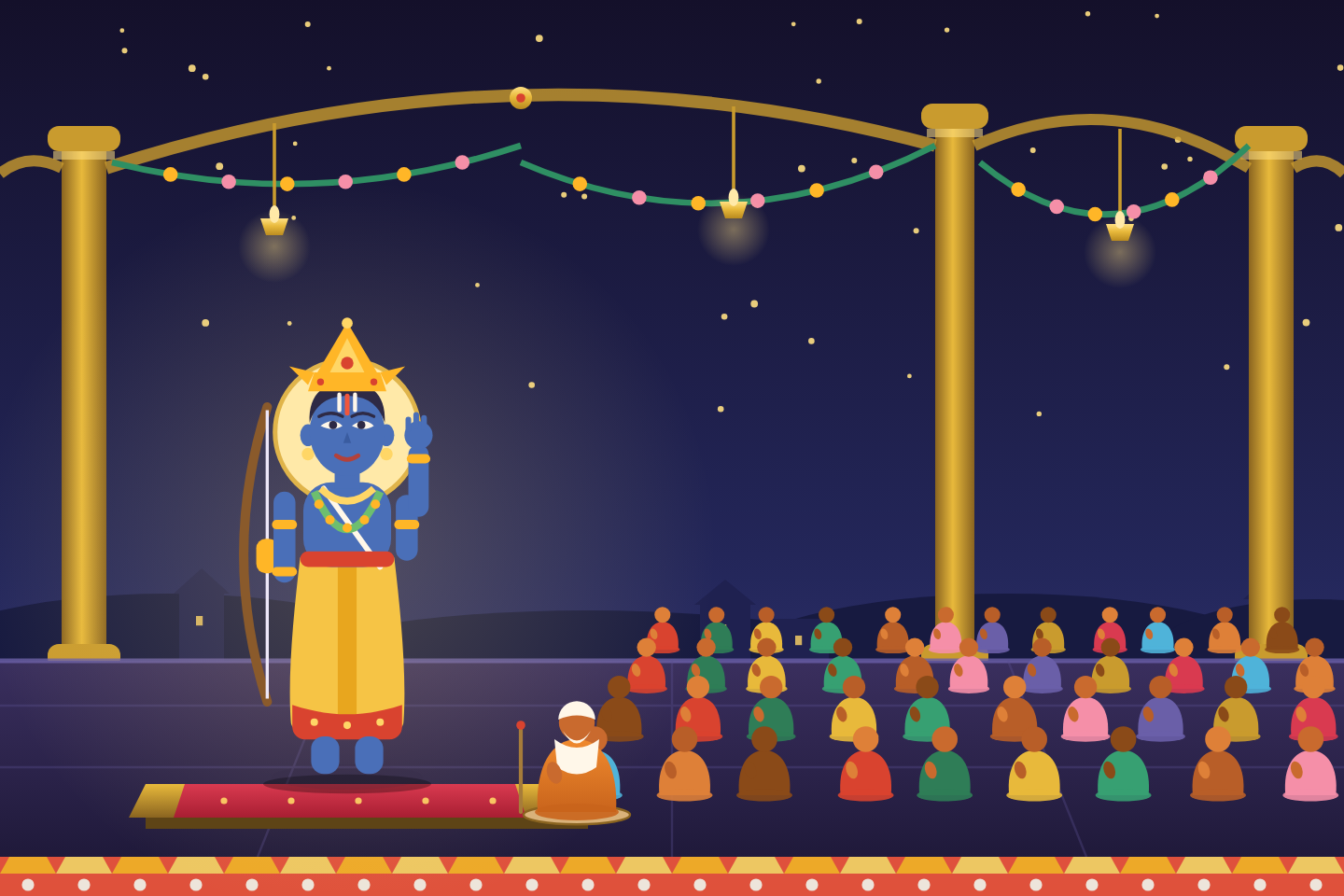
One day Lord Rāma sent out an invitation. Not only to his ministers, and not only to the great — to everyone. His guru, Sage Vasiṣṭha, came. The learned Brāhmaṇas came. And the people of the city came too: shopkeepers and farmers, grandmothers and children, anyone who lived in Ayodhyā. When the guru, the sages, the learned and all the good people had found their places and sat down, the Lord — who frees his devotees from the long round of birth and death — began to speak.
Gosvāmī Tulsīdās
'Only if it pleases you'
'Listen to my words, people of my city,' he said. 'I am not saying this out of attachment. Nothing I ask of you is wrong, and I am not using my power as your king. So listen — and then do as pleases you.' Imagine a king saying that! Then he went further. 'The one who follows my word is my servant, and dearest to me of all. But if I say anything that is wrong, brothers — do not be afraid. Stop me.' Before he had taught them a single thing, he had asked their leave, and asked to be corrected.
Gosvāmī Tulsīdās
The rarest gift
'It is by great good fortune,' Lord Rāma told them, 'that you have been given a human body. Every scripture says the same: even the gods find it hard to win. It is the home of all good effort, and the doorway to freedom.' He wanted them to understand how precious it was — and how easy to waste. 'The fruit of this life is not pleasure,' he said. 'Even heaven's pleasures are small, and they end in sorrow. Someone who gets a human life and spends it chasing only pleasure is like a person who trades nectar for poison — or throws away a wishing-stone to pick up a little red berry.' Whoever wastes the gift, he said gently, is sorry later, and blames time and fate and God instead of himself.
Gosvāmī Tulsīdās
A raft, a wind and a helmsman
Then the Lord gave them a picture to carry home. 'This human body is a raft,' he said, 'for crossing the great ocean of the world. My grace is the wind at your back. A true guru is the helmsman who steers it. All of this is so hard to come by — and here it is, in your hands, made easy.' And he told them there was a simple, happy road to walk: loving devotion to him, which the Vedas and the Purāṇas have sung of forever. 'Bhakti,' he said, 'is the mine of every happiness. But no one finds it without satsaṅg — the company of the good. And the company of the good is what ends the long wandering.'
Gosvāmī Tulsīdās
The secret told with folded hands
Then the king of Ayodhyā did something kings do not do. He joined his palms to his own people. 'And one more thing, a secret, which I tell you all with folded hands: without the worship of Śaṅkara — Lord Śiva — no one gains my devotion.' Then he smiled at how simple the road really was. 'Tell me, what is hard about the path of bhakti? It needs no yoga, no great sacrifices, no endless chanting, no hard penances, no fasting. Only a simple nature, a mind with no crookedness in it, and contentment with whatever comes.' The one who lives like that, he told them, has no quarrels and no fears — and every direction is full of happiness for him.
Gosvāmī Tulsīdās
What the city said back
When they heard these words, sweet as nectar, the people did not clap or cheer. They came forward and took hold of the Lord's feet. 'You are our mother and our father,' they said. 'You are our guru and our brother, dearer to us than life. No one but you would teach us like this — even a mother and father think a little of themselves. In this whole world only two do good for no reason at all: you, and your servants.' Hearing their words, soaked in love, Lord Rāma's heart was glad. And with his leave they went home, talking all the way about the beautiful things the Lord had said. And Lord Śiva, telling this story to Mother Umā, said: blessed are the men and women of Ayodhyā, whose king is the Lord himself.
Gosvāmī Tulsīdās
✦ Two tellings, one story
Sage Vālmīki’s Rāmāyaṇa (Sanskrit)
Sage Vālmīki does not tell this story. His Uttara Kāṇḍa shows Lord Rāma ruling Ayodhyā and hearing his people — but there is no day when he calls the whole city to court, asks their leave before teaching them, invites them to correct him, and speaks of the human body as a raft with his grace for the wind and the guru for helmsman. That assembly, and that teaching, belong to Gosvāmī Tulsīdās. We have not invented a Vālmīki version of it.
Gosvāmī Tulsīdās’s Rāmcaritmānas (Awadhi)
In the Rāmcaritmānas, Uttar-kāṇḍa, Lord Rāma invites Guru Vasiṣṭha, the Brāhmaṇas and all the citizens to his court. He tells them he speaks without attachment, asks nothing wrong and uses none of his authority as king — they should act on his words only if they please, and if he says anything wrong they should not be afraid to correct him. He teaches that a human body is gained by great good fortune and is hard even for the gods to win; that it is a raft for crossing the ocean of the world, with his grace for a favourable wind and a true guru for the helmsman; that his devotion is the easy, happy road and cannot be found without the company of the good; and, with folded hands, that without the worship of Lord Śiva no one gains his devotion. The citizens reply that he is their mother, father, guru and brother, and go home glad.
What this story teaches
The wisest people ask to be corrected
Lord Rāma was king, and he was the Lord — and he still said, 'If I say anything wrong, stop me.' Asking to be corrected is not weakness. It is what the strongest and kindest leaders do.
Your life is a rare gift — don't let it drift
A human life is a raft, the Lord said, not a toy. You do not have to be grim about it; you only have to steer. Every kind, honest, brave thing you do is a stroke of the oar.
The happy road is simpler than you think
No mountains to climb: a simple heart, no crookedness, contentment, and good company. Choose your friends the way you would choose a crew for a long voyage.
Words to know
- Vasiṣṭha · the great sage who was guru — teacher and guide — to Lord Rāma and the royal family of Ayodhyā
- Brāhmaṇa · a member of the community of priests and scholars who kept and taught the scriptures
- bhakti · loving devotion to God; the 'easy, happy road' Lord Rāma told the city about
- satsaṅg · the company of good people — 'sat' means true or good, 'saṅg' means company
- Śaṅkara · a name of Lord Śiva, meaning 'the one who brings blessings'; Lord Rāma said no one gains his devotion without worshipping him
- helmsman · the person who steers a boat; in the Lord's picture, a true guru steers the raft of human life
Rāmcaritmānas — Uttar-kāṇḍa (Lord Rāma's address to the citizens of Ayodhyā, the caupāīs after dohā 42 through dohā 47). The Vālmīki Rāmāyaṇa does not tell this episode. Where the two Rāmāyaṇas differ, we tell both faithfully.