Kids · बालकाण्ड Bāla Kāṇḍa · Ages 8–12
The King Who Wanted to Go to Heaven in His Own Body
In Mithilā, Sage Śatānanda was still telling Lord Rāma and Lakṣmaṇa the long story of how King Viśvāmitra became a sage. After losing to Sage Vasiṣṭha's staff, the king had gone away to practise tapas — hard penance — for a thousand years. At the end of it Brahmā himself came and called him a royal sage. But that was not what Viśvāmitra wanted. He wanted to be a brāhmaṇa sage, like Vasiṣṭha. So he began all over again.
And while he sat in his penance, a king with a very unusual wish came walking towards him through the forest. This is the story of that king, Triśaṅku, and of the strange place in the sky where he still shines.
A king with an unusual wish
King Triśaṅku belonged to the same royal family that Lord Rāma would one day be born into — the line of Ikṣvāku, kings of Ayodhyā. Sage Vālmīki says he always spoke the truth and had his senses well under control. But he had one wish that no one had ever had before. He wanted to go to heaven alive — not after he died, like everyone else, but now, in his own body, just as he was. So he called his family priest, the great Sage Vasiṣṭha, and asked him to perform a yajña, a sacrifice, that would send him up. The sage listened. Then he said, plainly, that it could not be done.
Sage Vālmīki
The hundred angry sons
The king would not give up. He went south to where Sage Vasiṣṭha's hundred sons were living a life of penance, bowed to each one in order of age, and asked them to do what their father had refused. The sons were angry. 'Our father has already told you no,' they said. 'How dare you go behind his back? Go home to your city.' And the king said something he should not have said: 'Then I shall find another priest.' At that, in their fury, the sons cursed him. When the night passed, the king who woke up was no longer a king to look at: his fine robes had gone dark, his jewels had turned to iron, and his ministers and people, seeing him so changed, ran away and left him alone.
Sage Vālmīki
The sage who did not turn him away
Burning with sorrow day and night, but never once losing his courage, Triśaṅku walked all alone to the hermitage of Viśvāmitra. And the sage — who had every reason to dislike anything to do with Vasiṣṭha — was moved to pity the moment he saw him. 'What has brought you here, brave prince?' he asked. The king told him everything, and ended: 'I have no other shelter. Please help me.' Sage Viśvāmitra answered gently: 'Welcome to my hermitage, child. I know you to be a good man. Do not be afraid — I will protect you.' And he sent his followers out in every direction to call the sages of all the lands to a great sacrifice. Most of them came. But Sage Vasiṣṭha's hundred sons, and a sage named Mahodaya, refused, and mocked the idea of a sacrifice led by a kṣatriya for a cursed king. Sage Viśvāmitra's anger at them was terrible — and the other sages, seeing it, hurried to begin.
Sage Vālmīki
'If my penance is worth anything — rise!'
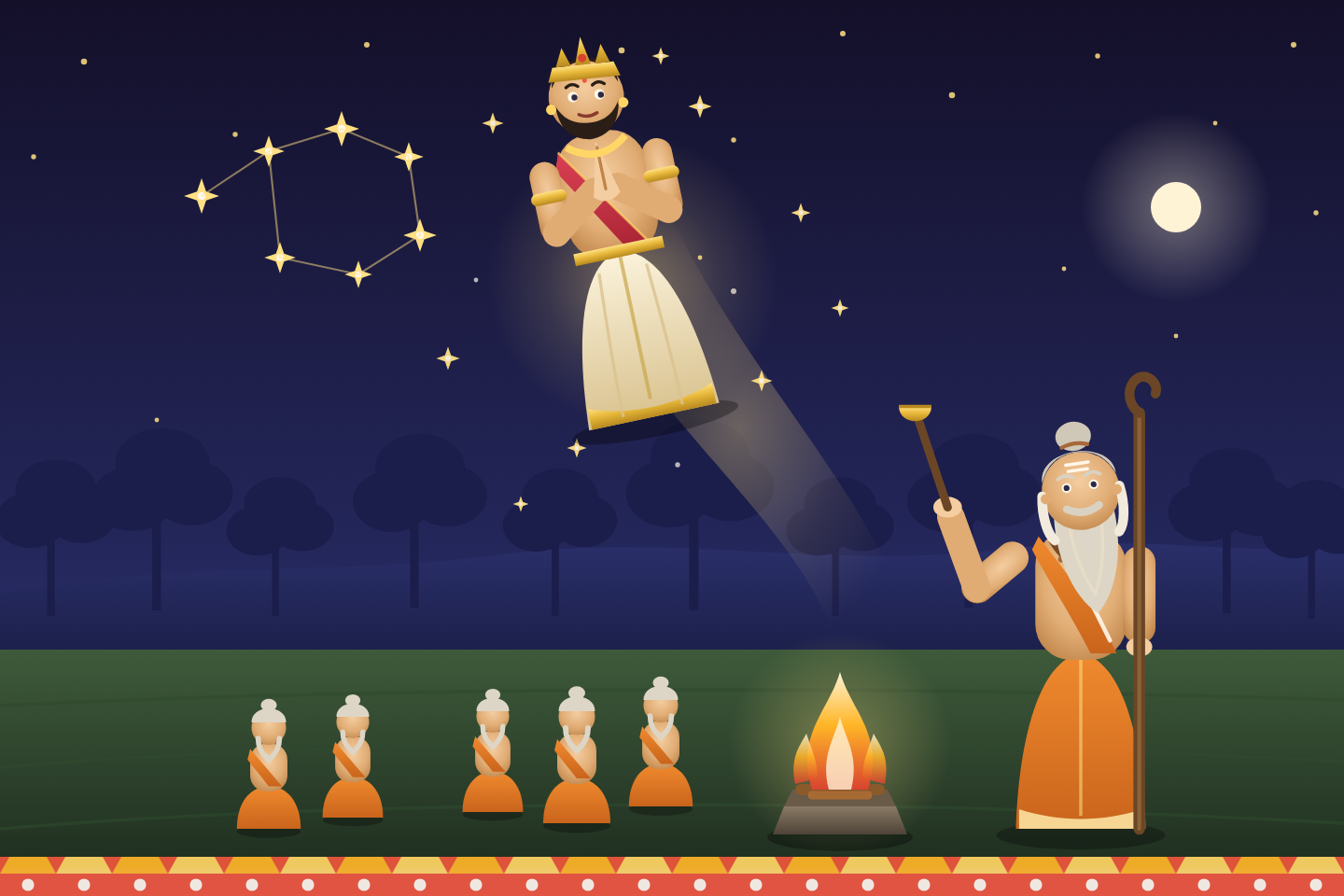
The fire was lit and the sages took their places, with Viśvāmitra himself as chief priest. For a long time he called on the gods to come and take their share of the offerings, as gods do at every sacrifice. Not one of them came. So the sage lifted the sacrificial ladle in his hand and turned to the king. 'Behold,' he said, 'the power of what I have earned with my own effort. If my penance has earned anything at all, then by its strength — rise, O king, to heaven in your own body!' And as the sages stood watching, King Triśaṅku rose from the ground and went up, and up, into the sky.
Sage Vālmīki
Head first
He reached the gate of heaven — and there stood Indra, king of the gods, with all the gods around him. 'Triśaṅku,' said Indra, 'you have earned no place here. Your teacher's curse is on you, foolish man. Fall back to the earth, head first!' And down he fell, crying out as he tumbled: 'Save me, Viśvāmitra! Save me!' The sage heard him. 'Stop!' he roared. 'Stop where you are!' And the king stopped, hanging in the middle of the sky. Then Sage Viśvāmitra, sitting among the sages, did something no one but Brahmā had ever done. Out of his anger he began to make a brand-new heaven in the south: seven new stars like the Great Bear, then twenty-seven new star-mansions for the moon to travel through. 'I will make a new Indra too,' he said, 'or my heaven shall have no Indra at all!'
Sage Vālmīki
A place among the stars
Now the gods were truly frightened. They came to the sage with the demons and the sages behind them, speaking very politely. 'This king carries his teacher's curse,' they said. 'He cannot enter heaven in his body.' And the sage answered: 'I gave this king my word that I would send him to heaven in his own body. I will not break it.' So they came to terms, the way even the mightiest must. The new stars would stay in the sky forever, beyond the old ones. And Triśaṅku would stay among them — hanging head-down, yes, but shining brightly, as happy as a god, with his new stars circling round him. 'All right,' said Sage Viśvāmitra. The sacrifice was finished, the gods took their share at last, and everyone went home. And there, Sage Vālmīki says, the king remained — glorious as any dweller of heaven, shining in the midst of his own stars.
Sage Vālmīki
✦ Two tellings, one story
Sage Vālmīki’s Rāmāyaṇa (Sanskrit)
This is Sage Vālmīki's story, told in his Bāla Kāṇḍa by Sage Śatānanda to Lord Rāma in Mithilā, as one chapter in the long life of Sage Viśvāmitra: the king's wish, Sage Vasiṣṭha's refusal, the hundred sons' curse, the sage's pity, the empty sacrifice, the rise, the fall, 'Stop where you are!', the new stars in the south, and the agreement that left Triśaṅku shining among them. Vālmīki tells it with the full force of the sage's anger — he curses the sages who mocked him too — and makes Triśaṅku's own goodness clear: a truthful king who 'reckoned fate alone as supreme' and still kept his courage.
Gosvāmī Tulsīdās’s Rāmcaritmānas (Awadhi)
Gosvāmī Tulsīdās does not tell this story. In his Bāl-kāṇḍa, Sage Viśvāmitra arrives at Ayodhyā already a great sage, and the long tale of how he became one is not told. The name Triśaṅku appears just once in the whole Rāmcaritmānas — in the Ayodhyā-kāṇḍa, when Lakṣmaṇa, angry at Citrakūṭa, lists him among the kings whom the pride of power brought low. So for the king among the southern stars, we go to Sage Vālmīki.
What this story teaches
Pity can be stronger than old grudges
Sage Viśvāmitra had been humbled by Sage Vasiṣṭha, and here was a man cast out by Vasiṣṭha's own sons. He could have turned him away. Instead he said, 'Do not be afraid — I will protect you.'
A promise is a promise
When the gods themselves asked him to give up, the sage answered that he had given his word and would not break it. He found a way to keep it — even if it meant building new stars.
Even the mightiest must come to terms
The sage could make a heaven, but he could not simply have his way. The gods could not have theirs either. The answer was a middle place in the sky — and sometimes a fair agreement is a kind of victory for everyone.
Words to know
- Triśaṅku (त्रिशङ्कु) · A king of Ayodhyā from the line of Ikṣvāku; today his name is used for anyone stuck halfway between two places.
- Ikṣvāku (इक्ष्वाकु) · The first great king of Ayodhyā; Lord Rāma's family is called the line of Ikṣvāku, or the Solar race.
- yajña (यज्ञ) · A sacred fire ceremony in which offerings are poured into the flames for the gods.
- tapas (तपस्) · Hard penance — years of prayer, fasting and stillness that build up great inner power.
- Indra · The king of the gods, who rules heaven and guards its gate.
- nakṣatra (नक्षत्र) · A 'mansion' of the moon — one of the twenty-seven groups of stars the moon passes through each month.
Vālmīki Rāmāyaṇa — Bāla Kāṇḍa (Sage Śatānanda's account to Lord Rāma: Triśaṅku's wish, Sage Vasiṣṭha's refusal, the curse of the hundred sons, Sage Viśvāmitra's shelter, the sacrifice the gods would not attend, the rise and fall, and the new heaven in the south — Cantos 57–60). Rāmcaritmānas — the episode is not told; Triśaṅku is named once, in the Ayodhyā-kāṇḍa.