Kids · बालकाण्ड Bāla Kāṇḍa · Ages 8–12
The Mother Who Saw the Whole World Inside Her Child
In Ayodhyā, in the palace of King Daśaratha, four little princes were growing up. The eldest was Lord Rāma — but to Mother Kausalyā he was simply her baby, the one she bathed and dressed and rocked in his cradle, so lost in love for him that, Gosvāmī Tulsīdās says, she did not notice the days and nights going by.
This is a small, quiet story from those days — not a battle, not a journey, but one ordinary morning in a palace that turned, for a few moments, into the most extraordinary morning in the world. It is told only in the Rāmcaritmānas, and it is about what a mother saw when her child smiled at her.
An ordinary morning
One day Mother Kausalyā bathed her little boy, dressed him in his finest, and laid him gently in the cradle to sleep. Then she bathed herself, because it was time to worship the family's own deity, as she did every day. She performed the worship, placed the offering of food before the deity, and went to the kitchen to see to the cooking.
Gosvāmī Tulsīdās
Who is eating the offering?
When she came back into the room of worship, she stopped still. There was her baby — eating the food she had just offered to the deity! Frightened, she hurried to the nursery. There he was, exactly where she had left him, fast asleep in the cradle. She ran back to the room of worship — and the child was still there too, eating. Her heart trembled and her mind would not settle. 'Two babies — one here, one there,' she thought. 'Is my mind playing tricks on me, or is something else happening?'
Gosvāmī Tulsīdās
The smile, and the whole world
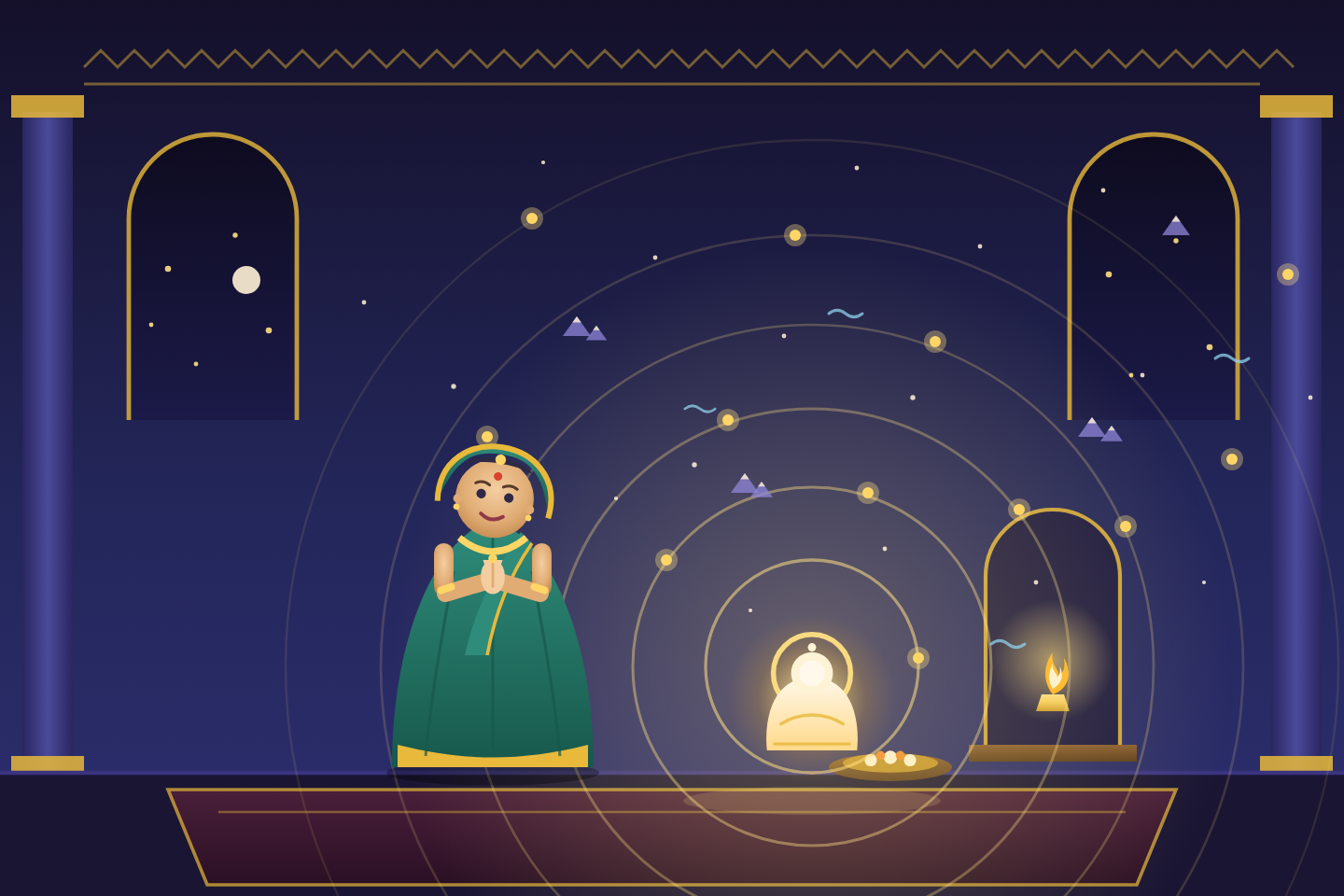
Lord Rāma saw his mother's face, so puzzled and afraid, and he smiled a sweet, gentle smile. And then he let her see. He showed Mother Kausalyā his true form — endless, unbroken — and in every single pore of it hung millions upon millions of worlds. She saw countless suns and countless moons. She saw many Lord Śivas and many four-faced Brahmās. She saw mountains and rivers, oceans and lands and forests without number. She saw Time itself, and Karma, and the three threads of nature, and Knowledge — and things she had never even heard the names of.
Gosvāmī Tulsīdās
The three she saw last
Then she saw three more things, and they were the strangest of all. She saw Māyā — the great power of illusion that holds the whole world under her spell — standing before the Lord trembling, with her palms pressed together. She saw the jīva, the little soul, whom Māyā makes dance like a puppet. And she saw Bhakti, loving devotion, the one who sets that soul free. Mother Kausalyā's hair stood on end. Not a word would come out of her mouth. She closed her eyes and bowed her head at the feet of her own baby.
Gosvāmī Tulsīdās
A baby again
When the Lord saw his mother so struck with wonder, he became a small child once more. She could not even find words to praise him. Instead she was afraid, because she had been treating the Father of the whole universe as her own little son — scolding him, washing him, singing him to sleep! Then Lord Rāma comforted his mother in many gentle ways, and said: 'Listen, Mother — do not tell this to anyone, anywhere.'
Gosvāmī Tulsīdās
The mother's prayer
Again and again Mother Kausalyā pressed her palms together and prayed: 'My Lord, let your Māyā never come over me again.' And the Lord went on being her baby: running away toddling when she came to call him for dinner, coming back covered in dust from the courtyard, his face smeared with curd and rice. The mother who had seen the whole world inside her child picked him up, and wiped his face, and loved him exactly as before.
Gosvāmī Tulsīdās
✦ Two tellings, one story
Sage Vālmīki’s Rāmāyaṇa (Sanskrit)
Sage Vālmīki does not tell this story at all. In his Bāla Kāṇḍa the four princes are born, named by Sage Vasiṣṭha, and grow up in a handful of verses — learning the Vedas, archery and the ways of a prince, with Lakṣmaṇa already devoted to his elder brother — and then Sage Viśvāmitra arrives at the court and the great adventures begin. There is no vision in the palace; Sage Vālmīki lets the Lord's greatness show through his deeds.
Gosvāmī Tulsīdās’s Rāmcaritmānas (Awadhi)
This story belongs to Gosvāmī Tulsīdās. In the Rāmcaritmānas it comes right after the naming of the four brothers, while Lord Rāma is still a baby in the cradle. Tulsīdās loves to show the Lord as a real little child — crawling on hands and knees, running from his mother, smeared with curd — and then, just for a moment, letting the whole universe shine through. He tells it as Lord Śiva telling it to Goddess Pārvatī, and he gives it only a few lines: the two babies, the vision in every pore, Māyā trembling with folded hands, and the mother's prayer.
What this story teaches
Great things hide in ordinary mornings
Nothing special was happening — a bath, a prayer, some cooking. And yet the most wonderful sight in the story came on exactly that sort of day. Pay attention to ordinary mornings; they are where the big things like to hide.
Love does not need to understand everything
Mother Kausalyā saw what sages spend whole lifetimes longing to see — and she asked the Lord to take the sight away. She did not want to know everything. She wanted to be his mother. Loving someone well matters more than understanding everything about them.
Even the greatest let themselves be small
The one who holds millions of worlds in every pore was happy to be wiped clean after dinner. Being great does not mean refusing to be small; the Lord chose to be a child so that he could be loved like one.
Words to know
- Kausalyā · the eldest queen of King Daśaratha and the mother of Lord Rāma
- iṣṭadeva · the family's own chosen deity, worshipped at home every day
- naivedya · food offered to a deity during worship
- Māyā · the Lord's great power of illusion, which makes the world seem to be all there is
- jīva · the individual soul — each living being
- Bhakti · loving devotion to the Lord; in this story, the one who sets the soul free
Rāmcaritmānas — Bāl-kāṇḍa (Mother Kausalyā's vision of the Lord's cosmic form in the baby: dohās 200–202 and the caupāīs between them). Vālmīki Rāmāyaṇa — Bāla Kāṇḍa (the princes' birth, naming and boyhood; this episode is not told). Told for ages 8–12; where the tellings differ, each is given as it stands.