Kids · सुन्दरकाण्ड Sundara Kāṇḍa · Ages 8–12
The Orchard and the Prince's Weapon
Hanumān Jī has done the impossible. He has leapt the ocean, slipped through the golden city and found Mother Sītā under the aśoka tree. He has given her Lord Rāma's ring and his message, and she has blessed him with the words every vānara would dream of: 'May you be ageless and deathless, my son, a treasure-house of virtues.'
A wiser messenger might have tiptoed straight back to the sea. But Hanumān Jī has one small problem. He is very, very hungry — and all around him hang the sweetest fruits in the three worlds. This is the story of what happened to Rāvaṇa's orchard, and to the warriors who came to guard it.
'Mother, I am very hungry'
Hanumān Jī bowed at Mother Sītā's feet again and again. Then he folded his hands and said, a little shyly, 'Mother, listen — looking at these lovely fruit trees, I have become terribly hungry.' Mother Sītā smiled, but she was worried. 'Son,' she said, 'great and mighty rākṣasa warriors guard this grove.' 'I am not afraid of them, Mother,' said Hanumān Jī, 'if only it makes you happy.' She looked at the small vānara who had crossed the sea for her, and she saw that he was as clever as he was strong. 'Go,' she said. 'Keep Lord Rāma's feet in your heart, dear one, and eat the sweet fruit.'
Gosvāmī Tulsīdās
The feast that shook the grove
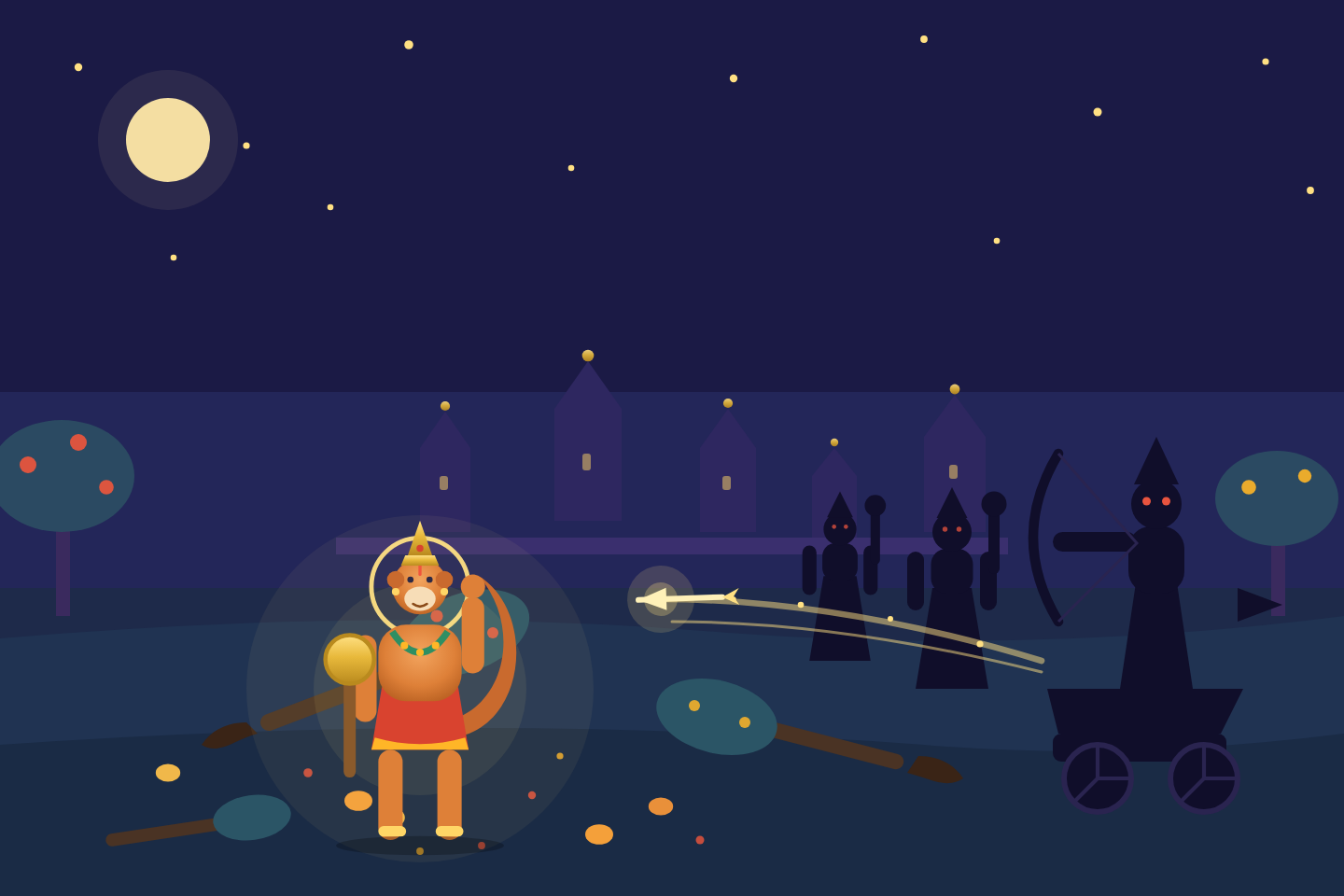
What a feast it was! Hanumān Jī ate mangoes and jackfruit and every sweet thing he could reach — and when the branches were bare, he pulled them down, and when the trees were empty, he pulled them up by the roots. Flowering aśoka trees came crashing down. Golden pavilions cracked. Startled birds burst into the night sky. Sage Vālmīki tells us that in the whole grove Hanumān Jī spared only one tree: the śiṁśapā under which Mother Sītā sat. The guards came running with their spears — and ran away much faster, shouting all the way to the palace: 'My lord! A giant vānara has wrecked the aśoka grove!'
In both Rāmāyaṇas
Warriors, one after another
Rāvaṇa was furious. He sent his fiercest household warriors — and back came only a few, limping. He sent champions with maces and arrows — Hanumān Jī roared, snatched up a tree, and they were scattered. Then Rāvaṇa sent his own son, Prince Akṣa, brave and young, in a golden chariot with a great army at his back. Akṣa fought with the courage of a true prince. But Hanumān Jī was the son of the Wind, and the young prince fell in that battle, and his soldiers scattered like leaves. When the news reached Rāvaṇa, the demon king's face grew dark.
In both Rāmāyaṇas
The prince with the terrible bow
Now Rāvaṇa turned to his eldest son, Meghanāda, called Indrajit because he had once defeated Indra, the king of the gods himself. 'Do not kill him,' Rāvaṇa ordered. 'Bind him and bring him here. I want to see what kind of creature this is.' Meghanāda rode out in his chariot, blazing with anger for his fallen brother. It was a battle like two mighty elephants locking tusks. Hanumān Jī smashed the prince's chariot with a tree, struck him one great blow, and leapt into the branches. Meghanāda staggered up and tried every magic he knew — and none of it could touch the son of the Wind. So the prince reached for the one weapon in the world that never fails: the astra of Brahmā, the Creator.
In both Rāmāyaṇas
The weapon that must be honoured
The great arrow flew, humming with the power of Brahmā himself. And in that instant Hanumān Jī thought a very deep thought. 'If I do not honour Brahmā's weapon,' he said to himself, 'its endless glory will be lost — and a boon of the Creator must never be made a lie.' So Hanumān Jī let the arrow strike him. He fell from the tree — knocking down a good many soldiers on the way, says Gosvāmī Tulsīdās — and lay still on the ground, though he was perfectly awake inside. The rākṣasas cheered, rushed in, and tied him tight.
In both Rāmāyaṇas
The bond he chose to keep
Here is the secret of the whole story. Sage Vālmīki tells us that the moment the demons bound Hanumān Jī with ropes, the astra let him go — for Brahmā's weapon will not share its prisoner with anything else. Hanumān Jī knew it. He could have snapped every rope like a thread and been gone. Instead he lay quietly and let them drag him away, because there was one person in Laṅkā he still needed to meet, face to face: the demon king who had stolen Mother Sītā. As Lord Śiva says in the Mānas, the messenger of the Lord whose very name cuts the bonds of the world let himself be bound — for his Lord's work. The door to Rāvaṇa's court was opening. And Hanumān Jī walked through it, as a prisoner, on purpose.
In both Rāmāyaṇas
✦ Two tellings, one story
Sage Vālmīki’s Rāmāyaṇa (Sanskrit)
In Sage Vālmīki's telling there is no asking for fruit. After leaving Mother Sītā, Hanumān Jī decides on his own that a messenger should also learn the enemy's strength — so he lays waste to the aśoka grove to draw Rāvaṇa's warriors out, and spares only the śiṁśapā tree. The poet then gives us a long roll-call of Laṅkā's champions sent one after another: eighty thousand kiṅkaras, the guard of the sanctuary, Jambumālī, the sons of the ministers, five generals, and at last Prince Akṣa, whose bravery Hanumān Jī himself admires before the young prince falls. Indrajit's brahmāstra strikes Hanumān Jī, who honours the weapon and lies still; when the rākṣasas bind him with ropes of hemp and bark, the astra releases him — and he chooses to stay bound so that he may see Rāvaṇa.
Gosvāmī Tulsīdās’s Rāmcaritmānas (Awadhi)
Gosvāmī Tulsīdās tells it warmly and quickly, and he begins with hunger. After Mother Sītā's blessing — 'be ageless and deathless, treasure-house of virtues' — Hanumān Jī asks her leave to eat, she warns him of the guards, and she sends him off with the Lord's feet in his heart. He eats the fruit, breaks the trees and scatters the guards; Rāvaṇa sends warriors, then Prince Akṣa, who is slain; then Meghanāda, with orders to bind him, not kill him. Hanumān Jī breaks the prince's chariot and strikes him senseless with one blow; Meghanāda tries his magic and fails; then he fits the brahmāstra to his bow. Hanumān Jī reasons that if he does not honour Brahmā's arrow its boundless glory will be lost, falls (slaying many as he falls), and is bound with the nāgapāśa, the serpent-noose, and carried off. And Lord Śiva adds the line that Mānas readers love: how could the messenger of Him whose name cuts the bonds of the world be bound? He let himself be bound, for the Lord's work.
What this story teaches
Ask before you take
Hanumān Jī was hungry and strong enough to take whatever he wanted. He still asked Mother Sītā first. Strength that asks permission is the kind people trust.
Some rules are bigger than winning
Hanumān Jī could have shrugged off the brahmāstra — but a boon of the Creator must never be made a lie. He chose to honour it even though it cost him. Keeping faith with what is sacred matters more than coming out on top.
A closed door can be the way in
Being captured looked like defeat. It was actually a ticket straight to Rāvaṇa's throne room, where Hanumān Jī needed to be. When something goes 'wrong', ask: where might this be taking me?
Words to know
- aśoka-vāṭikā (अशोकवाटिका) · Rāvaṇa's grove of aśoka trees, where Mother Sītā was kept — the orchard Hanumān Jī feasted on.
- Akṣa (अक्ष) · Rāvaṇa's brave young son, who came out with a great army and fell in battle with Hanumān Jī.
- Meghanāda (मेघनाद) · Rāvaṇa's eldest son, 'thunder-voiced', also called Indrajit — 'conqueror of Indra'.
- brahmāstra (ब्रह्मास्त्र) · The weapon of Brahmā the Creator — the one arrow in the world that must always be honoured.
- nāgapāśa (नागपाश) · The 'serpent-noose' — the magical bond Meghanāda used to tie up Hanumān Jī in Tulsīdās's telling.
- Pavanasuta (पवनसुत) · 'Son of the Wind' — one of Hanumān Jī's names; Meghanāda's magic could not defeat the Wind's son.
Vālmīki Rāmāyaṇa — Sundara Kāṇḍa (the destruction of the aśoka grove, the champions of Laṅkā, Prince Akṣa, Indrajit and the brahmāstra); Rāmcaritmānas — Sundara Kāṇḍa (Mother Sītā's blessing and leave to eat, the feast, Akṣa-kumāra, Meghanāda's orders, the brahmāstra honoured, the nāgapāśa). Retold for young readers; where the two tellings differ, both are given.