Kids · उत्तरकाण्ड Uttara Kāṇḍa · Ages 8–12
The Prince Who Did Not Want to Go Home
Have you ever been somewhere so happy that you forgot all about going home? That is how it was for the vānaras in Ayodhyā. Lord Rāma was king at last — that morning is told in 'The Day the Crown Came Home' — and the friends who had built the bridge and won the war stayed on as his guests. Gosvāmī Tulsīdās says they did not think of their own homes even in a dream, and that six whole months went by before anyone noticed.
But there were kingdoms to look after, far away in Kiṣkindhā and in Laṅkā. So one day the Lord called his friends together. This is the story of that goodbye, and of the young prince who found it hardest of all: Aṅgada, the son of Vāli. Gosvāmī Tulsīdās tells it most fully. Sage Vālmīki tells of the parting too, in his own way. Listen for whose telling is whose.
'Now, my friends, go home'
Lord Rāma sat his friends down close beside him and spoke gently. 'You have served me so well. How can I praise you to your faces? You gave up your homes and your comforts for my sake, and no one is as dear to me as you.' Then he said the hard thing. 'Now, my friends, go home. Remember me faithfully, every day. Know that I am everywhere, and that I wish everyone well — and love me dearly.' Nobody could say a word. They stood with their palms joined, looking and looking at him.
Gosvāmī Tulsīdās
The one who stayed in his seat
Beautiful clothes and jewels were brought, in every colour. Bharata dressed King Sugrīva with his own hands. Lakṣmaṇa dressed King Vibhīṣaṇa. The Lord himself dressed old Jāmbavān, Nīla and all the others, and they bowed at his feet and set out, carrying his picture in their hearts. But Prince Aṅgada stayed in his seat. He did not stir. And the Lord, who could see how much love was keeping him there, did not call him.
Gosvāmī Tulsīdās
'Where else would I go?'
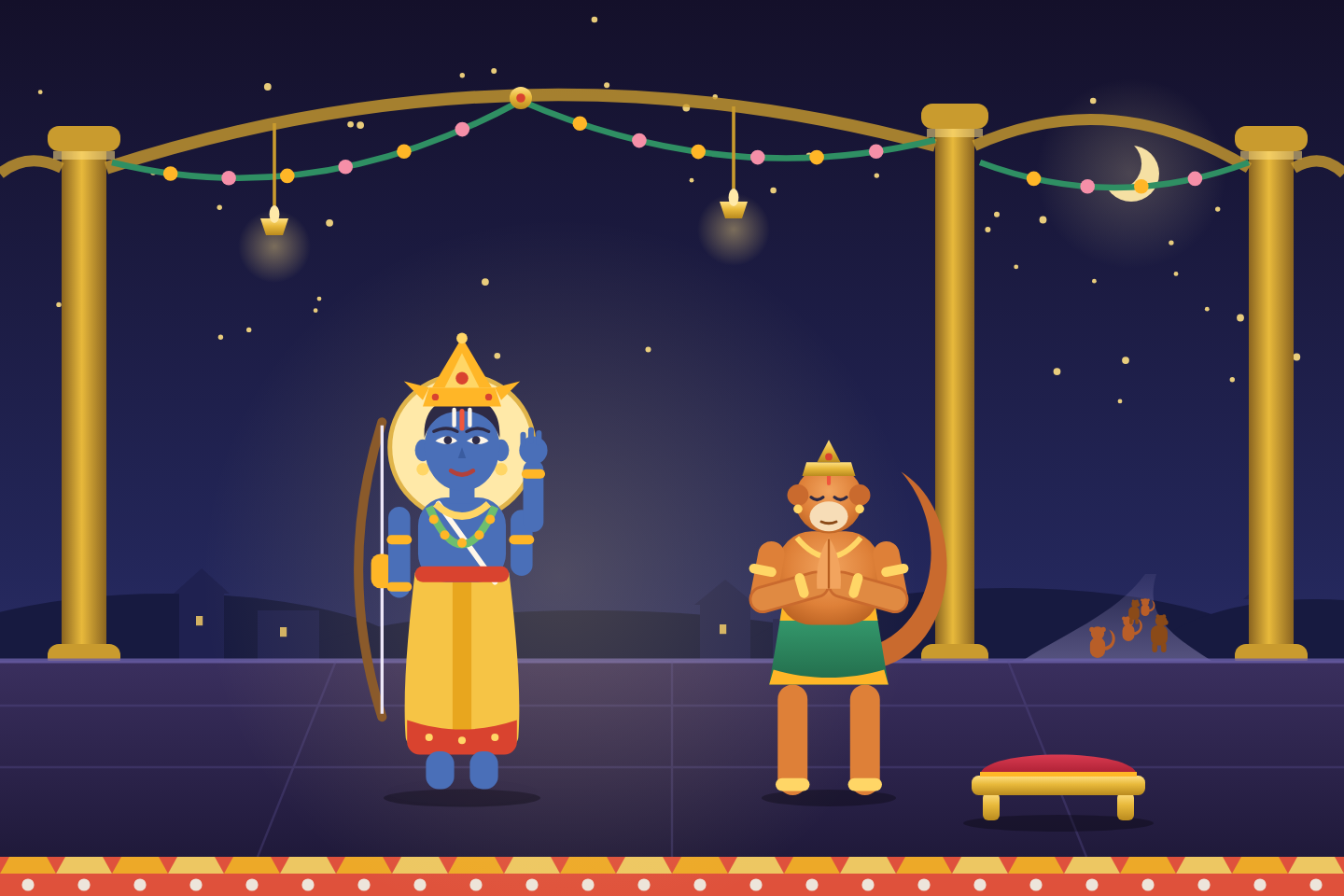
At last Aṅgada stood up. He bowed his head. His eyes were full of tears and his palms were joined. 'Lord,' he said, 'when my father Vāli was dying, he placed me in your care. Please do not send me away. You are my master, my teacher, my father and my mother. Where can I go, if I leave your lotus feet? I am only a child, without much wisdom or strength. Let me stay. I will do every humble job in your house.' Then he fell at the Lord's feet. 'Please, Lord — do not tell me to go home.'
Gosvāmī Tulsīdās
The Lord's own garland
The Lord's eyes filled with tears as well. He lifted Aṅgada up and held him to his heart. Then he took the garland from his own chest, and his own robe and jewels, and put them on Vāli's son. He comforted him in many ways — Gosvāmī Tulsīdās does not tell us the words — and then he said goodbye. Bharata, Lakṣmaṇa and Śatrughna walked out with the vānaras to see them off. Aṅgada kept turning round for one more look. Again and again he bowed to the ground, hoping to hear 'Stay with me.' He thought of the way the Lord looked at him, and spoke, and walked, and smiled when he greeted a friend. But he could see what the Lord wished. So he went — with the Lord's lotus feet kept safe in his heart.
Gosvāmī Tulsīdās
'Remind him of me'
On the road, Hanumān Jī clasped King Sugrīva's feet. 'Let me serve the Lord a little longer — ten days or so — and then I will come and bow to you again.' King Sugrīva answered, 'Son of the Wind, you are a treasure of good deeds. Go and serve the Lord of mercy.' The others hurried on. But Aṅgada stopped, and joined his palms before Hanumān Jī. 'Give the Lord my deepest bow. And please — remind him of me, again and again.' Then Vāli's son went home. Hanumān Jī went back and told the Lord how much Aṅgada loved him, and the Lord was filled with joy. The Lord's heart, says Gosvāmī Tulsīdās, is harder than a thunderbolt and softer than a flower. Who can understand it?
Gosvāmī Tulsīdās
Two goodbyes, one love
Sage Vālmīki tells of the parting in his own way. In his telling the Lord sat Hanumān Jī and Aṅgada on his own lap and told King Sugrīva that these two deserved every honour. He took precious ornaments off his own body and fastened them on the two of them. And when the day came to send everyone home, he asked King Sugrīva to look on Aṅgada and Hanumān Jī with the greatest love. The vānaras bowed at his feet and left with their eyes full of tears, hardly able to speak. So the two poets tell it differently — but in both, the Lord gives Aṅgada something he himself was wearing, and nobody leaves without tears.
In both Rāmāyaṇas
✦ Two tellings, one story
Sage Vālmīki’s Rāmāyaṇa (Sanskrit)
Sage Vālmīki tells of the parting in his Uttara Kāṇḍa. The vānaras, the bears and the rākṣasas who came with King Vibhīṣaṇa stay on happily in Ayodhyā as the Lord's guests for more than a month. The Lord seats Hanumān Jī and Aṅgada on his lap, tells King Sugrīva that both deserve every kind of honour, and fastens on them precious ornaments taken from his own body. He calls the vānara chiefs his friends, his brothers, his other self. When he sends them home he asks King Sugrīva to regard Aṅgada and Hanumān Jī with the greatest affection, and never to do anything displeasing to the vānaras who risked their lives for his sake. In this telling Aṅgada makes no plea to stay. It is Hanumān Jī who asks for something: that his love for the Lord may never waver, and that life may stay in his body for as long as the Lord's story is told on earth. The Lord rises from his seat, embraces him and grants it. Then the friends bow at his feet and go home, their eyes full of tears and their voices choked.
Gosvāmī Tulsīdās’s Rāmcaritmānas (Awadhi)
Gosvāmī Tulsīdās tells it in his Uttar Kāṇḍa, and here the goodbye belongs to Aṅgada. Six months pass unnoticed; the vānaras do not remember their homes even in a dream. The Lord seats his friends beside him, tells them that none is as dear to him as they are, and asks them to go home, to worship him steadily, and to love him knowing that he is present everywhere and is the friend of all. Bharata dresses King Sugrīva with his own hands, Lakṣmaṇa dresses King Vibhīṣaṇa, and the Lord himself dresses Jāmbavān, Nīla and the rest, who bow and leave. Aṅgada stays seated and does not stir, and the Lord, seeing his love, does not call him. Then Aṅgada rises, bows his head and, with tears and joined palms, says that his dying father Vāli placed him in the Lord's care; that the Lord is his master, teacher, father and mother; that he is a child without knowledge, wisdom or strength; and that he will do every lowly service of the household if only he is not sent home. He falls at the Lord's feet. The Lord, his own eyes wet, lifts him and holds him to his heart, puts his own garland, robe and jewels on him, consoles him in many ways and sends him off. Aṅgada looks back again and again and bows repeatedly, hoping to be told to stay; then, seeing the Lord's wish, he leaves with the Lord's feet in his heart. Hanumān Jī asks King Sugrīva's leave to serve the Lord some days longer, and King Sugrīva, calling him a store of merit, tells him to go and serve the Lord. Aṅgada asks Hanumān Jī, with joined palms, to carry his prostrations to the Lord and to remind the Lord of him again and again. Hanumān Jī returns and tells the Lord of Aṅgada's love, and the Lord is absorbed in joy.
What this story teaches
You can carry someone with you
Aṅgada had to go, but he went wearing the Lord's own garland and with the Lord's feet kept in his heart. When you have to say goodbye to someone you love — a grandparent, a friend who is moving away — you do not leave them behind. You take them with you.
It is all right to say how you feel
Aṅgada did not pretend. He stood up, joined his palms and said the truth: I do not want to go. Nobody scolded him. He was lifted up and held. And then he did the hard thing anyway.
Carry a friend's love for them
Aṅgada could not stay, so he asked Hanumān Jī to remind the Lord of him — and Hanumān Jī did. When you cannot be there, send your love with someone who can. And when a friend trusts you with a message, deliver it.
Words to know
- Aṅgada · the young prince of the vānaras — son of Vāli and nephew of King Sugrīva
- Vāli · Aṅgada's father, who was king of Kiṣkindhā before Sugrīva; as he was dying he placed his son in Lord Rāma's care
- Kiṣkindhā · the kingdom of the vānaras, far to the south of Ayodhyā
- daṇḍavat · bowing down flat on the ground, straight as a stick (daṇḍa) — the deepest bow of all
- lotus feet · a loving, respectful way of speaking of the Lord's feet
- Son of the Wind · a name for Hanumān Jī, whose father is Vāyu, the god of the wind
A true episode from the days after the coronation, told in Rāmcaritmānas — Uttar Kāṇḍa; Sage Vālmīki tells of the same parting, differently, in Vālmīki Rāmāyaṇa — Uttara Kāṇḍa. The six months that passed unnoticed, the Lord's words to his friends and his asking them to go home, the dressing of the guests by Bharata, Lakṣmaṇa and the Lord himself, Aṅgada staying in his seat, his plea with joined palms and his falling at the Lord's feet, the Lord's embrace and the gift of his own garland, robe and jewels, Aṅgada's looking back on the road, Hanumān Jī asking King Sugrīva's leave to stay and serve, Aṅgada's message to the Lord, and the saying about the Lord's heart are Gosvāmī Tulsīdās's. The Lord seating Hanumān Jī and Aṅgada on his lap and fastening on them ornaments from his own body, his asking King Sugrīva to look on them with affection, Hanumān Jī's request to live as long as the Lord's story is told, and the vānaras leaving with choked voices are Sage Vālmīki's. The loving farewell to the vānaras after a happy stay in Ayodhyā is in both tellings.