Kids · अरण्यकाण्ड Araṇya Kāṇḍa · Ages 8–12
The Prince Who Stood Alone
When Śūrpaṇakhā fled from Pañcavaṭī with her pride stinging, she did not go home quietly. She ran wailing to Janasthāna, where her fierce brothers Khara and Dūṣaṇa ruled the wild forest with an army of rākṣasas — and what she set moving there came back to the little cottage by the Godāvarī like a storm.
This is the story of the day the whole forest held its breath: the day fourteen thousand demons marched against one prince, and learned what the sages already knew — that goodness standing its ground is stronger than any army.
The wailing at Janasthāna
Śūrpaṇakhā burst into her brothers' court with tears streaming. "Fie, fie upon your strength, brothers!" she cried. "What use is your power, if this is how I am treated?" She told them everything — the two radiant princes, the refusals, her punishment. Khara and Dūṣaṇa leapt up in fury and called their whole army: rākṣasas of every fearsome shape came swarming like dark mountains on the move.
In both Rāmāyaṇas
To the cave, quickly
Far away at Pañcavaṭī, Lord Rāma heard the distant thunder of the marching host and understood at once. "A terrible army of rākṣasas is coming," he told his brother calmly. "Take Mother Sītā to a mountain cave, and stay on your guard." Lakṣmaṇa obeyed without a single question, bow and arrows in hand — for protecting comes before fighting, always.
In both Rāmāyaṇas
One prince before fourteen thousand
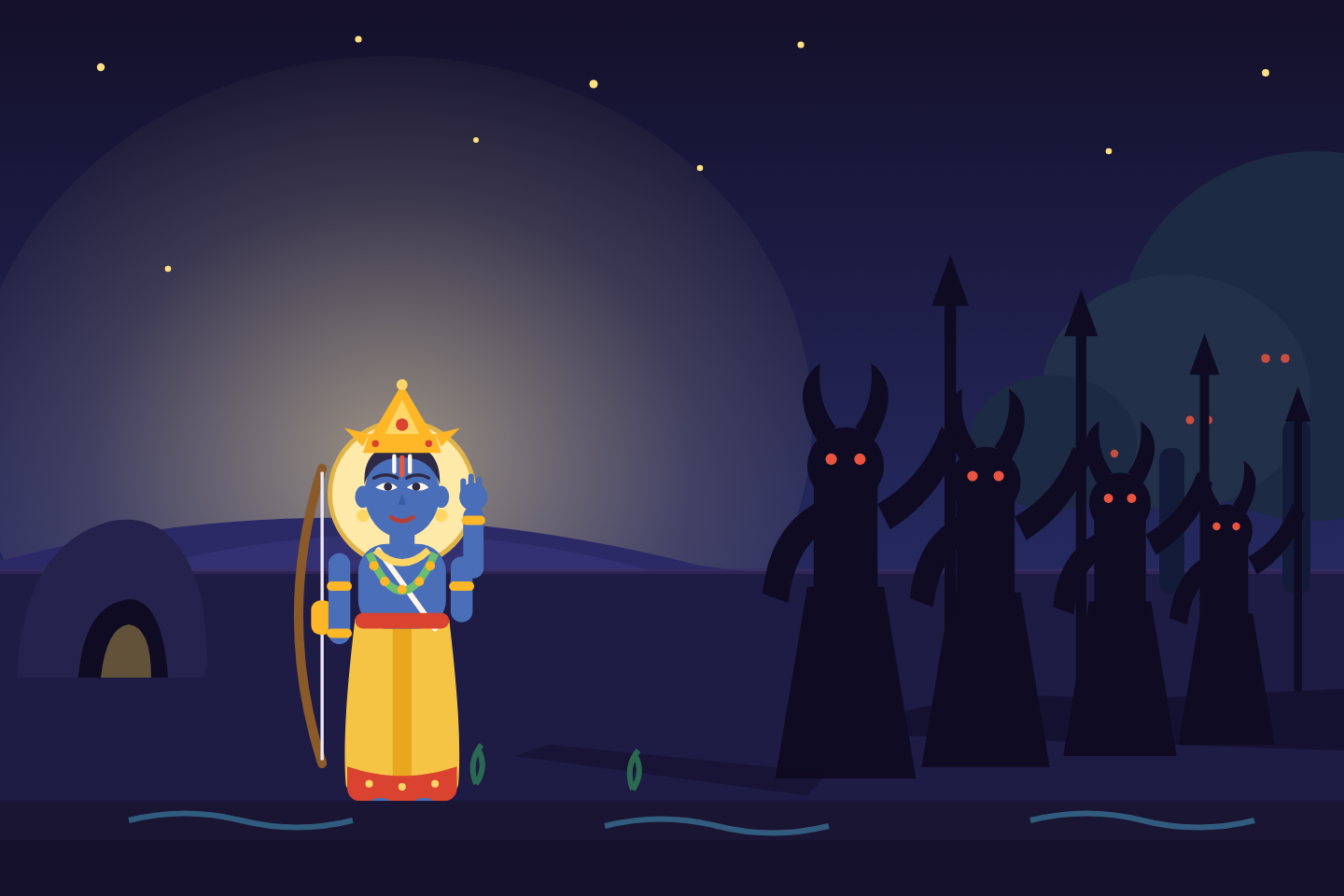
Then Lord Rāma strung his great bow and stood alone in the clearing, as calm as the morning Godāvarī. Out of the forest poured the demon host — fourteen thousand strong, with Khara and Dūṣaṇa at their head. High above, the devas gathered in the sky to watch, and their hearts trembled: so many, against just one! But the one they were worried about was smiling.
In both Rāmāyaṇas
The bow like a circle of fire
In Sage Vālmīki's telling, the battle that followed filled the sky. The demons hurled their spears and maces like black rain, but Lord Rāma's bow bent and sang so fast that no one could see him draw it — it seemed a circle of fire in his hands. One by one the great demon chiefs fell, Dūṣaṇa and Triśirā and at last mighty Khara himself, until not one of the fourteen thousand warriors was left standing.
Sage Vālmīki
The wonder in the battle
Gosvāmī Tulsīdās tells a wonder from that same battle. Lord Rāma, who is the master of all māyā — all magic and illusion — worked a marvel of his own: the rākṣasas suddenly saw HIM everywhere. Each demon looked at his own friends and saw only Lord Rāma, and so they fought one another, crying "Rāma! Rāma!" And here is the secret the poet smiles over: because his holy name was on their lips as they fell, even these enemies found peace.
Gosvāmī Tulsīdās
The forest breathes again
Then flowers came drifting down from the sky, and the drums of the devas sounded overhead. Lakṣmaṇa brought Mother Sītā home from the cave, and she joyfully took her place again by Lord Rāma's side. All through the forest, the sages who had lived so long in fear of Khara's army came out of their hermitages into the sunlight. The forest was free — and it had taken only one prince, standing exactly where he was needed.
In both Rāmāyaṇas
✦ Two tellings, one story
Sage Vālmīki’s Rāmāyaṇa (Sanskrit)
Sage Vālmīki tells the battle in glorious detail — the omens before it, Lord Rāma sending Sītā and Lakṣmaṇa to the cave, and then the long duel: the demon host's weapons falling like rain, the bow moving so fast it seemed a wheel of fire, and Dūṣaṇa, Triśirā and Khara falling one after another until all fourteen thousand lay still, while gods and sages watched from the sky.
Gosvāmī Tulsīdās’s Rāmcaritmānas (Awadhi)
Gosvāmī Tulsīdās tells it briefly and full of wonder: the gods tremble to see fourteen thousand against one, and the Lord of māyā works a marvel — the demons see Lord Rāma in one another and destroy their own army, falling with his name on their lips and finding, through it, the peace that saints seek. Flowers rain from heaven as the gods sing his praise.
What this story teaches
Courage is not counted
Fourteen thousand against one sounds like a finished story — but right does not become wrong just because it is outnumbered. Standing your ground for what is good matters more than how many stand with you.
Protect first, then fight
Before Lord Rāma even strung his bow, he made sure Mother Sītā was safe. The bravest people always think of protecting others before proving themselves.
His kindness is bigger than the battle
In the Mānas, even the demons who came to fight found peace, because his name was on their lips at the end. Goodness that great does not only defeat its enemies — it lifts them.
Words to know
- Pañcavaṭī · The forest clearing by the river Godāvarī where the exiles built their cottage.
- Janasthāna · The stronghold in the Daṇḍaka forest where Khara and Dūṣaṇa ruled their rākṣasa army.
- rākṣasa · A demon; a being who chooses cruelty — the mighty ones could change shape at will.
- māyā · Magic or illusion — making things seem other than they are. Lord Rāma is its true master.
- devas · The shining gods who watch great deeds from the sky and rain down flowers.
A real episode from the Araṇya Kāṇḍa of both Rāmāyaṇas: Sage Vālmīki's epic tells the full battle of Janasthāna (the Khara–Dūṣaṇa cantos, told here at section level), and Gosvāmī Tulsīdās's Rāmcaritmānas tells it in Araṇya-kāṇḍa, dohās 17–20 with their caupāīs and chandas — the cave instruction, the gods' fear at fourteen thousand against one, the demons beholding Lord Rāma in one another, and the rain of flowers.