Kids · लङ्काकाण्ड Laṅkā Kāṇḍa · Ages 8–12
The Queen and the Grandfather Who Told the Truth
The sea has been crossed. On the shore of Laṅkā, beneath Mount Suvela, Lord Rāma's host of vānaras and bears roars so loudly that the sound rolls over the golden walls and into every palace. In his council-hall, Rāvaṇa, the ten-headed king, pretends not to be afraid. But two people who know him better than anyone can see straight through him.
One is his queen. The other is his grandfather. Neither of them is a warrior. Neither of them has an army. All they have is the truth — and the courage to say it to a king who does not want to hear it. This is their story.
The queen at her husband's feet
Gosvāmī Tulsīdās begins the Laṅkā-kāṇḍa here, in the palace, with Queen Mandodarī. She is Rāvaṇa's chief wife, the daughter of Maya, and she has been watching her husband's face since the news came. Now she speaks. 'My lord, Lord Rāma is kind to those who bow to him. Even a tiger will not harm a man who comes before it humbly. You have already conquered everything there is to conquer — gods, demons, the whole world. The holy books say a king should give up the throne in the last part of his life. Go to the forest. Worship the Lord who has come to your very door.' Then she does the bravest thing a queen can do. She kneels, takes hold of his feet, and with tears running down her face and her whole body trembling, she says: 'Worship Śrī Rāma, my lord — so that I may never lose you.'
Gosvāmī Tulsīdās
'What warrior is my equal?'
Rāvaṇa lifts her gently to her feet — and then he does what proud people do when they are frightened. He boasts. 'My darling, these fears are foolish. What warrior in all the world is my equal? With these arms I have beaten Varuṇa, lord of the waters, and Kubera, lord of riches, and the Wind, and Yama, and Death himself. Gods, demons and men all do as I say. What is there to be afraid of?' He soothes her with a hundred such words and marches back to his council. But Mandodarī is not soothed. In her heart, Gosvāmī Tulsīdās says, she understood something terrible: her husband's death was already near, and it had gone to his head.
Gosvāmī Tulsīdās
The flatterers and the one who was not
In the council-hall the ministers say exactly what the king wants to hear. 'Why do you keep asking, my lord? Men, vānaras and bears are our food!' Only one voice is different. Prahasta, Rāvaṇa's own son, folds his palms and says, 'Father, do not cross the line of good sense. These counsellors have very little wit. One vānara leapt the ocean and burned this city — where were all these hungry heroes then? Hear me with respect, Father, and do not think me a coward for saying so.' But a king who is used to flattery hears good advice as an insult. He waves his son away, too.
Gosvāmī Tulsīdās
Crowns that fell and a queen who spoke again
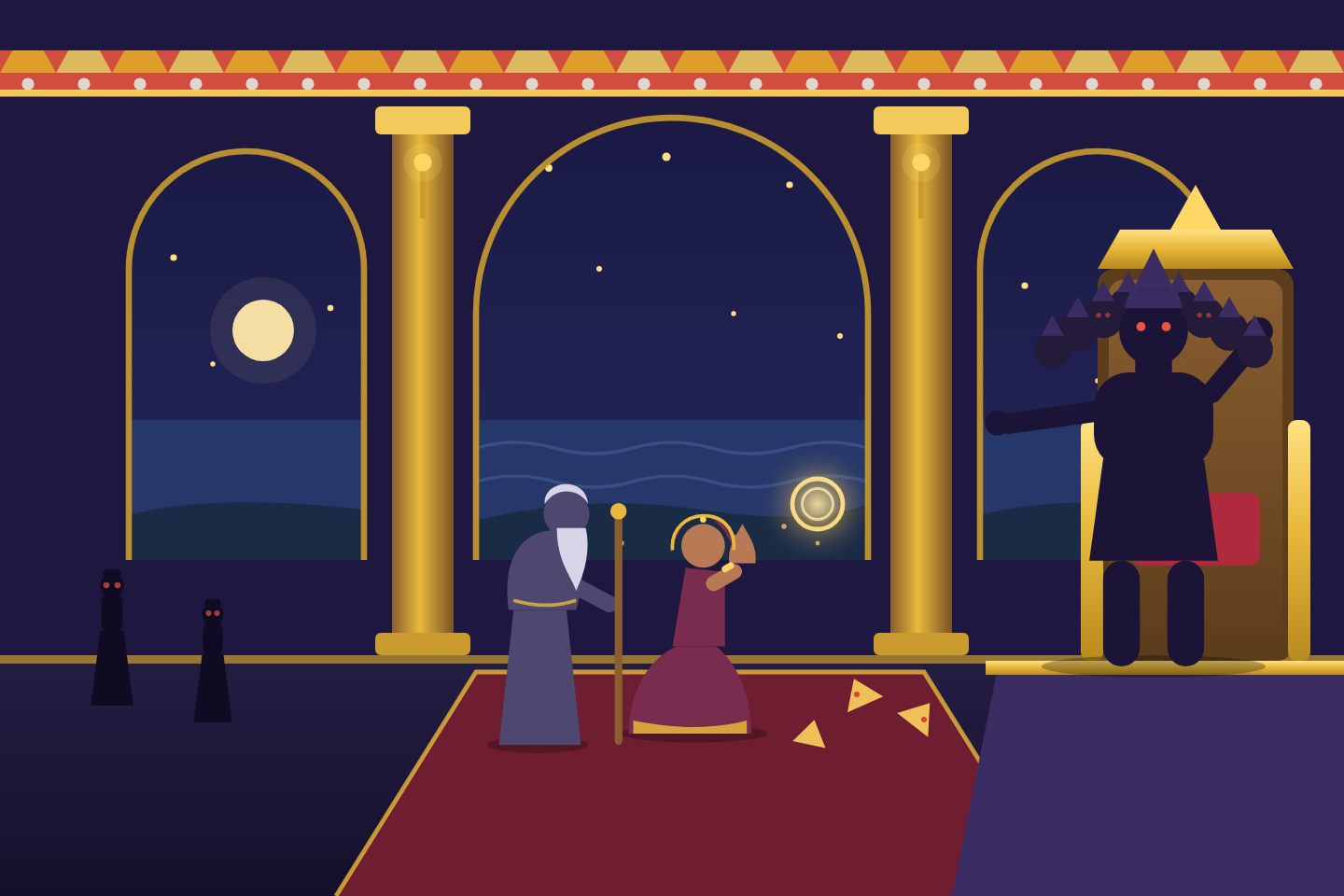
Then the omens begin. In the middle of the court, Rāvaṇa's crowns slip from his heads and fall to the floor. There is no earthquake and no wind — they simply fall. Mandodarī's earrings drop from her ears before everyone's eyes. The whole court goes pale. Rāvaṇa only laughs. 'If losing my heads once did me no harm,' he says, 'what is the falling of a few crowns?' But that night the queen comes to him again, with folded hands and eyes full of tears. 'O lord of my life, listen to me. Stop this quarrel with Lord Rāma. Do not go on thinking he is an ordinary man. The one you are fighting is the Lord of the whole universe — the deepest earth is his feet, the highest heaven is his head, the sun is his eye and the clouds are his hair.' And Rāvaṇa laughs again, and turns her warning into a joke. When the sun rises, he walks into his court blind with pride.
Gosvāmī Tulsīdās
The grandfather who read the signs
Sage Vālmīki tells of another voice. As the drums and conches of Lord Rāma's army sound outside the walls, Rāvaṇa calls his council together. And there rises old Mālyavān — his mother's father, the oldest and wisest counsellor in Laṅkā. 'A wise king makes peace when his enemy is as strong as he is,' the old rākṣasa says. 'Give Sītā back. The sages of heaven and the Gandharvas all wish Rāma victory. And look at the signs, my son. The horses and elephants are weeping. Jackals and vultures shriek inside the city. The sky has gone dull with dust. We believe this Rāma, who built a bridge across the ocean itself, is Lord Viṣṇu walking in the shape of a man. He is no ordinary human being. Make peace with him.'
Sage Vālmīki
'I would break before I would bend'
Rāvaṇa's eyes roll with rage. 'How can you call that wretched man powerful?' he shouts at his own grandfather. 'A prince thrown out by his father, living in a forest, hiding behind vānaras! Either you envy me, or you have taken the enemy's side!' Old Mālyavān says nothing more. He wishes the king victory, as a good counsellor must, and walks quietly home. And when he has gone, Rāvaṇa says to his ministers the words that tell you everything about him: 'I would sooner break in two than bend before anyone. That is my nature, and nature is hard to change.' Then he posts his generals at the four gates of Laṅkā and gets ready for war. Two people had told him the truth out of love. He had laughed at one and shouted at the other. And every word they said was about to come true.
Sage Vālmīki
✦ Two tellings, one story
Sage Vālmīki’s Rāmāyaṇa (Sanskrit)
In Sage Vālmīki's Yuddha Kāṇḍa the truth-teller before the war is Mālyavān, Rāvaṇa's aged maternal grandfather and foremost counsellor. When Lord Rāma's army marches on Laṅkā, Mālyavān rises in the council to speak of statecraft — a king should make peace with an equal — and of the dreadful omens in the city, and declares that Rāma, who bridged the ocean, is no mere man but Lord Viṣṇu in human form; he urges Rāvaṇa to restore Sītā and make peace. Rāvaṇa, furious, accuses him of siding with the enemy and declares he would break rather than bend. Mālyavān falls silent, blesses the king with victory as propriety requires, and withdraws, while Rāvaṇa arranges Laṅkā's defence. Queen Mandodarī does not plead with Rāvaṇa before the war in Sage Vālmīki's telling; her great speech comes later, as a lament.
Gosvāmī Tulsīdās’s Rāmcaritmānas (Awadhi)
Gosvāmī Tulsīdās opens his Laṅkā-kāṇḍa with Queen Mandodarī, who falls at Rāvaṇa's feet in tears and begs him to give up the throne, worship Lord Rāma and save himself; Rāvaṇa lifts her up and boasts of his conquests. In the court his ministers flatter him and only Prahasta, his son, speaks sense. Then omens follow — Rāvaṇa's crowns and Mandodarī's earrings fall — and the queen pleads a second time, describing the Lord's cosmic form and begging him not to take Rāma for a mere mortal; Rāvaṇa laughs it away. Mālyavān appears in the Mānas too, but later: after the first day's battle he counsels Rāvaṇa to return Sītā and worship the All-merciful, and Rāvaṇa orders him from his sight, sparing him only for his age.
What this story teaches
The people who love you tell you hard truths
Mandodarī and Mālyavān had nothing to gain by speaking. They spoke because they loved Rāvaṇa and could see where he was heading. Flatterers say what is easy; friends say what is true.
Laughing at a warning does not make it go away
Rāvaṇa turned every warning into a joke or an insult. The crowns still fell. The army was still outside the walls. Ignoring the truth only means you meet it later, unprepared.
Pride says 'I would break before I bend'
Rāvaṇa thought bending was weakness. But the strongest people in the Rāmāyaṇa — Hanumān Jī, Vibhīṣaṇa, Bharata — all bowed when it was right to. Bending to the truth is not breaking. It is wisdom.
Words to know
- Mandodarī (मन्दोदरी) · Rāvaṇa's chief queen, daughter of the architect Maya — wise and devoted, and the one voice in the palace brave enough to tell him the truth.
- Mālyavān (माल्यवान्) · Rāvaṇa's aged maternal grandfather and senior counsellor in Laṅkā, who read the omens and urged peace.
- asaguna (असगुन) · An ill omen — a strange sign, like crowns falling for no reason, that warns of trouble to come.
- Prahasta (प्रहस्त) · A great general of Laṅkā; in the Mānas he is Rāvaṇa's son, and the one minister who refuses to flatter.
- Suvela (सुवेल) · The mountain on Laṅkā's shore where Lord Rāma's army camped after crossing the sea.
- mantrī (मन्त्री) · A royal counsellor — someone whose whole job is to give the king honest advice, whether he likes it or not.
Rāmcaritmānas — Laṅkā-kāṇḍa (Mandodarī's pleas to Rāvaṇa, his boasting, Prahasta's counsel, the falling crowns and earrings, and — after the first day of battle — Mālyavān's counsel); Vālmīki Rāmāyaṇa — Yuddha Kāṇḍa (Mālyavān's speech on statecraft and omens, and Rāvaṇa's angry refusal). Retold for young readers; where the two tellings differ, both are given.