Kids · उत्तरकाण्ड Uttara Kāṇḍa · Ages 8–12
The Quiet Brother and the City on the Yamunā
Everyone knows Lord Rāma. Most people know Lakṣmaṇa, who went to the forest with him, and Bharata, who ruled Ayodhyā from a hut while he was away. But there was a fourth brother. His name was Śatrughna, and in all the long story he had mostly stood beside Bharata and said very little.
Sage Vālmīki tells this adventure in the Uttara Kāṇḍa of his Rāmāyaṇa, in the peaceful years after Lord Rāma was crowned. It is a story only he gives us — the Rāmcaritmānas does not tell it, and we will say so at the end. This is the Vālmīki telling.
The sages at the door
One clear morning Sumantra, the old charioteer, came to Lord Rāma with news. 'O King, holy men are waiting at the gate — more than a hundred of them, from the banks of the river Yamunā, with the great Sage Cyavana at their head.' The Lord had them brought in at once, and they came carrying pitchers of holy water and baskets of fruit. 'Tell me what I must do,' said Lord Rāma, with folded hands, before he had even heard their trouble. 'This kingdom, my whole life, everything in my heart — it is all for you.' The sages looked at one another in joy. 'Many mighty kings have come and gone,' they said, 'and not one of them would promise that before he knew how hard the task was.'
Sage Vālmīki
The demon with the trident
Then Sage Cyavana told the story. Long ago there had been an asura called Madhu — a good one, who honoured the gods and the sages — and Lord Śiva, pleased with him, had given him a wonderful trident. 'As long as this trident is in your family's hand,' the Lord had said, 'no one can defeat the one who holds it.' But Madhu's son was nothing like his father. His name was Lavaṇa, and he had been cruel since he was a boy. Now he lived in a great white house in the forest of Madhu, and with the trident in his hand he roamed the land devouring every creature he could catch, and the hermitages along the Yamunā lived in fear. 'We have asked king after king,' said the sage. 'No one would come. Now Rāvaṇa is gone, and you are the only protector left in the world.'
Sage Vālmīki
'Let me go,' said the quiet one
'I will rid you of him,' said Lord Rāma. 'Let your fear be gone.' Then he turned to his brothers. 'Who will go to Lavaṇa — long-armed Bharata, or wise Śatrughna?' Bharata spoke first, as everyone expected. 'I shall kill him. Give the task to me.' But then something happened that no one expected. Śatrughna rose from his golden seat, bowed to the King, and said: 'Bharata has already done his share. While you were in the forest, he guarded Ayodhyā from a hut in Nandigrāma — sleeping on the hard ground, eating only roots and fruits, in bark cloth and matted hair, grieving for you every day. While I, your servant, am standing here, Bharata should not be troubled again.' Lord Rāma looked at his youngest brother for a long moment. 'So be it, Śatrughna,' he said.
Sage Vālmīki
A crown he did not ask for — and a secret
Then the Lord did a surprising thing: he had Śatrughna crowned king of Madhu's country that very day, before he had even set out. Śatrughna's face burned. 'How can the youngest be crowned over his elders?' he asked. 'It does not seem right.' But an elder brother's word must be obeyed, and he said no more. Lord Rāma drew him onto his lap and placed in his hands a shining arrow — Lord Viṣṇu's own, which the Lord had not used even against Rāvaṇa, because it was too terrible. And he told him the secret of the trident. 'When Lavaṇa goes out hunting for his food, he leaves the trident at home. Wait at the gate of his city. Challenge him before he can get inside. With the trident in his hand no one can beat him — without it, you can.'
Sage Vālmīki
Alone at the gate
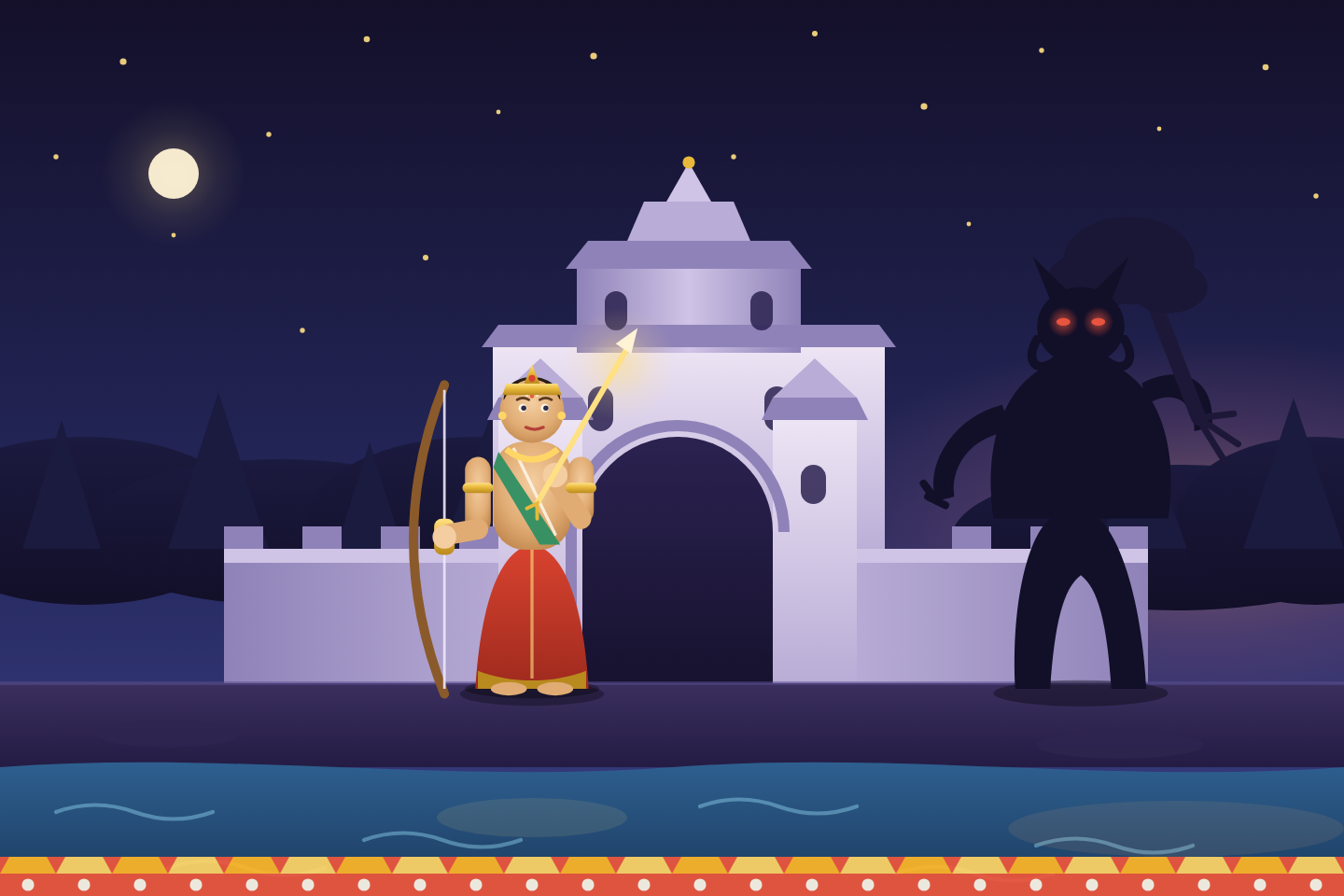
Śatrughna sent his army ahead to wait on the banks of the Gaṅgā, stayed a month more with his brothers, and then set out alone, with nothing but his bow. He rested on the way at the hermitage of Sage Vālmīki, who welcomed him like one of his own family, and then with the sages of the Yamunā, who blessed him. At dawn Lavaṇa went out of his city to hunt, as he did every day. Śatrughna crossed the river and took his stand at the gate. At midday the demon came home, carrying his dreadful load, and found a lone prince standing in his doorway. He laughed. 'What will you do with that little bow? Thousands like you have ended up in my mouth.' Śatrughna did not move. 'I am the son of King Daśaratha and the brother of Śrī Rāma. My name is Śatrughna, and I have come for you.' 'Wait there,' snarled Lavaṇa, 'while I fetch my trident.' 'Where will you go,' said the quiet brother, 'while I am alive?'
Sage Vālmīki
One arrow, and a city
Lavaṇa tore up whole trees and hurled them, and Śatrughna cut them to pieces in the air; then one tree struck him, and he fell, and the sages and the gods watching from the sky cried out. But the demon, thinking him finished, did not go in for his trident. Śatrughna rose, fitted the shining arrow to his bow, drew it to his ear, and let it fly — and the arrow found its mark, and Lavaṇa fell like a mountain struck by lightning. The gods came down and said, 'Ask us for a boon.' Śatrughna, with folded hands on his head, asked for only one thing: 'Let this city of Madhu become a fine capital, Madhurā, and let it be so soon.' And so it was. In twelve years a beautiful city shaped like a half-moon rose on the bank of the Yamunā, the rains came on time, the fields were full of grain, and no one in the land was afraid any more. Then the quiet brother, who had never asked to be a king, set out for Ayodhyā to see Lord Rāma's feet again.
Sage Vālmīki
✦ Two tellings, one story
Sage Vālmīki’s Rāmāyaṇa (Sanskrit)
In the Uttara Kāṇḍa of Sage Vālmīki's Rāmāyaṇa, sages from the banks of the Yamunā, led by Cyavana, come to Lord Rāma's court and tell him of Lavaṇa, the son of the asura Madhu, who holds a trident given by Lord Śiva and cannot be defeated while it is in his hand. Lord Rāma promises help before hearing the task and asks which brother will go; Bharata offers first, but Śatrughna asks for the task so that Bharata, who suffered for fourteen years in Nandigrāma, is not troubled again. Lord Rāma crowns him king of Madhu's country, gives him a divine arrow of Lord Viṣṇu that he had not used even against Rāvaṇa, and tells him to meet Lavaṇa at the gate before he can reach his trident. Śatrughna sends the army ahead, goes on alone, stays at Sage Vālmīki's hermitage and with the Yamunā sages, stands at the gate while Lavaṇa is out, and when the demon returns at midday names himself and refuses to let him go in for the weapon. He is knocked down once by a hurled tree, rises, and kills Lavaṇa with the single arrow. The gods offer a boon, and he asks only that the city become his capital, Madhurā; it is built over twelve years, and then he sets out to see Lord Rāma.
Gosvāmī Tulsīdās’s Rāmcaritmānas (Awadhi)
The Rāmcaritmānas does not tell this story. Gosvāmī Tulsīdās does not give Śatrughna an adventure of his own, and there is no Lavaṇa, no trident, and no founding of Madhurā in his Uttar-kāṇḍa, which turns instead to the happiness of Lord Rāma's reign and to the great conversations of its final part. We have not invented a Tulsīdās version of it. Where the two Rāmāyaṇas differ, we tell only what each one says.
What this story teaches
Quiet people are not small people
Śatrughna had stood in the background for the whole story. When his moment came, he stepped forward — not for glory, but so that someone he loved would not have to suffer again. You do not have to be the loudest in the room to be the bravest.
Listen to the plan before you fight
Śatrughna did not win because he was the strongest. He won because he listened carefully to Lord Rāma — wait at the gate, do not let him reach the trident — and did exactly that, even when it was hard. Good advice, followed patiently, beats brute force.
When you could ask for anything, ask for something that helps everyone
The gods offered Śatrughna any boon. He did not ask for riches or fame. He asked for a city where people could live without fear. The best wishes are the ones that make life better for others too.
Words to know
- Śatrughna · the youngest of the four princes of Ayodhyā, Lakṣmaṇa's younger brother and, like him, a son of Queen Sumitrā; his name means 'destroyer of enemies'
- asura · a powerful being who is often, but not always, an enemy of the gods; Madhu was a good asura, and his son Lavaṇa a wicked one
- Nandigrāma · the village outside Ayodhyā where Bharata lived like a hermit for fourteen years, ruling in Lord Rāma's name
- Yamunā · the great river beside which the sages lived, and on whose bank Śatrughna's new city was built
- Madhurā · the city Śatrughna founded where Lavaṇa's forest had been; it is the city we know today as Mathurā
- boon · a wish granted by the gods or by someone great; Śatrughna asked for only one
Vālmīki Rāmāyaṇa — Uttara Kāṇḍa (the sages' appeal, Śatrughna's offer and coronation, the journey, the fight at the gate and the founding of Madhurā). The Rāmcaritmānas does not contain this episode. Where the two Rāmāyaṇas differ, we tell both faithfully.