Kids · उत्तरकाण्ड Uttara Kāṇḍa · Ages 8–12
The Sacrifice Where No One Went Hungry
When a king in ancient India wanted to do something truly great — not for himself, but for his whole kingdom — he held an aśvamedha, the horse-sacrifice. A special horse was set free to wander for a year, an army followed to protect it, and at home a vast ceremony was prepared with priests, fires, feasting and gifts. It was the biggest thing a king could do.
Sage Vālmīki tells us that Lord Rāma, in the peaceful years after he was crowned, decided to hold one. This story is about how he did it — and about what people remembered afterwards. It was not the gold. It comes from the Uttara Kāṇḍa of Sage Vālmīki's Rāmāyaṇa; Gosvāmī Tulsīdās does not tell this sacrifice, and we will say so at the end.
A king makes up his mind
One day Lord Rāma called his brother Lakṣmaṇa. 'Gather the sages,' he said — 'Vasiṣṭha, Vāmadeva, Jābāli, Kāśyapa, and all the Brāhmaṇas who know how an aśvamedha is done. I shall set free a horse with auspicious marks, and I shall do it carefully.' Lakṣmaṇa brought the Brāhmaṇas, and when they heard what the Lord meant to do, they bowed to Lord Śiva and spoke very highly of the plan. The Lord was delighted.
Sage Vālmīki
Everyone is invited
Then the invitations went out — and they went out to everyone. 'Send for noble Sugrīva,' said the Lord, 'with his great vānaras and all the dwellers of the forest. May mighty Vibhīṣaṇa come too, with his rākṣasas who travel wherever they wish. Let every king who wishes me well come with his people.' He asked for the sages rich in penance, and for the Brāhmaṇas who had gone to live in faraway lands — and their wives with them. He asked for singers, dancers and actors. 'Let thousands of good people come and see the sacrifice,' he said, 'and go home well-fed and honoured.' The old enemies of the war in Laṅkā, the vānaras and the rākṣasas, were both on the guest list.
Sage Vālmīki
A hundred thousand carts of rice
Now think about feeding a crowd like that. Lord Rāma did. 'Let a hundred thousand carriers carry rice,' he told Lakṣmaṇa, 'and ten thousand more carry sesame, beans, grain, pulses and salt, with oil and fragrant things in the right amounts.' Bharata was to bring the treasure — gold and silver by the hundreds of millions — along with cooks, carpenters, treasurers, rows of travelling markets, and the people of Ayodhyā, young and old, with the Brāhmaṇas walking in front. The queen mothers, Kausalyā, Sumitrā and Kaikeyī, came too. The place chosen was the Naimiṣa forest on the banks of the river Gomatī — a forest so holy, the Lord said, that rites must be done on every side to keep all harm away. Fine houses were built there for the visiting kings, and Bharata set out with Śatrughna to make everything ready.
Sage Vālmīki
The horse goes out, and the Lord arrives
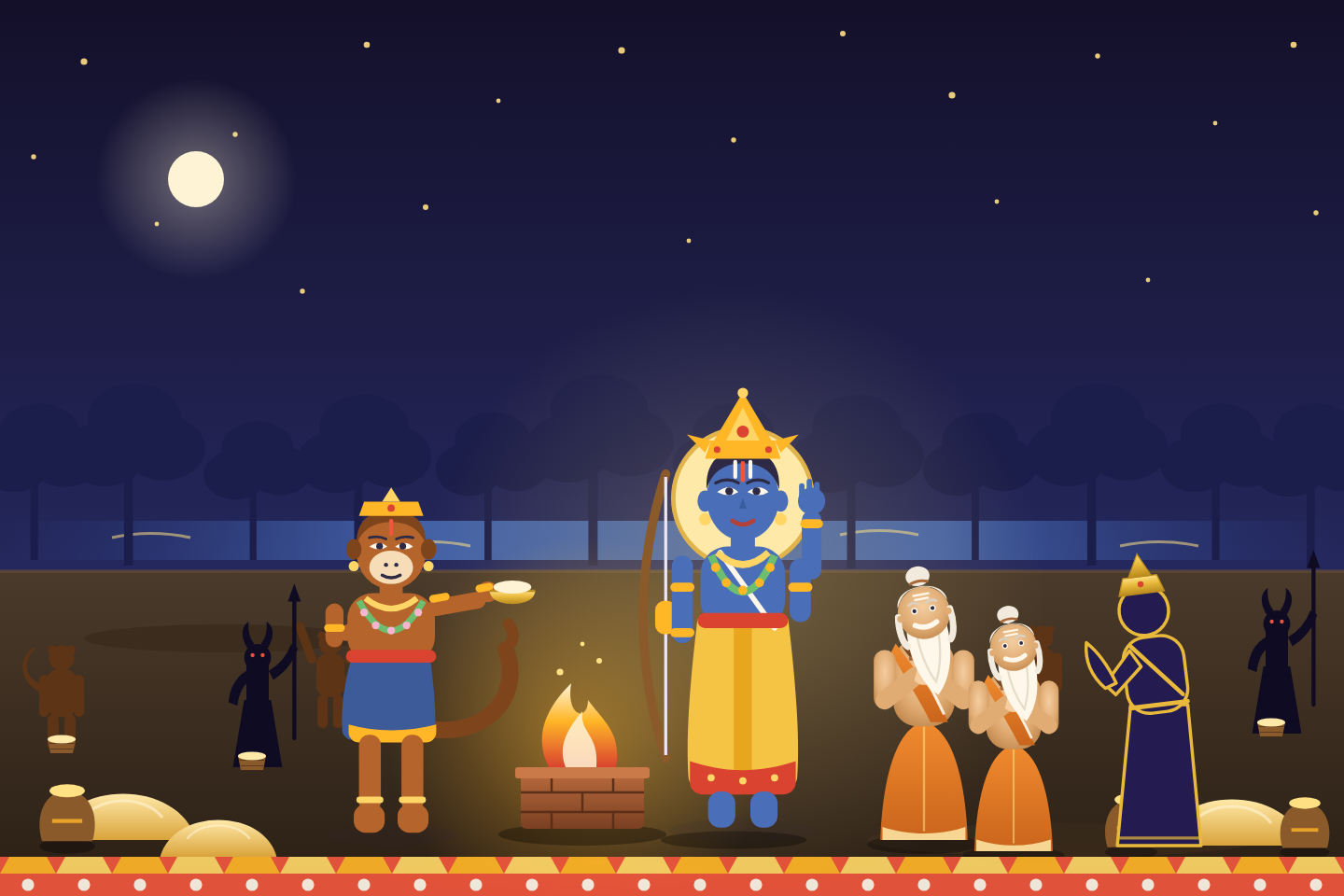
When all the supplies had been sent ahead, Lord Rāma set free the horse. Sage Vālmīki tells us it was mostly black, like the spotted deer, and marked with every auspicious sign. Lakṣmaṇa went with the priests to guard it on its long wandering. Then the Lord rode to Naimiṣa with his army, and when he saw the sacrificial ground laid out among the trees he was so pleased that he said out loud, 'This indeed is auspicious.' Kings from everywhere came bringing him presents, and he honoured each one of them in return, giving food, drink, clothing and whatever else they needed. The great sacrifice began.
Sage Vālmīki
Keep giving until everyone is full
And here is the part people remembered. Noble Sugrīva and his vānaras served clean, carefully prepared food to the Brāhmaṇas, paying attention to every plate. Vibhīṣaṇa and his rākṣasas welcomed the great sages and waited on them. At every corner of that vast camp stood vānaras and rākṣasas together, handing out food, clothes and wealth to anyone who asked, until the person said they had had enough. Sage Vālmīki says that in the whole sacrifice no other sound was heard but this: 'Go on giving, until the needy are satisfied.' Sweets and sugar were given out by the heap. Nobody there was poor. Nobody was unwashed or thin. The oldest, longest-lived sages shook their heads and said they could not remember a sacrifice like it — 'not one by Indra, not Soma, not Yama, not Varuṇa.' And it went on, without a single interruption, for more than a year.
Sage Vālmīki
✦ Two tellings, one story
Sage Vālmīki’s Rāmāyaṇa (Sanskrit)
In the Uttara Kāṇḍa of Sage Vālmīki's Rāmāyaṇa, Lord Rāma tells Lakṣmaṇa to gather Sage Vasiṣṭha, Vāmadeva, Jābāli, Kāśyapa and the Brāhmaṇas who know the aśvamedha, and to invite Sugrīva with the vānaras, Vibhīṣaṇa with the rākṣasas, the friendly kings, the sages, the Brāhmaṇas living abroad with their wives, and dancers and actors. He orders a hundred thousand carriers of rice and ten thousand of sesame, beans, grain, pulses and salt; Bharata brings gold and silver in the hundreds of millions, cooks, carpenters, markets, the citizens and the queen mothers to the holy Naimiṣa forest on the Gomatī, where houses are built for the kings. The Lord sets free a mostly-black horse with auspicious marks, guarded by Lakṣmaṇa and the priests, and goes to Naimiṣa with his army, saying 'This indeed is auspicious.' Kings bring gifts and are honoured. Sugrīva's vānaras serve purified food to the Brāhmaṇas, Vibhīṣaṇa's rākṣasas wait on the sages, and vānaras and rākṣasas stand at every corner giving food, clothes and wealth to all who ask. The only sound heard is 'Go on giving till the needy are satisfied'; no one there is poor or hungry; the eldest sages say not even Indra, Soma, Yama or Varuṇa held such a sacrifice; and it continues unbroken for more than a year.
Gosvāmī Tulsīdās’s Rāmcaritmānas (Awadhi)
Gosvāmī Tulsīdās does not tell the story of this sacrifice. The Uttar-kāṇḍa of the Rāmcaritmānas describes the happy years of Lord Rāma's reign in its own way — the joy of Ayodhyā, the Lord's kindness to all, the visits of sages, and the sons born to the four brothers — but there is no horse set free, no camp at Naimiṣa, and no feast served by vānaras and rākṣasas. That part of the story belongs to Sage Vālmīki alone, and we have not invented a Tulsīdās version of it.
What this story teaches
A great day is measured by who got fed
Gold and gems were given away by the heap, but what the sages remembered was that nobody went hungry. When you plan something big — a birthday, a festival, a team — ask the Lord's question first: will everyone who comes go home full?
Old enemies can stand at the same corner
A few years earlier, vānaras and rākṣasas had fought each other on the field of Laṅkā. Now they stood side by side handing out food. Peace is not only the end of a fight. It is the day you work together.
'Keep giving' is a sound a whole place can make
In the biggest camp in the world, only one sentence was heard. Not 'that's enough', not 'who is this for' — just 'go on giving until they are satisfied'. Try being the person who says that sentence at your own table.
Words to know
- aśvamedha · the horse-sacrifice — the grandest ceremony an ancient king could hold; a horse was set free to wander for a year while a vast rite with feasting and gifts was held at home
- Naimiṣa · a very holy forest on the banks of the river Gomatī, where Lord Rāma held his sacrifice
- Gomatī · the river that flows past the Naimiṣa forest
- Sugrīva · the king of the vānaras and Lord Rāma's friend; he and his vānaras served the food at the sacrifice
- Vibhīṣaṇa · Rāvaṇa's good brother, made king of Laṅkā by Lord Rāma; he and his rākṣasas waited on the sages
- Brāhmaṇas · the priests and learned people who knew how the ceremonies were to be performed
Told from Sage Vālmīki's Rāmāyaṇa — Uttara Kāṇḍa (the preparations for the aśvamedha and the sacrifice at Naimiṣa). Gosvāmī Tulsīdās's Rāmcaritmānas — Uttar-kāṇḍa — does not contain this episode.