Kids · बालकाण्ड Bāla Kāṇḍa · Ages 8–12
The Sage Who Asked for a Face Like the Lord's
Why did the Lord of the whole universe come down to earth and live as a prince called Rāma? In the Rāmcaritmānas, Lord Śiva tells Mother Pārvatī that there is more than one answer — a different story for a different age of the world. And one of those stories begins not with a demon, but with a very good sage who was, for a little while, rather too pleased with himself.
This is the story of Sage Nārada, his vīṇā, a city that was never really there, and a curse that the Lord said yes to with a smile.
The cave where love could not get in
High in the Himālayas there was a holy cave, with the river Gaṅgā flowing close by. Sage Nārada saw it and loved it so much that he sat down there to meditate on the Lord — and his mind went so still and so deep that he forgot the world altogether. Up in heaven, Indra, the king of the gods, grew nervous. 'What if this sage wants my throne?' he thought, like a foolish dog guarding a dry bone from a lion. So he sent Kāmadeva, the god of love, to disturb him. Kāmadeva turned the mountain into springtime — flowers, cuckoos, soft breezes, dancers singing — but not one of his tricks could touch the sage. Frightened, Kāmadeva fell at Sage Nārada's feet and asked to be forgiven. And the sage was not angry at all. He spoke kindly, and sent him home.
Gosvāmī Tulsīdās
The story he was told not to tell
Now Sage Nārada had beaten the god of love — and he knew it. He went straight to Lord Śiva and told him the whole story. Lord Śiva loved the sage dearly, and so he gave him a warning: 'I beg you again and again — never tell this story to Lord Hari. If it ever comes up in front of him, hush it up.' But the advice did not please the sage. He went to Brahmā's realm, and then, with his vīṇā in his hands and a song on his lips, he went down to the ocean of milk, where Lord Viṣṇu rested. The Lord rose to welcome him, sat him beside himself, and asked what news he brought. And Sage Nārada told him everything. 'Delusion can only touch a mind without wisdom,' said the Lord gently. 'Love could never trouble you.' 'It is all your grace, Lord,' the sage replied — but there was pride in his voice. The Lord looked into his heart and saw a great tree of pride just beginning to sprout. 'I will pull it out by the roots,' he decided, 'because I have vowed always to do what is best for those who serve me.'
Gosvāmī Tulsīdās
The city that was not there
So, on the sage's road home, the Lord's māyā — his power of illusion — built a city a hundred yojanas wide, more splendid than the Lord's own heaven. A king named Śīlanidhi ruled there, and he had a daughter named Viśvamohinī, so lovely that even Goddess Lakṣmī would have gazed at her. She was about to choose a husband in a svayaṁvara, and kings beyond counting had come. Sage Nārada walked in, curious, and the king welcomed him, brought out the princess and said, 'Holy sir, read her marks and tell me her fortune.' The sage looked at her — and forgot his meditation, his cave, his vows, everything. He read in her marks that whoever married her would never die and never lose a battle. He kept that to himself, told the king a few made-up things, and walked out with one thought in his head: how can I make her choose me?
Gosvāmī Tulsīdās
'Give me your own face'
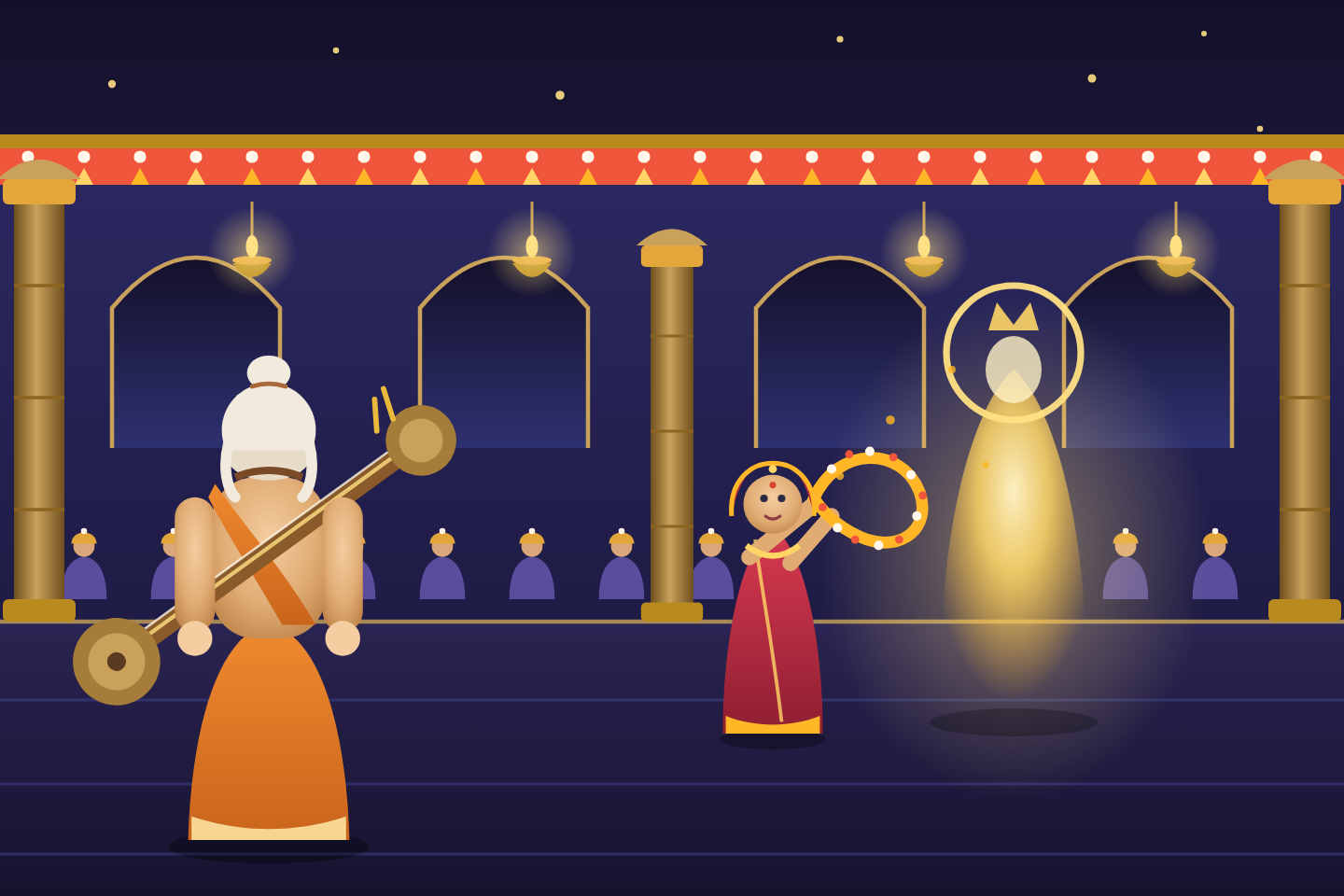
'I need to be beautiful,' the sage said to himself, 'and no one is more beautiful than Lord Hari. He is my only true friend — let him help me now.' He prayed with all his heart, and the Lord appeared before him. 'Give me your own form, Lord,' Sage Nārada begged. 'There is no other way I can win her. Do quickly whatever is best for me — I am your servant.' The Lord smiled to himself and answered carefully: 'Nārada, listen. I will do only what is truly good for you, and nothing else. My word is never false. When a sick man asks for something that will harm him, the doctor does not give it to him.' And with that, he vanished. The sage was so lost in the spell that he could not understand even those plain words. He hurried to the hall, certain that the princess could not possibly choose anyone but him.
Gosvāmī Tulsīdās
The garland
The kings sat in their rows in all their finery, and Sage Nārada sat among them, very sure of himself. He did not know that, for his own good, the Lord had changed his face — and that to the princess, and to her alone, he now looked like a vānara. Two of Lord Śiva's attendants had slipped in dressed as brāhmaṇas. They knew the secret, and they teased him: 'Hari has given this one a fine face — the princess is sure to pick him!' The sage heard, and did not understand. Then Princess Viśvamohinī came gliding like a swan with the garland in her hands. She looked at every king — and never once at the sage, however much he fidgeted. Then the Lord himself entered, in the form of a king, and she placed the garland round his neck, and he led her away. The sage felt as if a jewel had slipped from a knot in his robe. 'Go and look at your face in a mirror,' said the two attendants, smiling — and ran. He bent over the water and saw. His anger blazed. 'Be born as demons, both of you!' he cried after them.
Gosvāmī Tulsīdās
The curse the Lord said yes to
When he looked in the water again, his own face was back — but his heart was not. He set off to find the Lord and curse him too. And there on the road stood the Lord, with Goddess Lakṣmī and the princess at his side. 'Where are you going in such distress, holy one?' he asked kindly. The sage, still deep in the spell, poured out angry words he would never otherwise have spoken, and then the curse: 'You have made me look like a vānara — so vānaras shall be your helpers. You have parted me from the one I wanted — so you too shall suffer the pain of being parted from your wife.' The Lord accepted the curse gladly, as if it were a gift, begged the sage's pardon many times over — and drew back his māyā. The goddess, the princess, the city: all gone. Sage Nārada stood on an empty road and understood everything. He fell at the Lord's feet, trembling. 'Let my curse come to nothing, Lord! I said such terrible things — how can I ever make it right?' 'It was my will,' the Lord said. 'Go and repeat Lord Śiva's name a hundred times, and your heart will be at peace. No one is dearer to me than Śiva.' Then he was gone, and the sage went on his way singing the glories of Lord Rāma. He even softened his curse on the two attendants: they would be born as mighty demons, yes — but they would die at the Lord's own hands and be set free. And that, says Gosvāmī Tulsīdās, is one reason why, in one age of the world, the Lord came to earth as a man.
Gosvāmī Tulsīdās
✦ Two tellings, one story
Sage Vālmīki’s Rāmāyaṇa (Sanskrit)
Sage Vālmīki does not tell this story at all. In his Bāla Kāṇḍa, Sage Nārada appears only at the very beginning — as the wise visitor who tells Sage Vālmīki the whole story of Lord Rāma in brief, which the poet then sets to verse. There is no cave in the Himālayas, no city made of māyā, and no curse. For Sage Vālmīki, the reason for Lord Rāma's birth is the one the gods give: to end the tyranny of Rāvaṇa.
Gosvāmī Tulsīdās’s Rāmcaritmānas (Awadhi)
This is Gosvāmī Tulsīdās's story, told in his Bāl-kāṇḍa by Lord Śiva to Mother Pārvatī when she asks why the Lord took a human form. Tulsīdās gives it in full — the cave, Kāmadeva's defeat, Lord Śiva's warning, the pride that sprouted 'like a tree', King Śīlanidhi's city, the two attendants in disguise, the garland, the curse, and the Lord's glad acceptance of it — and he ends it with a gentle moral: there is no god, man or sage whom the Lord's māyā cannot bewilder, so one should adore the Lord of that māyā.
What this story teaches
Pride slips in right after a victory
Sage Nārada had done something wonderful — and that was exactly when the tree of pride began to sprout. The moment you have done well is the moment to be most careful.
A true friend gives you what is good, not what you ask for
The Lord compared himself to a doctor who will not hand a sick man the thing that would hurt him. Sometimes 'no' is the kindest answer there is.
The Lord turned a curse into a blessing
Angry words spoken in confusion were forgiven in a moment. And out of them the Lord made the loveliest of plans — a birth on earth as Lord Rāma, with the vānaras as his dearest helpers.
Words to know
- Nārada · A heavenly sage who travels everywhere singing the Lord's praises on his vīṇā.
- vīṇā (वीणा) · A long stringed instrument with a round gourd at each end.
- māyā (माया) · The Lord's power to make things seem real — like a whole city on an empty road.
- svayaṁvara (स्वयंवर) · A ceremony where a princess chooses her own husband, often by placing a garland on him.
- Kāmadeva · The god of love, whose arrows make hearts restless.
- kalpa (कल्प) · A whole age of the world; the Lord has come to earth in many of them.
Rāmcaritmānas, Bāl-kāṇḍa — the stretch from dohā 124 to dohā 139 (Lord Śiva's telling to Mother Pārvatī). Sage Vālmīki's Bāla Kāṇḍa does not tell this episode.