Kids · उत्तरकाण्ड Uttar Kāṇḍa · Ages 8–12
The Sage Who Came to Sing
Not every story in the Rāmāyaṇa is about a battle. Some of the loveliest are about an ordinary afternoon — a king who is tired, a brother who spreads out his scarf, a friend who waves a fan, and a visitor who arrives with a song. This is one of those.
Gosvāmī Tulsīdās tells it in the Uttar-kāṇḍa of the Rāmcaritmānas, in the peaceful years after Lord Rāma was crowned king of Ayodhyā. It comes straight after the day Sage Vasiṣṭha visited the palace. Sage Vālmīki's Rāmāyaṇa does not have this scene, and we will say so at the end. This is the Tulsīdās telling — and, like the whole Rāmcaritmānas, it is told by Lord Śiva to Mother Pārvatī.
A gift for everyone
When Sage Vasiṣṭha had gone home, Lord Rāma was glad in his heart. He called Hanumān Jī, and his brothers Bharata, Lakṣmaṇa and Śatrughna, and walked out of the city with them. 'Bring the elephants,' he said. 'Bring the chariots and the horses.' And they were brought — rows and rows of them, stamping and snorting in the sunshine. Then the Lord looked kindly at all the people who had gathered, praised every one of them, and began to give the animals away. Each person was given what they deserved, and each person was given what they had been wishing for. No one went home empty-handed.
Gosvāmī Tulsīdās
The cool mango grove
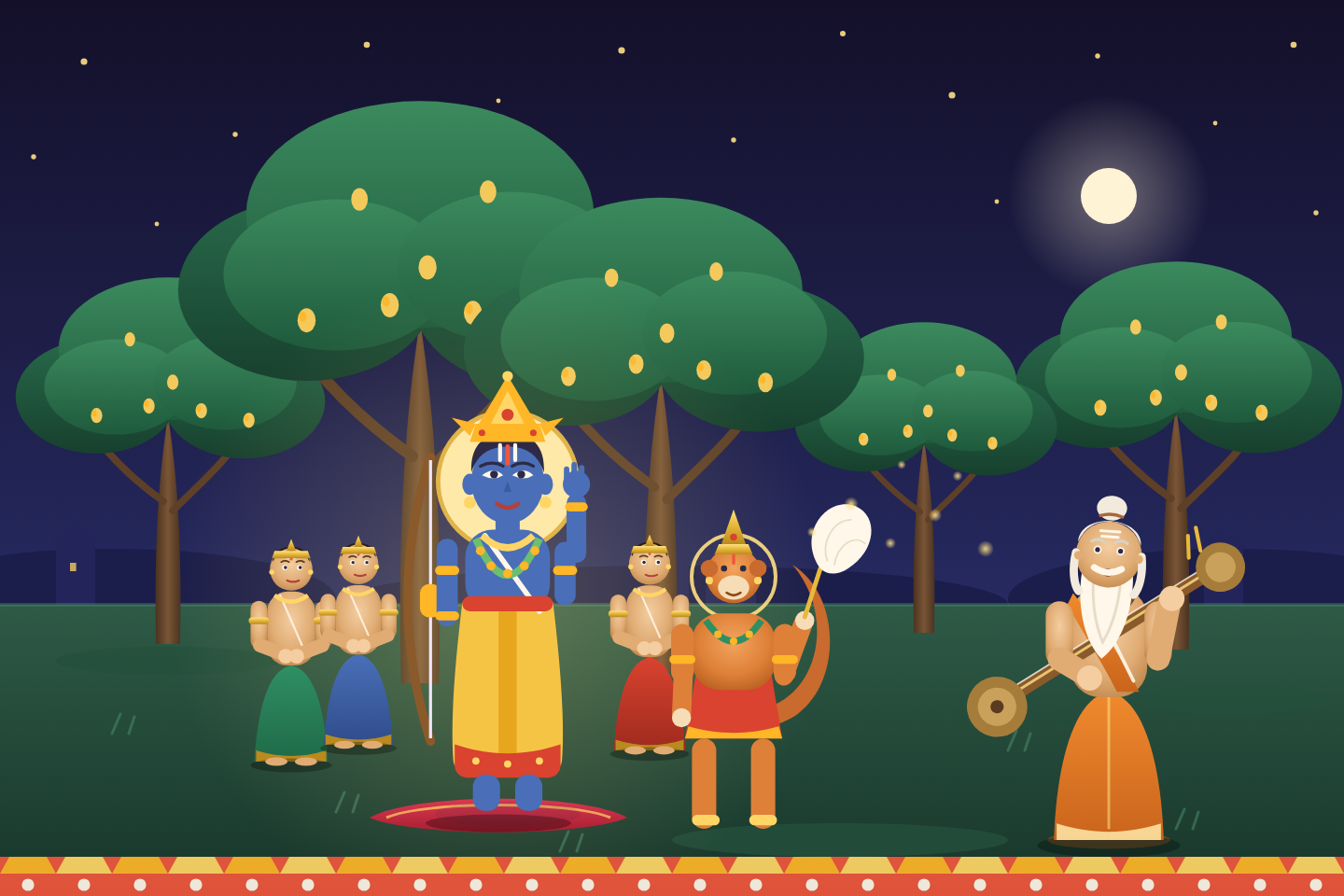
Now here is something to notice. Lord Rāma is the one who takes away everyone else's tiredness — and that day, he was tired himself. So he walked into a cool mango grove nearby, where the leaves made a green roof against the sun. Bharata quickly took off his own scarf and spread it on the ground, and the Lord sat down on it, with all three brothers standing close by to serve him. Hanumān Jī picked up a fan and began to wave it gently over the Lord. As he did, a thrill of joy ran through his whole body, and his eyes filled with tears. Lord Śiva, who is telling this story, stops here to say something to Mother Pārvatī: 'O daughter of the mountain, there is no one so blessed as Hanumān Jī, and no one who loves Lord Rāma's feet as he does. The Lord himself has praised his love and his service, again and again, with his own mouth.'
Gosvāmī Tulsīdās
A sage with a vīṇā
And at that very moment, someone came. It was Sage Nārada — the wandering sage who travels between heaven and earth, and who always carries a vīṇā, a long stringed instrument with a round gourd at each end. He lifted his vīṇā and began to sing the sweet renown of Lord Rāma. Gosvāmī Tulsīdās says this renown is sadā nabīna — always new. However many times it is sung, it never gets old, like a flower that is somehow fresh every single morning.
Gosvāmī Tulsīdās
What the sage sang
This is some of what Sage Nārada sang, there under the mango trees. 'Look at me, O lotus-eyed Lord, with your kind glance — you who take away all worry. You are dark as the blue lotus. You shatter the strength of the demon armies, and you bring delight to the sages and the good. To the Brāhmaṇas you are like a bank of fresh rain-clouds to a thirsty crop. You are the shelter of those who have no shelter, and the friend of those in trouble. Hail, Slayer of Rāvaṇa, noblest of kings, a moon to the lily that is King Daśaratha's line! Your fame is sung wherever gods and sages and saints gather. Your very name washes away the dirt of this dark age. Protect the one who bows before you.' And right at the end of the song, the poet does something cheeky and beautiful: he slips his own name into it. 'O Lord of Tulsīdās,' the last line says — as if Gosvāmī Tulsīdās, hundreds of years later, were standing in the grove and singing too.
Gosvāmī Tulsīdās
A treasure carried in the heart
When the song was over, Sage Nārada did not ask for a gift. He did not need one. Gosvāmī Tulsīdās says that having lovingly sung the whole catalogue of Lord Rāma's virtues, the sage went back to Brahmā's abode — and that he carried the Lord, the Ocean of beauty, enshrined in his heart. Think about that for a moment. The elephants and chariots had gone to people who could hold them in their hands. Sage Nārada went home with his hands empty and his heart completely full.
Gosvāmī Tulsīdās
Drops of rain, grains of sand
Then Lord Śiva turns to Mother Pārvatī, whom he also calls Girijā and Umā. 'Listen, Girijā,' he says. 'I have told you this holy story as well as I know how. But the stories of Lord Rāma have no end. Not even the Vedas, not even Śāradā, the goddess of speech, could tell them all. You might manage to count the drops of water in a shower of rain, or the grains of sand on a beach — but you could never count all the deeds of the Lord of the Raghus.' And Mother Pārvatī answers softly, 'I am blessed, I am blessed, I am blessed to have heard this.' So the next time someone tells you they have heard every story about Lord Rāma — you will know that is not possible. There is always one more.
Gosvāmī Tulsīdās
✦ Two tellings, one story
Sage Vālmīki’s Rāmāyaṇa (Sanskrit)
Sage Vālmīki's Rāmāyaṇa does not have this scene. There is no afternoon in a mango grove, and no song by Sage Nārada with his vīṇā in the years of Lord Rāma's reign. Sage Nārada does have a very special place in Sage Vālmīki's telling, though: at the very beginning of the epic, in the Bāla Kāṇḍa, it is Sage Nārada who first tells Sage Vālmīki the story of Lord Rāma — so in a way, the whole of that Rāmāyaṇa begins with Nārada speaking about the Lord. But the grove and the song belong to Gosvāmī Tulsīdās alone, and we have not invented a Vālmīki version of them.
Gosvāmī Tulsīdās’s Rāmcaritmānas (Awadhi)
In the Uttar-kāṇḍa of the Rāmcaritmānas, after Sage Vasiṣṭha's visit, Lord Rāma goes outside Ayodhyā with Hanumān Jī and his brothers, has elephants, chariots and horses brought, and gives them away — to each what they deserve and what they wish for. Tired, he rests in a cool mango grove on Bharata's own scarf, with his brothers attending and Hanumān Jī fanning him, thrilled and in tears; Lord Śiva tells Pārvatī that no one is so blessed or so devoted as Hanumān Jī. Then Sage Nārada arrives, vīṇā in hand, and sings the Lord's ever-fresh renown: the lotus-eyed reliever of worry, dark as the blue lotus, breaker of demon hosts, delight of sages, rain-cloud to a thirsty crop, refuge of the helpless, Slayer of Rāvaṇa, moon to Daśaratha's line, whose name wipes away the impurities of the Kali age — ending 'protect the suppliant, O Lord of Tulsīdās'. Having lovingly recounted the Lord's virtues, Nārada returns to Brahmā's abode with the Ocean of beauty enshrined in his heart. Lord Śiva then tells Girijā that the stories of Rāma are endless — one could count raindrops or grains of sand sooner — and Umā replies that she is thrice blessed to have heard them.
What this story teaches
Even the strongest need to rest — and the kindest thing is to help them
Lord Rāma takes away everyone else's tiredness, and that day he was tired too. Bharata spread his scarf. Hanumān Jī picked up a fan. Neither of them did anything grand. They just noticed, and helped.
Praise is a gift you can always give
Sage Nārada did not bring gold or a chariot. He brought a song about how good the Lord was. Telling someone, out loud, the good you see in them costs nothing — and it is one of the finest presents there is.
The best treasures are carried in the heart
Everyone else went home with something in their hands. Sage Nārada went home with his hands empty and his heart full of the Lord's beauty. Things in your hands can be lost or broken. What you keep in your heart stays with you.
Words to know
- Nārada · a wandering sage who travels between the heavens and the earth, famous for his vīṇā and for singing the Lord's praises
- vīṇā · an ancient Indian stringed instrument with a long neck and a round gourd at each end; Sage Nārada is almost always shown carrying one
- Brahmā · the creator god; Sage Nārada came down from his abode and returned to it after the song
- sadā nabīna · 'always new' — the poet's words for Lord Rāma's renown, which never grows old however often it is sung
- Girijā / Umā · names of Mother Pārvatī, daughter of the mountain-king Himālaya, to whom Lord Śiva tells the whole Rāmcaritmānas
- Śāradā · the goddess of speech and learning; even she, says Lord Śiva, could not tell all of Lord Rāma's stories
Told from the Rāmcaritmānas of Gosvāmī Tulsīdās — Uttar-kāṇḍa, dohās 50–51 and the caupāīs and chanda around them (the mango grove, Sage Nārada's song, and Lord Śiva's words to Girijā). Sage Vālmīki's Rāmāyaṇa — Uttara Kāṇḍa — does not contain this episode; Sage Nārada's role as the first teller of the story is from its Bāla Kāṇḍa.