Kids · सुन्दरकाण्ड Sundara Kāṇḍa · Ages 8–12
The Search Through the Sleeping City
Laṅkinī, the guardian of the gate, has bowed and stepped aside. Now tiny Hanumān Jī — no bigger than a gnat, says Gosvāmī Tulsīdās; no bigger than a cat, says Sage Vālmīki — stands inside the golden city of Rāvaṇa. It is the middle of the night. Somewhere in this maze of palaces, Mother Sītā is a prisoner.
This is the story of the longest night of Hanumān Jī's life: how he searched a city of demons house by house, how a good man was found living in a wicked place, how even the bravest heart nearly gave up — and how hope was waiting under a tree.
A city of gold, fast asleep
Laṅkā by night was a wonder. Its mansions rose seven storeys high, their walls set with jewels. Golden lamps glowed in the windows. Down every lane lay sleeping rākṣasas — some huge, some horned, some snoring like thunder — with their weapons beside them. Remembering Lord Rāma in his heart, tiny Hanumān Jī crept from house to house. He peeped into every room. He looked in every garden. But nowhere did he see Mother Sītā.
In both Rāmāyaṇas
The palace of the ten-headed king
At last he came to the grandest palace of all, so marvellous that the poets say it cannot be described. This was Rāvaṇa's own home. Hanumān Jī slipped inside, past sleeping guards, past halls of silver and gold — and there lay the ten-headed king himself, deep in sleep, his great chest rising and falling. Hanumān Jī searched every corner of the palace. Mother Sītā was not there either.
In both Rāmāyaṇas
The house with tulasī at the door
Then Hanumān Jī noticed a house unlike any other. On its walls were painted Lord Rāma's bow and arrow. In its courtyard grew clusters of fresh, green tulasī. "Laṅkā is a nest of demons," he wondered. "How can a good person be living here?" Just then the master of the house woke and began softly saying "Rāma, Rāma." It was Vibhīṣaṇa, Rāvaṇa's youngest brother. Hanumān Jī took the form of a brāhmaṇa and spoke to him — and when he told him who he was and whose messenger he was, the two of them wept with joy. "I live here like a tongue between the teeth," said Vibhīṣaṇa. "Will the Lord ever show his grace to one like me?" Then he told Hanumān Jī the way to the Aśoka grove, where Mother Sītā was kept.
Gosvāmī Tulsīdās
The night the brave heart nearly broke
In Sage Vālmīki's telling, Hanumān Jī had no friend to point the way. He searched on and on, and found nothing. And for the first time in his life, the mighty vānara grew afraid. "What if she is no longer alive?" he thought. "What shall I tell Lord Rāma? What shall I tell the vānaras waiting on the shore?" He sat in the dark, and despair crept over him. But then Hanumān Jī gave himself a talking-to. "Not giving up is the root of all success," he said. "Not giving up is the greatest happiness. Whatever a person does, it is not giving up that makes it bear fruit." He stood, bowed to the gods, and went to search the one place he had not yet looked — a grove of aśoka trees.
Sage Vālmīki
Under the śiṁśapā tree
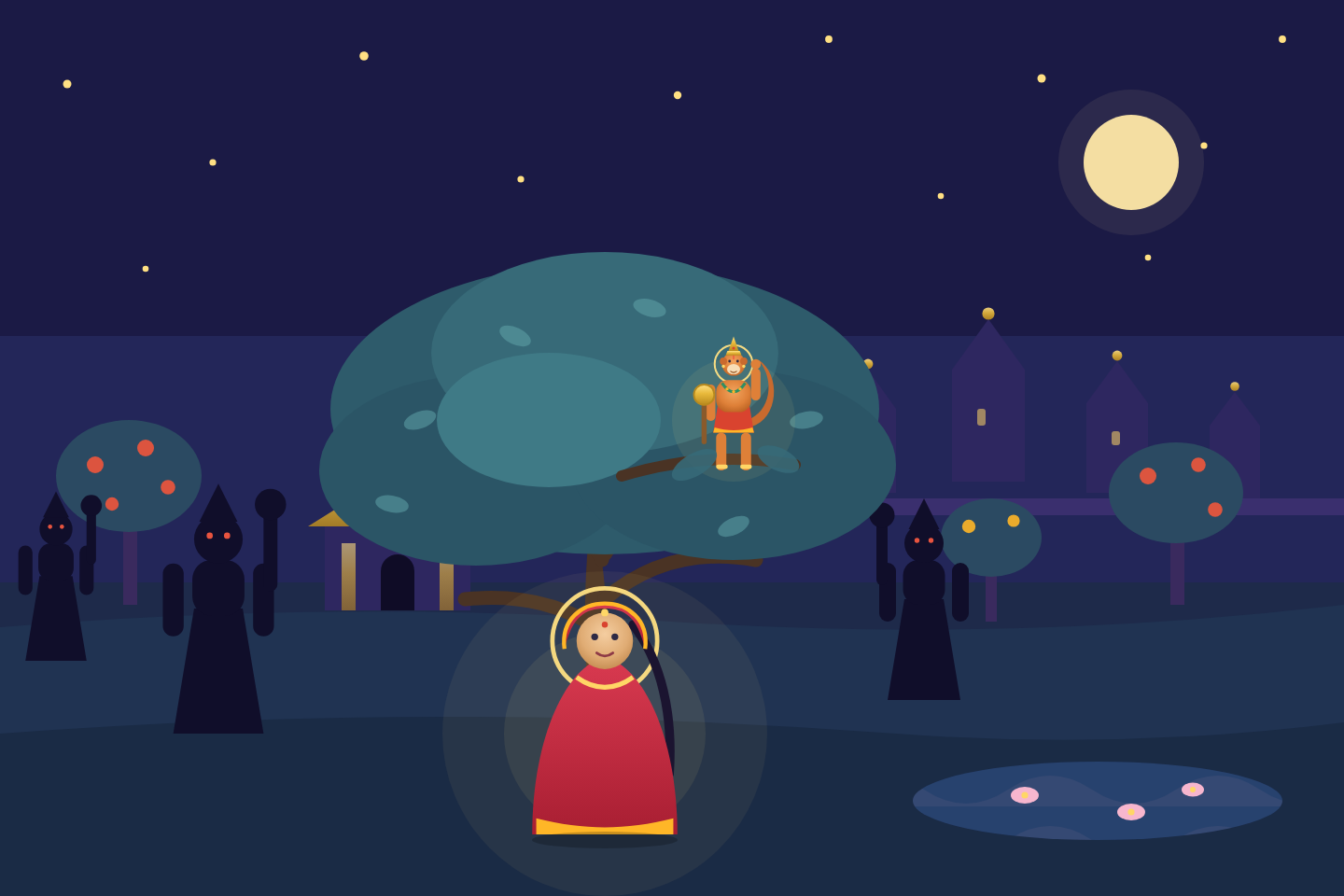
The grove was the loveliest place in all of Laṅkā, full of flowering trees and golden pavilions. Hanumān Jī climbed a great śiṁśapā tree, its leaves thick enough to hide him, and looked down. And there below him sat a lady in a single worn cloth, thin from fasting, her hair in one long braid, her eyes fixed on her own feet. All around her sat fierce rākṣasīs, set to guard her. But her lips were moving. She was whispering the name of Lord Rāma, over and over.
In both Rāmāyaṇas
"It is she"
Hanumān Jī's heart leapt and ached at the same time. He knew her at once — the same gentle face Lord Rāma had described to him, the same beauty that shone even through sorrow, like a flame wrapped in smoke. He folded his hands and bowed to her in his heart. "It is she," he whispered. "It is Mother Sītā." The search was over. Now the messenger had only to find a way to speak to her — and that, as you will hear, took the cleverest idea of all.
In both Rāmāyaṇas
✦ Two tellings, one story
Sage Vālmīki’s Rāmāyaṇa (Sanskrit)
Sage Vālmīki spends many cantos on this night. Hanumān Jī, cat-sized, enters Laṅkā by moonlight and searches the mansions of the great rākṣasas one by one — Prahasta's, Kumbhakarṇa's, even Vibhīṣaṇa's, though there is no meeting with him here — and then Rāvaṇa's own palace and his flying chariot, Puṣpaka. Finding nothing, he sinks into despair and fears Mother Sītā has perished; he even thinks of never returning. Then he lifts himself with the famous words that not despairing is the root of prosperity and the source of all achievement, prays to the gods and ṛṣis for success, and enters the Aśoka grove. From the śiṁśapā tree he sees a lady surrounded by ogresses, thin with fasting, in a single yellow cloth, and knows her by her beauty and her grief.
Gosvāmī Tulsīdās’s Rāmcaritmānas (Awadhi)
Gosvāmī Tulsīdās tells it swiftly and adds a meeting Vālmīki does not have. Hanumān Jī, gnat-sized, remembers the Lord and enters, searches every mansion, and finds Rāvaṇa asleep. Then he sees a house apart — a temple of Śrī Hari, Lord Rāma's bow and arrow painted on its walls, tulasī growing in its yard — and wonders how a good man can live among demons. Vibhīṣaṇa wakes saying "Rāma, Rāma"; Hanumān Jī appears as a brāhmaṇa, they recognise each other, and Vibhīṣaṇa confesses that he lives in Laṅkā like a tongue among teeth and longs for the Lord's grace. Vibhīṣaṇa tells him where Mother Sītā is and how to see her. In the Aśoka grove Hanumān Jī finds her thin, her hair in a single braid, her eyes on her own feet and her heart on Lord Rāma's, and bows to her in his mind.
What this story teaches
Look for the tulasī
Even in a city of demons, Hanumān Jī found one house with tulasī at the door. Wherever you go, there is someone good. Look for them, and be the tulasī house for someone else.
Not giving up is the root of success
The bravest hero in the story had a moment when he wanted to quit. He didn't scold himself for feeling it — he simply stood up and searched the one place left. That is what courage looks like from the inside.
Small and quiet can still be strong
Mother Sītā had no army and no weapon. She had a name on her lips and her eyes on her own feet. Sometimes the strongest thing in a room is the person who refuses to stop hoping.
Words to know
- Laṅkā (लंका) · Rāvaṇa's golden island city, built on Mount Trikūṭa.
- tulasī (तुलसी) · The sacred basil plant, grown in the courtyards of devout homes.
- Vibhīṣaṇa (विभीषण) · Rāvaṇa's youngest brother — the one good man of Laṅkā, who loved Lord Rāma.
- Aśoka grove (अशोक वाटिका) · The beautiful garden where Mother Sītā was held captive; aśoka means 'without sorrow'.
- śiṁśapā (शिंशपा) · The leafy tree in the grove under which Mother Sītā sat, and in whose branches Hanumān Jī hid.
- anirveda (अनिर्वेद) · Not giving up; not losing heart — the word Hanumān Jī used to lift himself out of despair.
Vālmīki Rāmāyaṇa — Sundara Kāṇḍa (the search of Laṅkā, Hanumān Jī's despair and resolve, and the Aśoka grove); Rāmcaritmānas — Sundara Kāṇḍa (the entry into Laṅkā, the meeting with Vibhīṣaṇa, and the first sight of Mother Sītā). Retold for young readers; where the two tellings differ, both are given.