Kids · लङ्काकाण्ड Laṅkā Kāṇḍa · Ages 8–12
The Serpent-Arrows and the Coming of Garuḍa
The first day of the war is over. Rāvaṇa's warriors have run back inside the walls, and the vānaras are singing. But the most dangerous person in Laṅkā has not been beaten. He has only been embarrassed. Meghanāda — the prince the gods call Indrajit, because he once defeated Indra, the king of the gods himself — has had his chariot smashed and his horses killed by Prince Aṅgada, and he has vanished into thin air. Sage Vālmīki says he was very, very angry.
Meghanāda has a gift no other warrior has. By a boon from Brahmā, the Creator, he can fight without being seen. And he has a weapon that is worse than any sword: the nāgapāśa, the snare of serpents. Tonight he is going to use both. Hold on — this is the darkest hour in the whole war, and it is also the story of how help arrives.
Arrows from nowhere
It begins with a sound, not a sight. Lances, pikes, axes and stones come whistling out of the empty air, and then arrows — so many that the sky is covered with them, the way the clouds pour down rain in the monsoon month. 'Seize them! Kill them!' cries a voice, and nobody can see whose voice it is. The vānaras snatch up rocks and trees and leap into the sky, but there is no one there to hit, and they come down again, bewildered. Hanumān Jī, Aṅgada, Nala, Nīla — every great hero is hit. Lakṣmaṇa, King Sugrīva and Vibhīṣaṇa are pierced through. Meghanāda is fighting from inside the clouds, and nobody can lay a hand on him.
In both Rāmāyaṇas
The snare of serpents
Then he turns on Lord Rāma himself. And here the arrows do something terrible: the moment they strike, they become living snakes. Sage Vālmīki says they were the sons of Kadru, the mother of all serpents — sharp-fanged, full of poison, turned into arrows by Meghanāda's magic. Coil after coil, they wrap around Lord Rāma and Lakṣmaṇa until the two brothers cannot move an arm. In the Mānas, Gosvāmī Tulsīdās stops the story right here to tell us something. The Lord who is free of everything, he says, allowed himself to be bound — like an actor playing a part — to give the battle a glory of its own. Even the gods watching from the sky were dismayed. But the Lord was never truly caught.
In both Rāmāyaṇas
The night the vānaras wept
The two brothers lie on the ground, still as fallen banners, and the whole army gathers round them. Hanumān Jī stands at their head. Nobody speaks. Sage Vālmīki says the vānaras' eyes filled with tears, and that Meghanāda went home to Laṅkā and told his father the war was won. Rāvaṇa even sends Mother Sītā over the field in the flying chariot Puṣpaka so that she will see her husband lying there and lose hope. She cries out. But the kind rākṣasī Trijaṭā, beside her, says, 'Look at the vānaras. An army whose lord is dead runs away. This one is standing guard. Your Lord is alive.' And she takes Mother Sītā home.
Sage Vālmīki
Jāmbavān's answer
In the Mānas the old bear-king does not wait to weep. When Meghanāda finally shows himself and starts shouting insults, Jāmbavān says, 'Stand still a moment, wretch.' The prince is furious — 'I only spared you because you are old!' — and hurls his shining trident. Jāmbavān catches it in his hand. He strikes Meghanāda in the chest with his own weapon, seizes him by the foot, swings him round, and flings him all the way back over the walls into Laṅkā. It does not kill him; a boon protects his life. But it clears the sky. And far away, the sage Nārada sees what has happened and sends for the one creature in the universe that every snake is afraid of.
Gosvāmī Tulsīdās
The wind before the wings
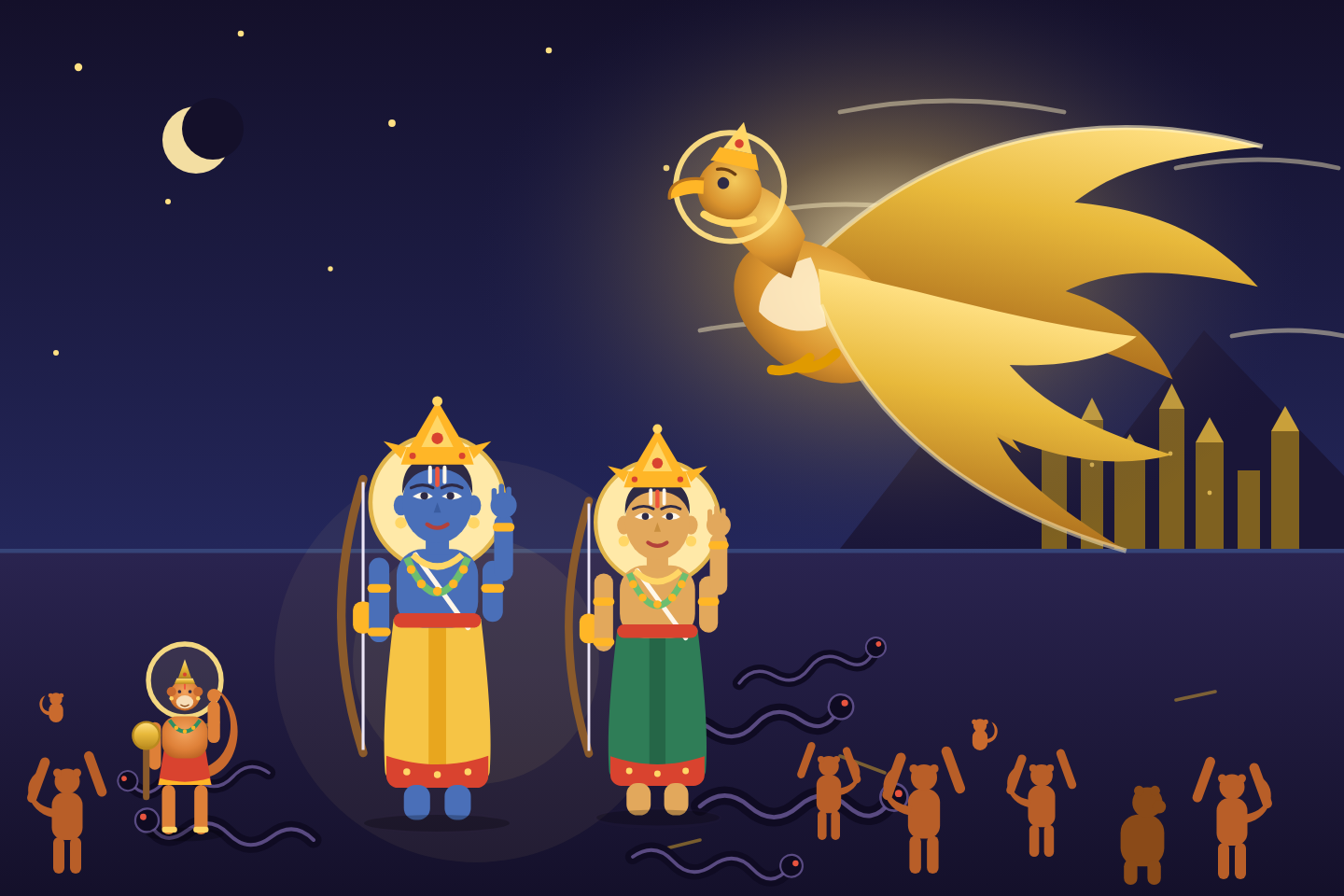
Sage Vālmīki tells it like a storm. First a wind rises out of nowhere, so strong that the trees of Laṅkā bend and break and the sea itself is whipped into waves. The great snakes of the island slide into the ocean to hide. Then the vānaras look up, and there he is, blazing like a fire in the night sky: Garuḍa, the king of birds, the son of Vinatā, who carries Lord Viṣṇu himself. The moment the serpent-arrows see him they let go. Every snake flees — and never comes back. In the Mānas he does not even give them the chance: the king of birds simply seizes the whole swarm of Meghanāda's magic snakes and swallows them. The spell is broken.
In both Rāmāyaṇas
Your very breath, moving outside you
Garuḍa lifts the two princes up in his arms and wipes their faces with his hands, and where he touches them every wound closes. Their strength comes back doubled. Lord Rāma looks at this shining stranger and asks, 'Who are you?' And the great bird answers: 'I am Garuḍa, your beloved friend — your very breath, moving outside you. I heard that serpents had bound you and I came at once.' Then he gives one warning: 'Never trust a rākṣasa on the battlefield. They fight by tricks; your strength is that you do not.' He walks around Lord Rāma the way you walk around a temple, embraces him, and rises into the sky with the speed of the wind. Behind him the vānaras roar like lions, beat their drums, blow their conches, tear up trees — and run for the gates of Laṅkā.
Sage Vālmīki
✦ Two tellings, one story
Sage Vālmīki’s Rāmāyaṇa (Sanskrit)
In Sage Vālmīki's Yuddha Kāṇḍa the binding comes at the end of the first night's battle. Indrajit, beaten by Aṅgada and protected by Brahmā's boon, fights invisibly and shoots arrows that are really the venomous sons of Kadru, binding Lord Rāma and Lakṣmaṇa so tightly that the brothers fall. The vānaras despair; Indrajit tells Rāvaṇa the war is won; Mother Sītā is carried over the field in Puṣpaka and consoled by Trijaṭā; Lord Rāma wakes and weeps for Lakṣmaṇa; the vānaras even flee from Vibhīṣaṇa, mistaking him for Indrajit, until Jāmbavān calls them back. Then a great wind rises, Garuḍa appears blazing like fire, the serpents flee at the sight of him, he heals the brothers with his touch, names himself Lord Rāma's friend and 'very breath moving outside', warns him never to trust rākṣasas in battle, and departs.
Gosvāmī Tulsīdās’s Rāmcaritmānas (Awadhi)
Gosvāmī Tulsīdās tells it more briefly and puts a teaching at its heart. Meghanāda rains weapons from the sky unseen, wounds every hero, and his arrows become serpents that bind Lord Rāma — but the Mānas says at once that the ever-free Lord allowed this, like an actor playing a part, to lend the battle glory; Lord Śiva asks Pārvatī how the One whose name cuts the bonds of the world could ever truly be bound. Jāmbavān then catches Meghanāda's trident, strikes him with it, whirls him by the foot and hurls him into Laṅkā. The sage Nārada sends Garuḍa, who arrives in an instant and devours the whole swarm of magic snakes; the charm is dispelled, the vānaras rejoice and charge, and the rākṣasas flee up onto the fort.
What this story teaches
The darkest hour is still an hour
Everyone on that field thought the story was over. It was not even the middle. When something goes badly wrong, remember that you are standing inside one hour of a much longer day, and that you cannot see yet who is already on the way.
Help can come from a friend you never thought to call
Nobody on the battlefield sent for Garuḍa. Nārada did, far away, and Garuḍa came because he loved Lord Rāma. Some of the people who will help you most are not the ones you are looking at — so be the kind of person friends fly to.
Tricks are a weakness, not a strength
Meghanāda could only win by hiding. Garuḍa's one warning was to expect that, and never to copy it. Winning by trickery is a way of admitting you cannot win fairly. Fight in the open, and let your strength be that you do not need to hide.
Words to know
- nāgapāśa (नागपाश) · 'The snare of serpents' — Meghanāda's magic weapon: arrows that turn into living snakes and bind whoever they strike.
- Garuḍa (गरुड) · The king of birds, son of Vinatā, who carries Lord Viṣṇu. Every serpent in the world is afraid of him — which is why the snake-bonds fled the moment he appeared.
- Indrajit (इन्द्रजित्) · 'Conqueror of Indra' — the title Meghanāda earned by defeating the king of the gods. He can fight while invisible.
- Puṣpaka (पुष्पक) · Rāvaṇa's flying chariot. In Sage Vālmīki's telling, Mother Sītā is carried in it over the battlefield to see the fallen brothers.
- Trijaṭā (त्रिजटा) · The kind rākṣasī among Mother Sītā's guards, who told her the truth: an army that is still standing guard has a lord who is still alive.
- Nārada (नारद) · The wandering divine sage who travels everywhere between heaven and earth. In the Mānas it is Nārada who sends Garuḍa to Lord Rāma.
Vālmīki Rāmāyaṇa — Yuddha Kāṇḍa (Indrajit's invisible attack and the serpent-arrows, the vānaras' despair, Mother Sītā and Trijaṭā in the Puṣpaka, and the coming of Garuḍa); Rāmcaritmānas — Laṅkā-kāṇḍa (Meghanāda's unseen assault, the nāgapāśa, Jāmbavān's answer, and Garuḍa devouring the serpents). Retold for young readers; where the two tellings differ, both are given.