Kids · सुन्दरकाण्ड Sundara Kāṇḍa · Ages 8–12
The Song in the Aśoka Grove
Hanumān Jī has found her. From the branches of the great śiṁśapā tree he looks down at Mother Sītā, thin from fasting, her eyes on her own feet, Lord Rāma's name on her lips. The search is over. But the hardest part has only just begun.
How do you tell a frightened prisoner that help has come, when every visitor she has had for months has been a demon in disguise? If a strange vānara drops out of a tree and speaks, she will think it is one more of Rāvaṇa's tricks. Hanumān Jī sits very still among the leaves and thinks. This is the story of what he decided.
The night she asked the tree for help
It had been a terrible night. Rāvaṇa had come to the grove with his threats, and gone away again. Only one of the guards, kind Trijaṭā, had stayed to comfort her. When even Trijaṭā had gone to bed, Mother Sītā looked up at the aśoka tree above her and whispered a prayer. "Your name means 'without sorrow'," she said. "Hear me, and take my sorrow away." Up in the leaves, Hanumān Jī heard every word. The poet says that moment felt to him as long as an age of the world.
Gosvāmī Tulsīdās
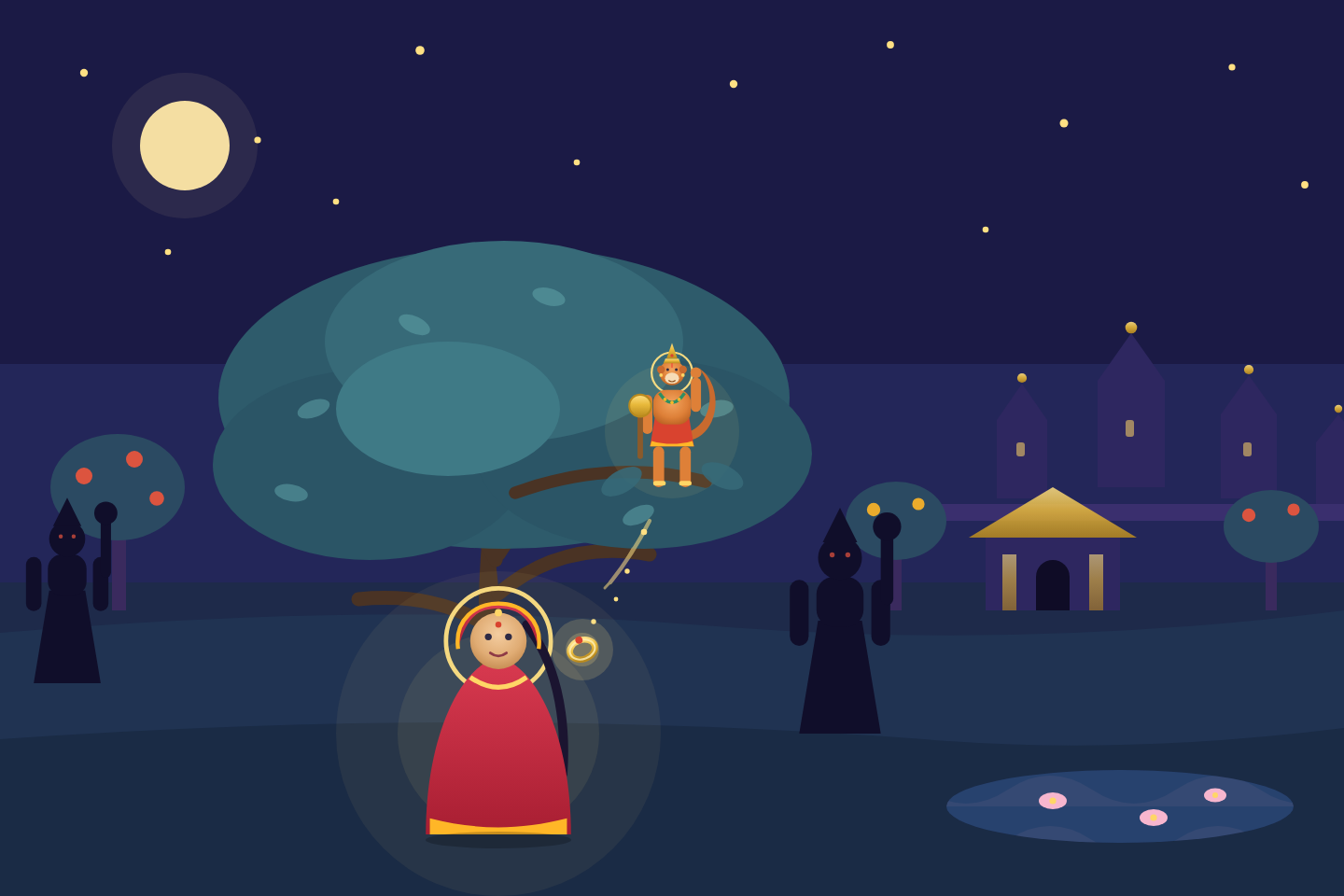
A spark from the aśoka tree
Hanumān Jī thought carefully — and then he let something fall. Down through the leaves it dropped, catching the moonlight, and landed in front of her. Gosvāmī Tulsīdās says it was as if the aśoka tree had answered her prayer by throwing down a spark. Mother Sītā sprang up and took it in her hand. It was a ring. And on it, most beautifully engraved, was the name of Lord Rāma. Joy and sorrow rushed through her heart together. "No one can defeat the Lord of the Raghus," she thought, "and no demon's magic could ever make a ring like this."
Gosvāmī Tulsīdās
A sweet voice among the leaves
Then, from somewhere above her, a gentle voice began to speak. It told a story she knew better than anyone. Once there was a great king of Ayodhyā named Daśaratha, whose eldest son was Rāma, the best of all bowmen. To keep his father's promise, Lord Rāma went into the forest with his wife and his brother Lakṣmaṇa. There a demon king stole his wife away. Searching for her, he made friends with the vānara king Sugrīva, and the vānaras spread across the whole earth to look for her — and one of them leapt across the sea. As Mother Sītā listened, her grief flew away like a bird. "Who is telling this tale?" she wondered. "It is like nectar in my ears. Why won't they show themselves?"
In both Rāmāyaṇas
"Is it a dream? Is it a trick?"
She looked up — and there on a bough of the śiṁśapā sat a small vānara, glowing like the rising sun. Sage Vālmīki tells us her first thought was that she must be dreaming. Her second was worse: what if this was Rāvaṇa again, in a new disguise? Hanumān Jī climbed down, bowed low, and stood before her with folded hands. "Mother Jānakī," he said, "I am Lord Rāma's messenger. I swear it by the all-merciful Lord himself." But she turned her face away. So Hanumān Jī did the wisest thing of all. He didn't argue. He told her exactly how a man and a vānara had become friends, and described Lord Rāma so truly — every mark, every habit — that only someone who loved him could have known it.
In both Rāmāyaṇas
The ring in her hand
"This ring, Mother, I brought myself," said Hanumān Jī. "Lord Rāma gave it to me as a token for you." Sage Vālmīki says she gazed at the ring that had adorned her husband's hand for so long as though Lord Rāma himself had come to her in its shape. And then the questions poured out. Is he well? Is Lakṣmaṇa well? Does he ever think of me? Why hasn't he come? Hanumān Jī answered her softly. "The Lord and his brother are well, Mother — except that the all-merciful one is sorrowful because of your sorrow. Do not feel small in your heart. Lord Rāma loves you twice as much as you love him."
In both Rāmāyaṇas
A boat in the ocean of sorrow
Mother Sītā's eyes filled with tears, but they were a different kind of tears now. "Dear Hanumān," she said, "I was drowning in an ocean of separation, and you have come to me like a boat." To show her how strong the vānaras really were, Hanumān Jī grew and grew until he stood like a golden mountain — and then made himself small again, so as not to frighten her. "Have courage, Mother," he said. "The demon hosts are only moths, and Lord Rāma's arrows are the flame." For the first time in a long, long time, hope was alive again in Laṅkā. And now, his errand done, the small messenger had one more request — a very hungry one.
In both Rāmāyaṇas
✦ Two tellings, one story
Sage Vālmīki’s Rāmāyaṇa (Sanskrit)
Sage Vālmīki gives this meeting many cantos, and the order matters. Hanumān Jī, still hidden in the śiṁśapā tree, first recites the whole story of Lord Rāma in a human voice — from King Daśaratha to his own leap across the sea — so that Mother Sītā will hear a friend before she sees a stranger. She looks up and sees him on the bough, shining like the rising sun; she wonders whether she is dreaming, then fears he is Rāvaṇa in another disguise. He comes down, bows with folded hands, and asks her who she is; she tells him her story. When she doubts him, he describes the marks and ways of Lord Rāma and Lakṣmaṇa and tells his own life-story. Only then does he give her the signet ring, which she gazes on as if her husband had come in its shape, praising him for crossing the sea 'like a cow's hoofprint'. She asks after Lord Rāma's welfare, and he consoles her by describing the Lord's own grief.
Gosvāmī Tulsīdās’s Rāmcaritmānas (Awadhi)
Gosvāmī Tulsīdās tells it more swiftly, and begins with the ring. After Mother Sītā's prayer to the aśoka tree, Hanumān Jī 'takes thought in his heart' and drops the ring — 'as if the aśoka tree had thrown down a spark' — and she springs up joyfully and takes it. She sees Lord Rāma's name engraved on it and reasons that no māyā could make such a ring. Then Hanumān Jī begins to sing the Lord's praises and tells the whole story from the beginning; her grief flies away and she asks why the teller does not appear. He comes near, she turns her face away in wonder, and he swears he is Lord Rāma's messenger and that the ring is a token from the Lord. She asks how a man and a vānara became friends; he tells her; and trust is born in her heart. Then come the words that Tulsīdās readers love — 'you have been a boat to me, drowning in the ocean of separation', 'Lord Rāma loves you twice as much as you love him', and 'the demons are moths and the Lord's arrows the flame'.
What this story teaches
Earn trust before you ask for it
Hanumān Jī did not leap down shouting 'trust me!' He gave a sign she could recognise, told a story only a friend could know, and answered every question honestly. That is how trust is built — slowly, with proof, and with patience.
Say the kind thing twice
'Lord Rāma loves you twice as much as you love him.' When someone you love feels forgotten, don't just fix the problem — tell them plainly that they are loved. It changes everything, even before the rescue arrives.
Hope can arrive very small
The greatest news in Laṅkā came from the tiniest visitor, in the shape of a small gold ring. Watch for the small signs that things are about to change. Sometimes hope looks like a spark falling from a tree.
Words to know
- mudrikā (मुद्रिका) · A ring — here, Lord Rāma's own signet ring, engraved with his name.
- sahidānī (सहिदानी) · A token or sign of recognition — the word Hanumān Jī uses for the ring.
- aśoka (अशोक) · The tree Mother Sītā sat beneath; its name means 'without sorrow'.
- śiṁśapā (शिंशपा) · The leafy tree in whose branches Hanumān Jī hid.
- Trijaṭā (त्रिजटा) · The one kind rākṣasī among the guards, who comforted Mother Sītā.
- jalajāna (जलजान) · A boat or ship — 'you have been a boat to me,' Mother Sītā tells Hanumān Jī.
Vālmīki Rāmāyaṇa — Sundara Kāṇḍa (Hanumān Jī's recital from the śiṁśapā tree, the meeting, and the giving of the ring); Rāmcaritmānas — Sundara Kāṇḍa (the prayer to the aśoka tree, the ring 'like a spark', the song, and Lord Rāma's message). Retold for young readers; where the two tellings differ, both are given.