Kids · बालकाण्ड Bāla Kāṇḍa · Ages 8–12
The Sorrow That Became a Song
A few days ago we met Lava and Kuśa, the two boys who sang the whole Rāmāyaṇa in Lord Rāma's own court. But where did their song come from? Who made it, and how? Sage Vālmīki tells us himself, right at the start of his poem — and it is a story about a river, two birds, and a feeling that turned into a verse.
This is the very first thing that happens in the Vālmīki Rāmāyaṇa. There is no battle in it and no demon. There is a kind old sage, a young pupil carrying a water pot, a clear river on a bright morning, and a sorrow so deep that it had to come out as a song.
A visitor from the sky
Sage Vālmīki lived in a hermitage by the forest with his pupils. One day the celestial sage Nārada came down to visit him, and Sage Vālmīki asked him a question that had been on his mind: was there anyone alive in the world who was truly good — brave, truthful, kind to every creature, and master of his own anger? Sage Nārada smiled. 'There is,' he said. 'His name is Rāma, of the house of the Raghus.' And he told the whole story of Lord Rāma in a short while, from beginning to end. Then Sage Vālmīki worshipped his guest with his pupils, and Sage Nārada rose into the sky and was gone.
Sage Vālmīki
The river as clear as a good heart
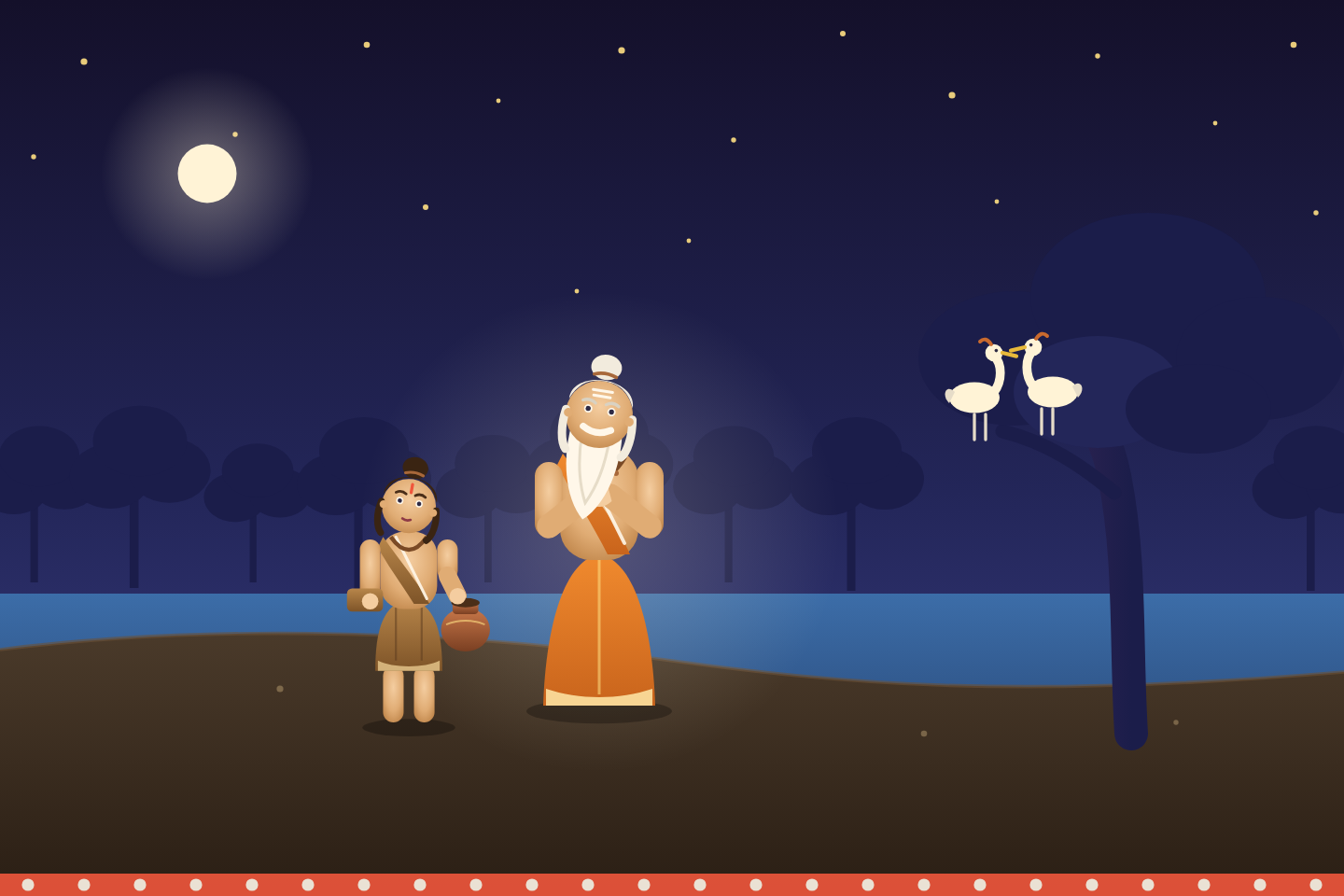
A little later, Sage Vālmīki walked down to the river Tamasā, which runs near the holy Gaṅgā, to bathe. His pupil Bharadvāja walked beside him, carrying the water pot and the bark cloth the sage would wear after his dip. The sage looked at the water and his face lit up. 'Look at this place, Bharadvāja,' he said. 'No mud at all — and the water is as clear as the mind of a good person.' He took the bark cloth from his pupil's hands and wandered along the bank for a while, looking out at the great forest on every side.
Sage Vālmīki
The two birds
Close to the river, in the trees, the sage saw a pair of krauñca birds. They were never apart from each other, and they were calling to one another in the sweetest voices. Then, while the sage was still watching, a hunter's arrow flew out of the forest and struck the male bird, and he fell. His mate flew round and round him, crying out. Sage Vālmīki's heart broke open with pity. And out of his mouth, before he could think, came words — words to the hunter, telling him that because he had killed one of two birds who loved each other, he would never find peace.
Sage Vālmīki
Śoka became śloka
Then the sage stopped and stood very still. 'What is this that I have just said?' he wondered. The words had come out in a shape he had never heard before: four little feet, each with exactly eight syllables, with a rhythm you could sing to a lute. He thought about it as he walked. At last he turned to Bharadvāja. 'These words came out of me because I was full of grief,' he said. 'But listen to them — they are poetry.' Bharadvāja, who was a good pupil, learned the verse by heart on the spot, and the sage was pleased with him. Then Sage Vālmīki took his bath, and the two of them walked home with the sage still thinking about the birds.
Sage Vālmīki
The Creator comes to call
At the hermitage the sage sat down, still turning the sad verse over in his mind — and suddenly a great light filled the place. Brahmā, the Creator of all the worlds, had come in person to see him. Sage Vālmīki leapt up, bowed, washed the Creator's feet and offered him the best seat. But even with Brahmā sitting in front of him, his mind kept slipping back to the bird and the hunter, and he said the verse again, out loud, and felt sorry all over again. Brahmā laughed kindly. 'Do not worry about it any more,' he said. 'Those words came out of your mouth because I willed it. Now use that same measure, and tell the sacred story of Śrī Rāma, just as you heard it from Nārada. Whatever you write will be true, even the parts no one has told you. And as long as the mountains stand and the rivers flow on this earth, people will tell the story you are about to make.' Then he vanished where he sat, and the sage and his pupils stared at each other in wonder, and said the little verse again and again.
Sage Vālmīki
Like a fruit in the palm of his hand
So Sage Vālmīki sat down on a mat of kuśa grass facing the east, folded his hands, and went deep into meditation. And by the power the Creator had given him, he saw the whole story — Lord Rāma, Lakṣmaṇa, Mother Sītā, King Daśaratha and his queens, how they laughed and talked and walked, all that had happened and all that was still to come — as clearly as you can see a small fruit sitting in the palm of your own hand. Then he began to compose. Verse after verse in the new measure, twenty-four thousand of them, until the whole life of Lord Rāma was a poem. And when it was finished, he taught it, every line, to two boys who lived in his hermitage. Their names were Kuśa and Lava.
Sage Vālmīki
✦ Two tellings, one story
Sage Vālmīki’s Rāmāyaṇa (Sanskrit)
This is Sage Vālmīki's own story about himself, and it opens his Rāmāyaṇa. In the first canto of the Bāla Kāṇḍa, Sage Nārada tells him the story of Lord Rāma in brief. In the second, the sage goes to the Tamasā with Bharadvāja, sees the hunter strike the krauñca bird, and finds that his grief has come out of his mouth as a verse of four equal feet — then Brahmā himself comes to the hermitage and tells him to compose the whole story of Śrī Rāma in that measure, promising that it will last as long as mountains and rivers remain and that nothing in it will be false. In the third, the sage sees the whole story in meditation, as clearly as a fruit in his palm; and in the fourth he composes it in twenty-four thousand verses and teaches it to Kuśa and Lava.
Gosvāmī Tulsīdās’s Rāmcaritmānas (Awadhi)
Gosvāmī Tulsīdās does not tell the story of the krauñca birds at all. But he knew exactly whose footsteps he was walking in. At the very start of the Rāmcaritmānas, in his opening prayers, he bows to the lotus feet of the sage who composed the Rāmāyaṇa, and he calls Sage Vālmīki 'the oldest poet'. Later, in the Ayodhyā-kāṇḍa, Lord Rāma himself visits Sage Vālmīki's hermitage on his way into the forest. So in the Mānas the sage is honoured rather than described — and the morning by the Tamasā belongs to Sage Vālmīki alone.
What this story teaches
Your feelings can become something beautiful
Sage Vālmīki did not plan to invent poetry. He felt sorry for a bird, and the sorrow came out as a song. When something hurts, you can turn it into a drawing, a story, a tune — and the hurt becomes something that helps other people too.
Pay attention to the small things
The greatest poem in the world began with a sage noticing two birds in a tree. The water, the birds, the sad cry — he was looking, really looking. The people who make wonderful things are usually the ones who notice.
A good pupil remembers
Bharadvāja heard one verse, once, and learned it by heart straight away. Lava and Kuśa learned twenty-four thousand. The story reached us because somebody listened carefully and kept what they heard.
Words to know
- Tamasā · the clear river near the Gaṅgā where Sage Vālmīki went to bathe
- Bharadvāja · Sage Vālmīki's pupil, who carried the water pot and learned the very first verse by heart
- krauñca · a kind of large water-bird; the pair in the tree gave the Rāmāyaṇa its first verse
- śloka · a verse of four feet with eight syllables each — the measure Sage Vālmīki discovered that morning; it sounds like 'śoka', the word for sorrow
- Brahmā · the Creator of the worlds, who came to the hermitage and asked the sage to tell Lord Rāma's story
- kuśa grass · a sacred grass; the sage sat on a mat of it, facing east, to meditate
Vālmīki Rāmāyaṇa — Bāla Kāṇḍa (Cantos 1–4: Sage Nārada's visit, the krauñca birds at the Tamasā, Brahmā's visit, and the composing of the poem). Rāmcaritmānas — Bāl-kāṇḍa (the opening invocation to Sage Vālmīki, for the 'Two tellings' comparison). Told for ages 8–12; where the tellings differ, each is given as it stands.