Kids · किष्किन्धाकाण्ड Kiṣkindhā Kāṇḍa · Ages 8–12
The Tale of the Two Vānara Kings
On the slopes of Ṛṣyamūka mountain, a great friendship has just been sworn, with fire itself as the witness: Lord Rāma, searching for Mother Sītā, and Sugrīva, the exiled king of the vānaras. Each has promised to help the other. But a true friend wants to know your story — all of it.
So Lord Rāma asks gently: why does a king live hiding on a mountain? And Sugrīva tells him. It is a sad story about two brothers who loved each other dearly — and about how one misunderstanding, never talked through, split that love in two.
A king with no kingdom
"Why do you live in the forest, my friend?" Lord Rāma asked. Sugrīva's eyes filled with old sorrow. "My lord, Vāli and I are brothers. Once we loved each other so much that no words could measure it. He was the mighty king of Kiṣkindhā, and I was his shadow — where he went, I followed. And that," he said quietly, "is how the trouble began."
In both Rāmāyaṇas
The shout at midnight
One night, a roaring demon called Māyāvī came to the gates of Kiṣkindhā and bellowed a challenge into the dark. Mighty Vāli could never ignore a challenge. He charged out, and Sugrīva ran faithfully at his brother's side. The frightened demon fled across the moonlit country until he dived into a deep cave in the earth. "Wait for me here," Vāli told Sugrīva at the cave mouth — and plunged into the darkness after him.
In both Rāmāyaṇas
The mistake at the cave
Sugrīva waited. Days became weeks, and still his brother did not come. Then one dreadful day, a dark stream came flowing from the cave, and with it the sound of demons. Sugrīva's heart broke. "My brother is slain," he wept, "and the demon will come for me next." He rolled a boulder over the cave mouth and stumbled home with the terrible news. The ministers of Kiṣkindhā, seeing the throne empty, placed the crown on Sugrīva's head — though he never asked for it.
In both Rāmāyaṇas
The brother who came back
But Vāli was not dead. He had defeated the demon deep underground — and when he finally climbed out and found a stone across the cave and his brother on the throne, he believed the very worst: that Sugrīva had shut him in on purpose to steal his crown. He would not listen to a single word. Blazing with anger, he beat Sugrīva like an enemy and took everything from him — his home, his honour, even his wife. Sugrīva fled to Ṛṣyamūka mountain, where an old sage's curse kept Vāli from following, and lived there in fear, day and night.
In both Rāmāyaṇas
One arrow, seven trees
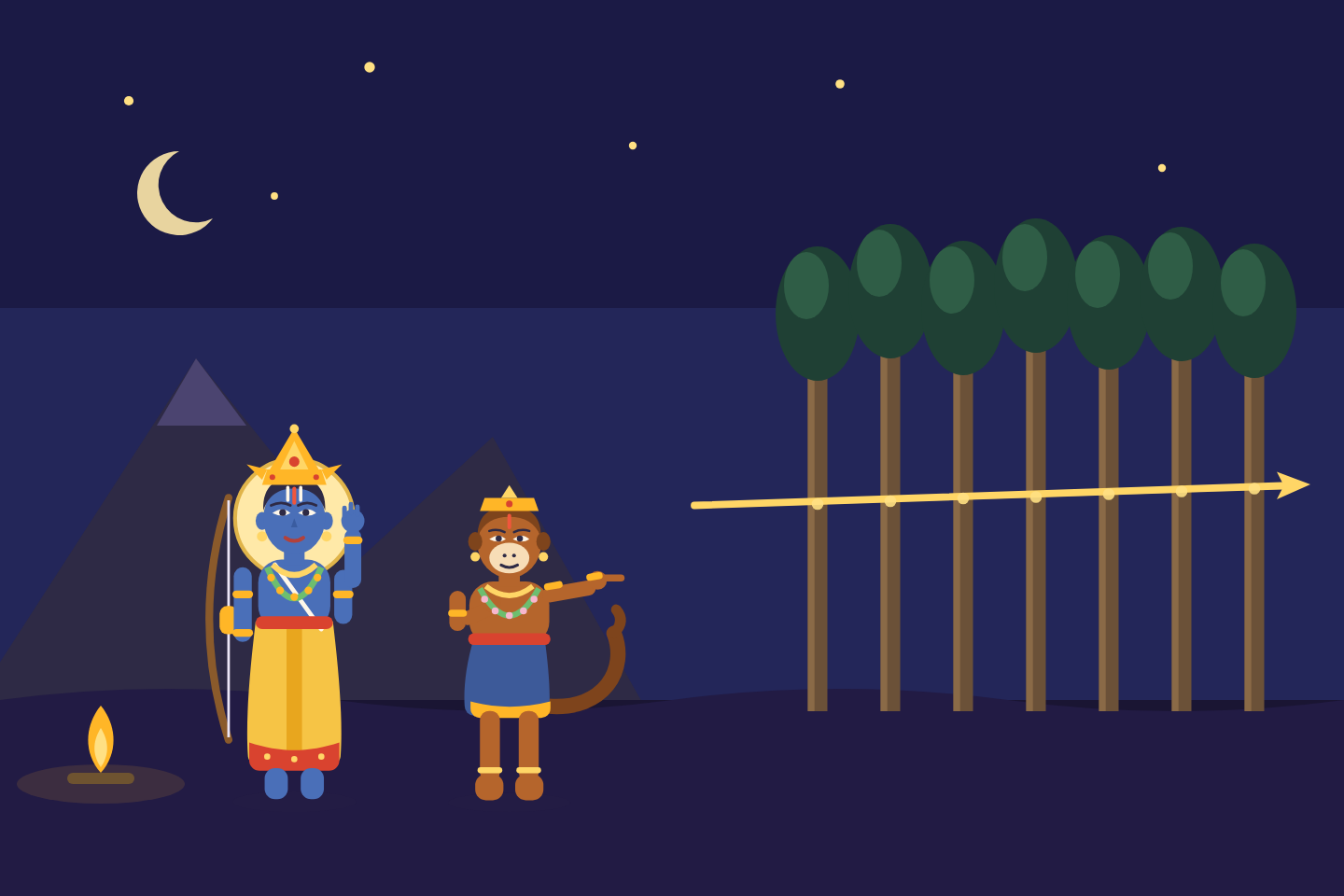
When Lord Rāma heard his friend's grief, his mighty arms trembled with feeling. "Hear me, Sugrīva," he said. "With a single arrow I will end Vāli's tyranny — this I promise." But Sugrīva had seen his brother's strength, and doubt still whispered in him. He pointed to the huge bones of the demon Dundubhi, and to the giant trees standing on the ridge like a row of towers. Lord Rāma smiled. He sent the bones flying far away with barely a touch — and then drew his great bow and loosed one arrow that passed through seven mighty sāl trees, one after another. Sugrīva's doubt melted away like mist in the morning sun. Now he knew: with this friend beside him, everything broken could be mended.
In both Rāmāyaṇas
✦ Two tellings, one story
Sage Vālmīki’s Rāmāyaṇa (Sanskrit)
Sage Vālmīki tells the story in rich detail: Sugrīva waits at the cave for a full year before the flowing blood convinces him his brother has fallen, and the sage whose curse protects Ṛṣyamūka is named — Sage Mataṅga. In his telling, Lord Rāma flings Dundubhi's vast skeleton an enormous distance with a flick of his foot, and the arrow that pierces the seven sāl trees returns humbly to his quiver — only then does Sugrīva's faith stand firm.
Gosvāmī Tulsīdās’s Rāmcaritmānas (Awadhi)
Gosvāmī Tulsīdās tells it more briefly and tenderly. Vāli asks Sugrīva to wait a fortnight, and Sugrīva keeps watch a whole month before the dark stream frightens him away. When Lord Rāma hears the tale, both his great arms quiver, and he vows to fell Vāli with one arrow — even Brahmā and Rudra could not shelter him. Sugrīva shows him Dundubhi's bones and the tall tāla trees, and Lord Rāma scatters and fells them without the least effort. In this telling Lord Rāma also teaches, right there, what a true friend is — one who feels a friend's pain as his own.
What this story teaches
Half a story can break a home
Vāli saw the stone and believed the worst; Sugrīva saw the dark stream and believed the worst. Neither asked. Before you believe something sad about someone you love, ask them what really happened.
Sorrow shared is sorrow halved
Sugrīva had carried his story alone for years. Telling it to a true friend was the first step toward setting everything right.
Trust grows from small proofs
Lord Rāma did not scold Sugrīva for doubting — he gently showed him what was true. Patience with someone's doubt is a kind of love.
Words to know
- vānara · the noble forest people of Kiṣkindhā, mighty and brave
- Kiṣkindhā · the mountain kingdom of the vānaras
- Ṛṣyamūka · the mountain where Sugrīva lived safely in exile
- sāl · a tall, strong forest tree that grows very straight
- Dundubhi · a mountain-huge demon defeated by Vāli long before
A real episode from both Rāmāyaṇas: Vālmīki Rāmāyaṇa — Kiṣkindhā Kāṇḍa (Sugrīva's tale, the curse of Sage Mataṅga, and the test of the sāl trees, told at section level) and Śrī Rāmcaritmānas — Kiṣkindhā-kāṇḍa (the caupāīs around dohās 5–7: Sugrīva's story, the one-arrow promise, and the test of strength).