Kids · उत्तरकाण्ड Uttar Kāṇḍa · Ages 8–12
The Teacher Who Bowed to His Student
Everyone has a teacher. A teacher knows things you do not know yet, and it is their job to tell you. But what happens when the student is Lord Rāma himself — and the teacher is a very old, very wise sage who has guided the kings of Ayodhyā for longer than anyone can remember?
Gosvāmī Tulsīdās tells this quiet visit in the Uttar-kāṇḍa of the Rāmcaritmānas, in the happy years after Lord Rāma was crowned. It is a scene only he gives us — Sage Vālmīki's Rāmāyaṇa does not have it, and we will say so at the end. This is the Tulsīdās telling.
The king washes his teacher's feet
One day Sage Vasiṣṭha came to the palace where Lord Rāma, the home of all happiness, was staying. Now, Sage Vasiṣṭha was the guru of the whole royal family — he had named the four princes when they were babies, and he had taught them everything. But the moment he arrived, the Lord of the Raghus received him with the greatest reverence of all. He washed the sage's feet with his own hands, and sipped the water in which they had been washed. That is how a student honours a guru. And this student was the king.
Gosvāmī Tulsīdās
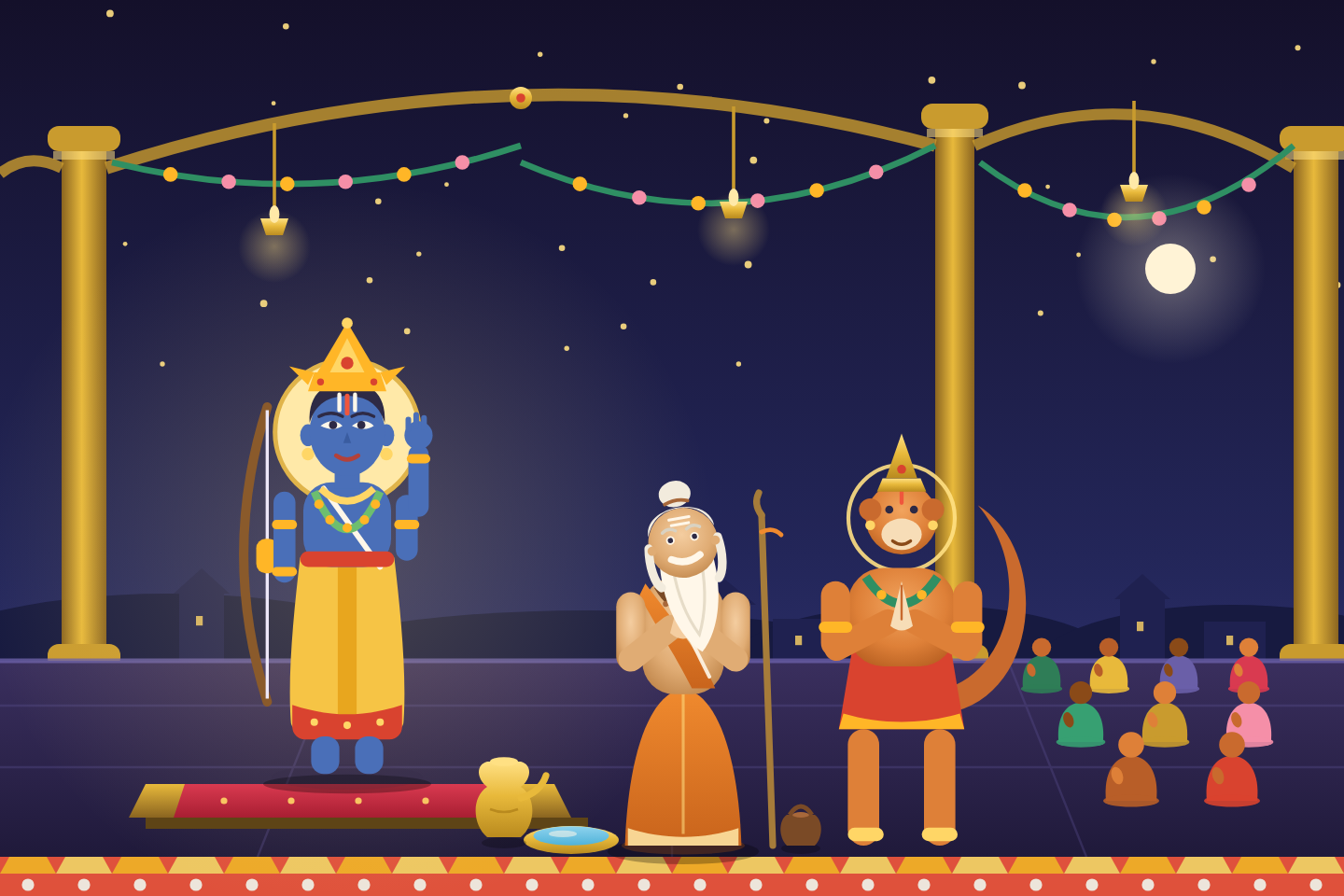
'Listen, Rāma,' said the sage
Then the old sage joined his palms and spoke. 'Listen, Rāma. I have something humble to say to you, O Ocean of mercy.' He looked at the Lord's feet. 'Whenever I watch the things you do, a great bewilderment fills my heart. Your greatness has no limit — even the Vedas do not know it. How can I describe it, O Lord?' Imagine that: the wisest teacher in the kingdom, admitting to his own student that he was confused.
Gosvāmī Tulsīdās
The secret of why he took the job
Then Sage Vasiṣṭha told the Lord something he had never told anyone. Being a family priest, he said, was thought to be a very lowly job — the Vedas and the Purāṇas all say so — and when it was offered to him, he did not want to accept it. 'But Brahmā, my father, said to me: "It will turn out for your good, my son. One day the Supreme Spirit himself will appear in human form, as a king, the ornament of Raghu's line." Then I thought to myself: through this very office I shall reach the One that all the yoga and sacrifices and vows and charity in the world are trying to reach. There could be no other work like it.'
Gosvāmī Tulsīdās
Dirt cannot wash dirt
And now the sage spoke the thing he had come to say. 'Prayers and penance, vows and yoga, doing one's duty, every good act the Vedas recommend, knowledge, compassion, self-control, bathing in holy rivers, reading and hearing all the holy books — all of these, my Lord, have only one reward: unending love for your lotus feet.' Then he gave the Lord two little riddles to prove it. 'Can dirt be cleaned by washing it with dirt? Can anyone get butter by churning water? In the same way, O Lord of the Raghus, without the water of loving devotion, the dirt inside a heart can never be washed away.'
Gosvāmī Tulsīdās
The one boon
A king can give a sage anything — gold, land, elephants, a kingdom. Sage Vasiṣṭha asked for none of it. 'My Lord,' he said, 'I ask for one boon. Grant it in your mercy, Rāma. Birth after birth, may my love for your lotus feet never grow less.' That was all. The sage who had just confessed he could not understand the Lord had understood the one thing that mattered. He bowed, and went home. And Lord Rāma, the All-merciful, was glad in his heart of hearts.
Gosvāmī Tulsīdās
In the cool mango grove
That same day the Lord went out of the city with Hanumān Jī and his brothers, Bharata, Lakṣmaṇa and Śatrughna. He had elephants, chariots and horses brought, praised them all kindly, and gave them away to the people — to each what he deserved and what he wished for. Then the Lord who takes away everyone's tiredness felt tired himself. He sat down in a cool mango grove, on the scarf Bharata spread for him, with his brothers around him. And Hanumān Jī began to fan him, his body thrilling with joy and his eyes full of tears — for, says Lord Śiva, there is no one so devoted to Lord Rāma's feet as Hanumān Jī.
Gosvāmī Tulsīdās
✦ Two tellings, one story
Sage Vālmīki’s Rāmāyaṇa (Sanskrit)
Sage Vālmīki's Rāmāyaṇa does not have this visit. In his Uttara Kāṇḍa, Sage Vasiṣṭha is there in Ayodhyā as the royal priest and counsellor, and Lord Rāma even tells stories about him from long ago — but there is no scene in which the sage comes to the palace, has his feet washed by the Lord, confesses that the Lord's doings bewilder him, and asks for the boon of love that never fades. We have not invented a Vālmīki version of it. Where the two Rāmāyaṇas differ, we tell only what each one says.
Gosvāmī Tulsīdās’s Rāmcaritmānas (Awadhi)
In the Uttar-kāṇḍa of the Rāmcaritmānas, after Lord Rāma's teaching to the people of Ayodhyā, Sage Vasiṣṭha comes to the palace. The Lord receives him with great reverence, washes his feet and sips the water. With joined palms the sage says that watching the Lord's doings fills him with bewilderment and that his greatness is beyond even the Vedas; he admits that the work of a family priest is called lowly by the Vedas, Purāṇas and Smṛtis, that he had not wanted to accept it, and that Brahmā, his father, told him the Supreme Spirit would be born as a king in Raghu's line, so that through this office he would reach the One that all yoga, sacrifice, vows and charity seek. He says every spiritual practice has one reward — unceasing devotion to the Lord's lotus feet — and that dirt cannot be cleaned with dirt, nor butter got by churning water, so without the water of loving devotion the heart's impurity is never washed away. He asks one boon: that his love for the Lord's feet never flag in birth after birth. He returns home, the Lord greatly pleased; the Lord then goes outside the city with Hanumān Jī and his brothers, gives away elephants, chariots and horses, and rests in a cool mango grove on Bharata's scarf while Hanumān Jī fans him.
What this story teaches
The best students honour their teachers — even when they have grown great
Lord Rāma was the king of the whole land, and still he washed his old teacher's feet himself. Being clever, strong or important never puts you above saying thank you to the people who taught you. If anything, it makes it matter more.
It is all right to say 'I don't understand'
Sage Vasiṣṭha was the wisest man in Ayodhyā, and he openly said that something bewildered him. Real wisdom is not pretending to know everything. It is being honest about what you do not know — and asking.
When you could ask for anything, ask for the thing that lasts
Offered any boon in the world, the sage asked only that his love for the Lord should never grow less. Toys break, prizes get forgotten, but love and goodness of heart go with you everywhere. Choose those first.
Words to know
- guru · a teacher and guide; Sage Vasiṣṭha was guru to Lord Rāma and the whole royal family of Ayodhyā
- purohita · a family priest, who performs a family's prayers and ceremonies; the job Sage Vasiṣṭha almost did not accept
- Brahmā · the creator god, who was Sage Vasiṣṭha's father and told him the Lord would be born in Raghu's line
- bhakti · loving devotion; the sage said it is the only water that can wash a heart clean
- boon · a wish granted by someone great; the sage asked for only one
- Uttar-kāṇḍa · the last book of the Rāmcaritmānas — 'uttar' means 'later' — telling of Lord Rāma's years as king
Rāmcaritmānas — Uttar-kāṇḍa (Sage Vasiṣṭha's visit to Lord Rāma: the caupāīs after dohā 47, dohās 48–49 and the caupāīs after them). Sage Vālmīki's Rāmāyaṇa does not contain this visit. Where the two Rāmāyaṇas differ, we tell both faithfully.