Kids · उत्तरकाण्ड Uttara Kāṇḍa · Ages 8–12
The Two Boys Who Sang the Rāmāyaṇa
Lord Rāma's great horse-sacrifice was still going on in the Naimiṣa forest — the camp where vānaras and rākṣasas served side by side and no one went hungry. Kings had come from everywhere. Sages had come from their forests. And then one more guest arrived: Sage Vālmīki, the poet, with his pupils walking behind him.
You already know Sage Vālmīki a little. He is the sage who composed the Rāmāyaṇa — the very story you have been reading. For years Mother Sītā had been living in his hermitage, and her twin sons, Lava and Kuśa, had grown up there and learned the sage's poem by heart. How she came to be there is another part of the story, for another day. Today's story is about what happened when two boys from the forest sang in front of a king.
The poet comes to the sacrifice
While the wonderful sacrifice was in full swing, the venerable Sage Vālmīki arrived with his pupils. He had his hut built among the cottages of the other seers, not far from the sacrificial ground, and carts full of grain, fine roots and fruits were set down beside it so that his household would want for nothing. The sage looked at the great sacrifice and at the hermits and great souls gathered there, and he was pleased.
Sage Vālmīki
'Go and sing the whole poem'
That evening Sage Vālmīki called his two cheerful pupils, Lava and Kuśa. 'Go,' he said, 'and sing the whole poem of the Rāmāyaṇa, carefully and most joyfully. Sing it in the holy huts of the sages, in the houses of the Brāhmaṇas, on the by-ways and the highways, at the doors of kings, at the entrance of Lord Rāma's own apartments and before the priests at the rite. Eat these sweet fruits from the mountain-tops so that you do not tire or lose the tune. Sing twenty cantos a day, to the lute, in a sweet voice. If the king asks whose sons you are, say only: we are two disciples of Vālmīki. Do not be greedy for wealth — what use is gold to those who live on roots and fruits? And never do anything disrespectful to the king, for a king is the father of all beings.' 'We shall do as you say,' said the boys, and they lay down and slept as peacefully as the two Aśvinīkumāras.
Sage Vālmīki
A song no one had heard before
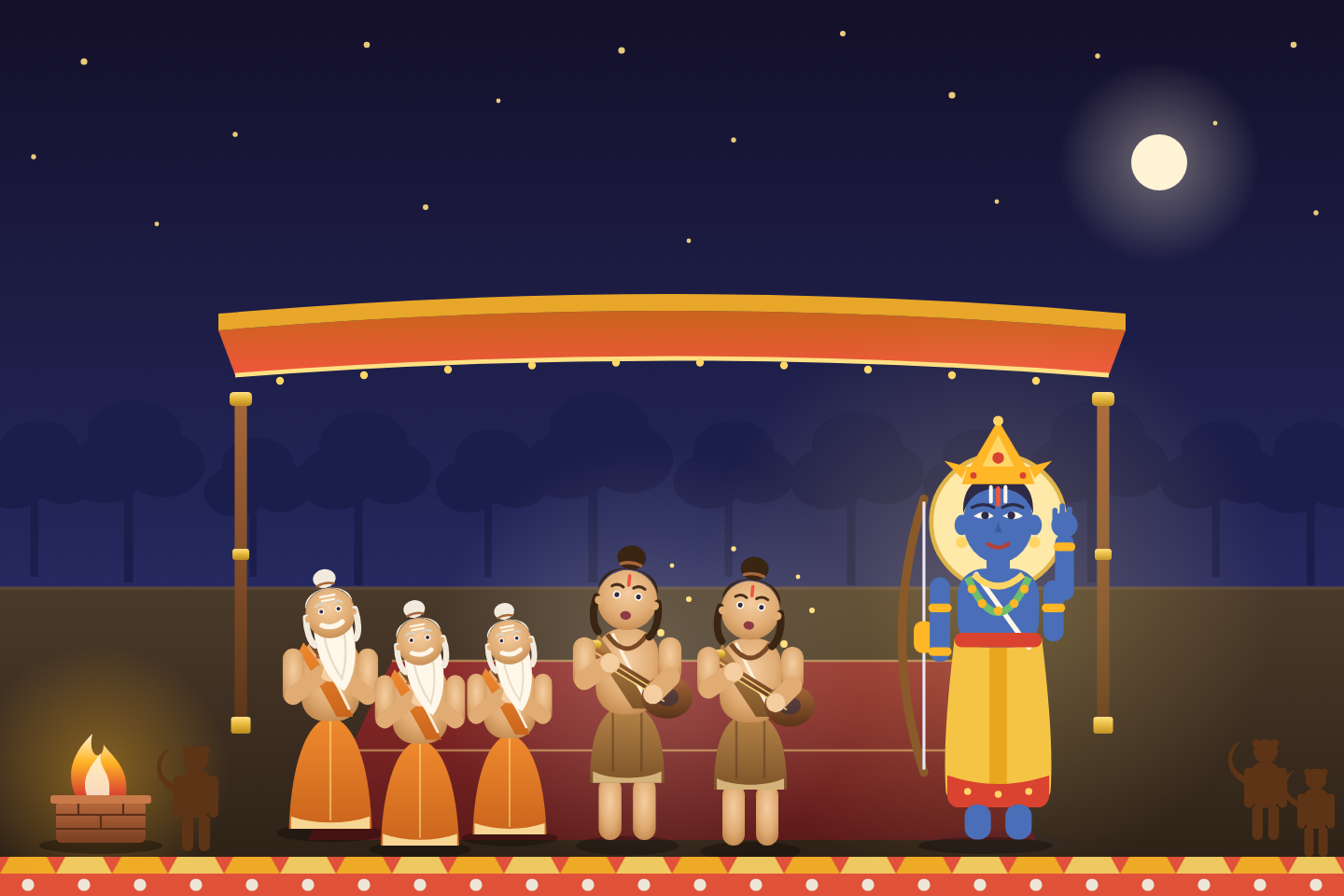
At dawn Kuśa and Lava bathed, made their offerings to the fire, and began to sing just as the sage had taught them. Lord Rāma heard it. He had never heard anything like it — a poem set to music in the old masters' cadences, in perfect time and tune, with two lutes ringing under two young voices. The Lord was amazed. He sent for the great ascetics, the kings and the learned men of the city: the people who knew the Vedas and the Purāṇas, the experts in metre and music and dance, the astrologers, the priests, the storytellers — everyone who would understand what they were hearing. And in the middle of that whole assembly he seated two boys with matted hair and bark garments, and asked them to sing.
Sage Vālmīki
Like the Lord's own reflection
The music that followed was more than human. No one who heard it could get enough; everyone wanted more. The sages and the mighty kings gazed at the two boys again and again, as if they would drink them up with their eyes, and whispered to one another: 'Look at them. Each one is like Lord Rāma himself, the way a reflection is like the thing it reflects. If they did not wear matted hair and bark, we could not tell these two singers from the king.' The boys sang the first canto, the one that begins with Sage Nārada, and went on, canto after canto, until twenty were done.
Sage Vālmīki
The gold they would not take
In the evening, when the twenty cantos were finished, Lord Rāma turned to his brother Bharata. 'Give these two noble ones eighteen thousand gold coins at once,' he said, 'and whatever else they ask for.' Bharata began to count it out — and Lava and Kuśa would not take it. 'What use is this to us?' they asked in surprise. 'We live in the forest and eat fruits and roots every day. What would we do with gold and silver in the forest?' Everyone was astonished. Then the Lord, wanting to know who had made such a poem, asked them: 'How long is it? Who composed it? Where is he?' 'The venerable Sage Vālmīki is its maker,' the boys answered, 'and he has come to this very place. Twenty-four thousand verses, a hundred stories, five hundred cantos in six kāṇḍas and the Uttara — all of it about your life, O king, for as long as there are beings to hear it. If you wish, listen to it between the rites of the sacrifice, together with your brothers.' 'So be it,' said Lord Rāma. And the two boys went cheerfully back through the camp to the place where their teacher was waiting.
Sage Vālmīki
✦ Two tellings, one story
Sage Vālmīki’s Rāmāyaṇa (Sanskrit)
In the Uttara Kāṇḍa of Sage Vālmīki's Rāmāyaṇa, the sage arrives at the aśvamedha with his pupils and builds his hut near the sacrificial ground, with carts of grain, roots and fruits beside it. He tells Lava and Kuśa to sing the whole Rāmāyaṇa joyfully — in the sages' huts, the Brāhmaṇas' houses, on the roads, at the kings' doors and at the entrance of Lord Rāma's apartments — twenty cantos a day to the lute; to say, if asked, that they are two disciples of Vālmīki; not to be greedy for wealth; and never to disrespect the king, the father of all beings. At dawn the boys bathe, make their fire-offerings and sing; Lord Rāma hears music 'unheard of before', is amazed, and gathers the sages, kings and all the learned people of the city to listen. No one can get enough of the song; the listeners say the boys are like the Lord's own reflection, told apart from him only by their matted hair and bark garments. After twenty cantos the Lord asks Bharata to give them eighteen thousand gold coins; they refuse, saying forest-dwellers have no use for gold. Asked about the poem, they say Sage Vālmīki composed it — twenty-four thousand verses, a hundred stories, five hundred cantos, six kāṇḍas and the Uttara — and invite the Lord to hear it between the rites with his brothers. He agrees, and the boys return to the sage.
Gosvāmī Tulsīdās’s Rāmcaritmānas (Awadhi)
Gosvāmī Tulsīdās does not tell this scene. In the Uttar-kāṇḍa of the Rāmcaritmānas, describing the happy years of Lord Rāma's reign, he says only that Mother Sītā gave birth to two handsome sons, Lava and Kuśa, who are sung of in the Vedas and Purāṇas — both victorious in battle, modest, full of virtue, like the very image of Śrī Hari — and that each of the Lord's brothers had two sons as well. There is no horse-sacrifice, no visit from Sage Vālmīki and no song in the assembly in the Mānas, and we have not invented one.
What this story teaches
Sing the whole thing, joyfully
Sage Vālmīki did not tell the boys to sing the easy parts, or the parts people might clap for. He said: the whole poem, carefully, most joyfully. When you have learned something well, give all of it — and give it gladly.
Say who taught you
'We are two disciples of Vālmīki.' The boys did not try to sound grander than that, and it was enough to amaze a king. Being honest about where you learned something never makes it smaller.
Know what you actually need
Eighteen thousand gold coins, and two children said 'what would we do with it in the forest?' They were not being rude. They simply knew what their life needed and what it did not — which is a kind of wealth all by itself.
Words to know
- Sage Vālmīki · the great poet-sage who composed the Rāmāyaṇa; Lava and Kuśa grew up in his hermitage and learned the poem from him
- Lava and Kuśa · the twin sons of Lord Rāma and Mother Sītā, who first sang the Rāmāyaṇa at the Lord's sacrifice
- lute · a stringed instrument played with the fingers; the boys sang the poem to the music of their lutes
- canto · one chapter of a long poem; the boys sang twenty cantos of the Rāmāyaṇa each day
- bark garments · the simple clothes made of tree-bark worn by people who lived in forest hermitages
- Aśvinīkumāras · the twin gods of the dawn, famous for their beauty and their skill; the boys slept as peacefully as they do
Told from Sage Vālmīki's Rāmāyaṇa — Uttara Kāṇḍa (Sage Vālmīki's arrival at the aśvamedha, his instructions to Lava and Kuśa, and the first day of their singing before Lord Rāma). Gosvāmī Tulsīdās's Rāmcaritmānas — Uttar-kāṇḍa — names Lava and Kuśa but does not tell this scene.